




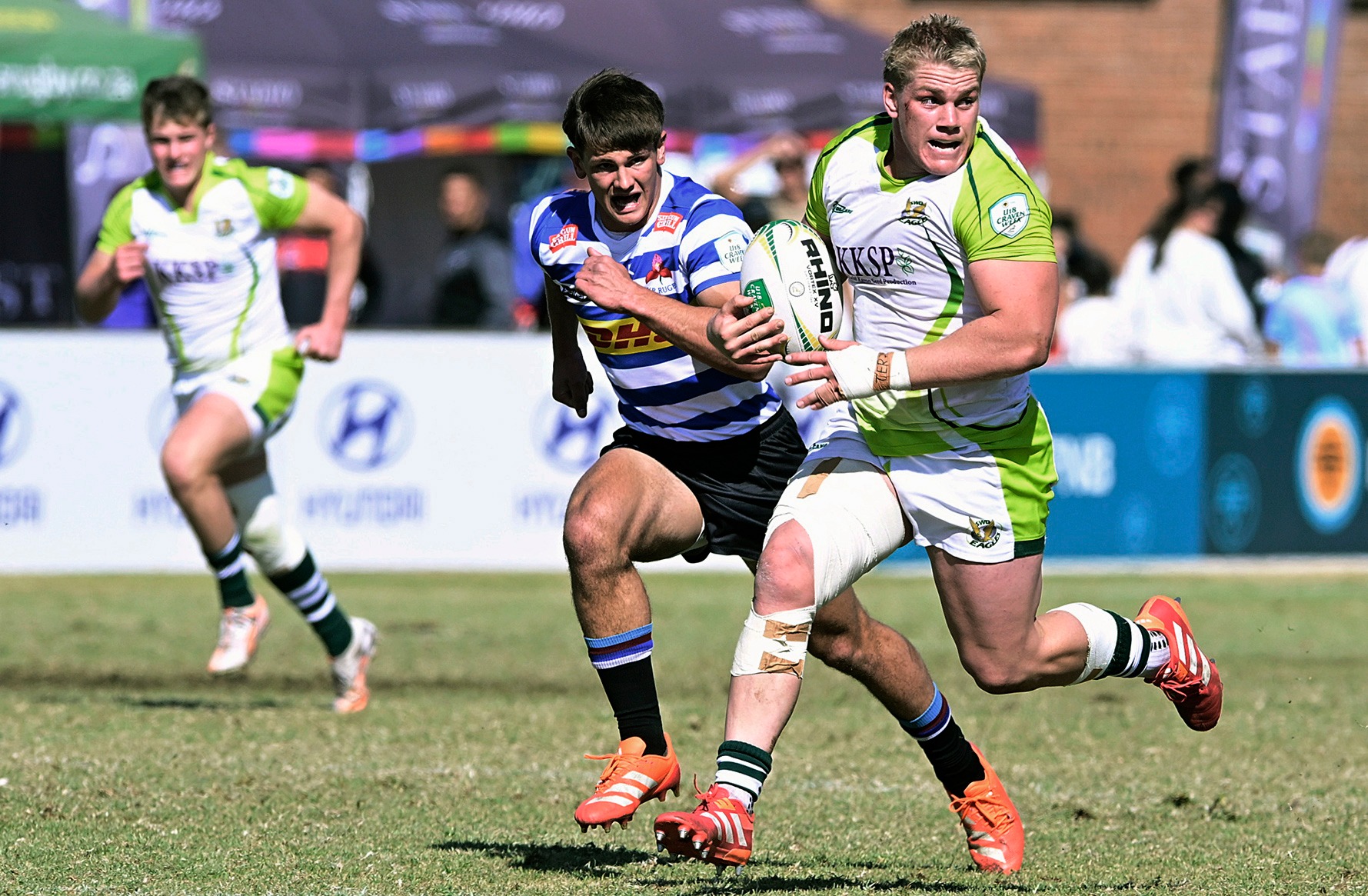
 Prop Kai Pratt in action for South Western Districts at the 2025 Craven Week at Middelburg High School in the Eastern Cape. (Photo: Sydney Seshibedi / Gallo Images)
Highly rated front row prospect Kai Pratt faces up to four years on the sidelines after testing positive for a prohibited substance earlier this year.
It’s a devastating blow for the player and for the image of South African rugby. Yet, ironically, it is a positive development for the South African Institute for Drug-Free Sport (Saids).
After months of funding battles and years of decreasing dope-testing numbers due to the closing of South Africa’s only accredited anti-doping laboratory, the unfortunate situation shows that the Saids system is still doing what it was supposed to do – police anti-doping effectively.
Pratt was withdrawn from the Junior Bok squad, which is currently at the U20 World Championships in Georgia, due to a foot injury, which subsequently required surgery.
Pratt is also contracted to the Sharks. The club confirmed the news in a statement.
“As this is a confidential and ongoing process, we are unable to comment further on any specifics relating to the matter,” a Sharks statement read.
“The Sharks take all matters relating to player welfare, education and compliance with anti-doping regulations extremely seriously.
“We remain committed to providing our players with the necessary guidance and support regarding their responsibilities under anti-doping regulations, while respecting the processes and rights of all parties involved.”
/file/attachments/2994/TL_2533143_596987.jpg "Kai Pratt at a Sharks training session on 12 March 2026 in Durban, South Africa. (Photo: Steve Haag Sports / Gallo Images)")
Saids chief executive officer Khalid Galant confirmed that the substance found in Pratt’s A sample was an anabolic steroid. The athlete has requested an analysis of the B sample, as protocol allows.
Routine dope tests were carried out at the Junior Boks’ training camp in Stellenbosch on 10 April, before the U20 Rugby Championships.
“The player was tested out of competition as part of the testing programme of the junior Bok squad,” Galant confirmed to Daily Maverick.
“He was one of five tests on the day at that camp. The player has employed legal counsel after receiving the notice of the positive dope test from Saids.
“His legal counsel will advise him on his rights during this time and the procedure that will unfold.”
Image blow
Pratt was a schoolboy star out of Oakdale Landbou and is one of the most highly rated young props in the country. He is so well regarded that he was included in a senior Springbok training camp earlier this year.
The news is another blow to the image of South African rugby. Media in Britain and Ireland have insinuated that there is a systemic doping programme in South African rugby, although no evidence of this has been shown.
Although Pratt is not with the Junior Boks, his teammates take on England in the U20 world championship semi-final on 13 July, and this news will certainly not go unnoticed.
In an article published on 2 March, the Telegraph drew a tenuous connection between the Springboks’ two World Cup titles in 2019 and 2023 and a decrease in dope-testing in South Africa.
“The significant drop in testing has coincided with the Springboks becoming the most dominant force in Test rugby, winning back-to-back World Cups in 2019 and 2023,” the article in the Telegraph read.
“South Africa is the nation with the highest number of convicted dopers in rugby with 89 violations in that time, which is around 20 per cent of the entire total worldwide.”
South African rugby, especially at junior level, has seen a regular list of doping violators, usually uncovered at the annual Craven Week where Saids is permitted to test athletes. But there is no evidence of a systemic, state-run-type of doping programme.
There has been a sharp decline in actual testing, which, according to a report in the Telegraph earlier this year, fell from 785 tests in 2015 to just 127 in 2024.
But according to Galant, the nature and strategy of drug testing used 10 years ago versus today has changed.
“Part of the reduction is because we use a lot of intelligence-based testing,” he said. “Now we have access to different types of data. We can be precise; we can look at performance, intelligence-based information and tip-offs.
“All those feed into our testing strategy. So, the numbers do decrease because there’s more precision in terms of the testing strategy.”
/file/attachments/2994/2272895204_944500.jpg "Ball carrier Kai Pratt of South Africa is brought down by Jerónimo Sorondo of Argentina during the U20 Rugby Championship at Nelson Mandela Bay Stadium on 27 April, 2026. (Photo: Richard Huggard / Gallo Images / Getty Images)")
Funding gap
Saids has pointed to funding constraints and the loss of its World Anti-Doping Association (Wada) accredited laboratory as key reasons for the drop.
The problem is most visible at schoolboy level, which has produced positive tests almost every year.
There were three positive dope tests at Craven Week in 2014, five in 2015, four in 2016, three in 2017, six in 2018, five in 2022, and three in 2023, almost all involving anabolic steroids in teenage players.
Galant has described a “win at all costs” culture and a troubling tolerance for doping among parents and coaches at this level.
At the professional end, the list of names is long and includes high-profile Springboks such as Aphiwe Dyantyi, Sbu Nkosi and Elton Jantjies among those banned for multiple years, alongside lesser-known players such as Ngonidzashe Chidoma, Emile Klassen, Nande Lucas and, most recently, Liam Santos.
Not every case is clear-cut, though, as the case of Lions and Bok prop Asenathi Ntlabakanye showed.
He declared a doctor-prescribed substance, complicating the usual narrative of deliberate cheating. Two medical professionals gave Ntlabakanye the all-clear to take two medications that contained banned substances. Both doctors declined to testify at the hearing.
It’s against this backdrop that 18-year-old Sharks prop Pratt’s positive test for an anabolic steroid must be read. Jumping to conclusions is premature.
Pratt’s case fits an unfortunately familiar pattern for junior rugby in South Africa, though nothing is resolved as no hearing has been set, and his B-sample result and any decision on guilt are still pending. DM
Comments
Scroll down to load comments...