




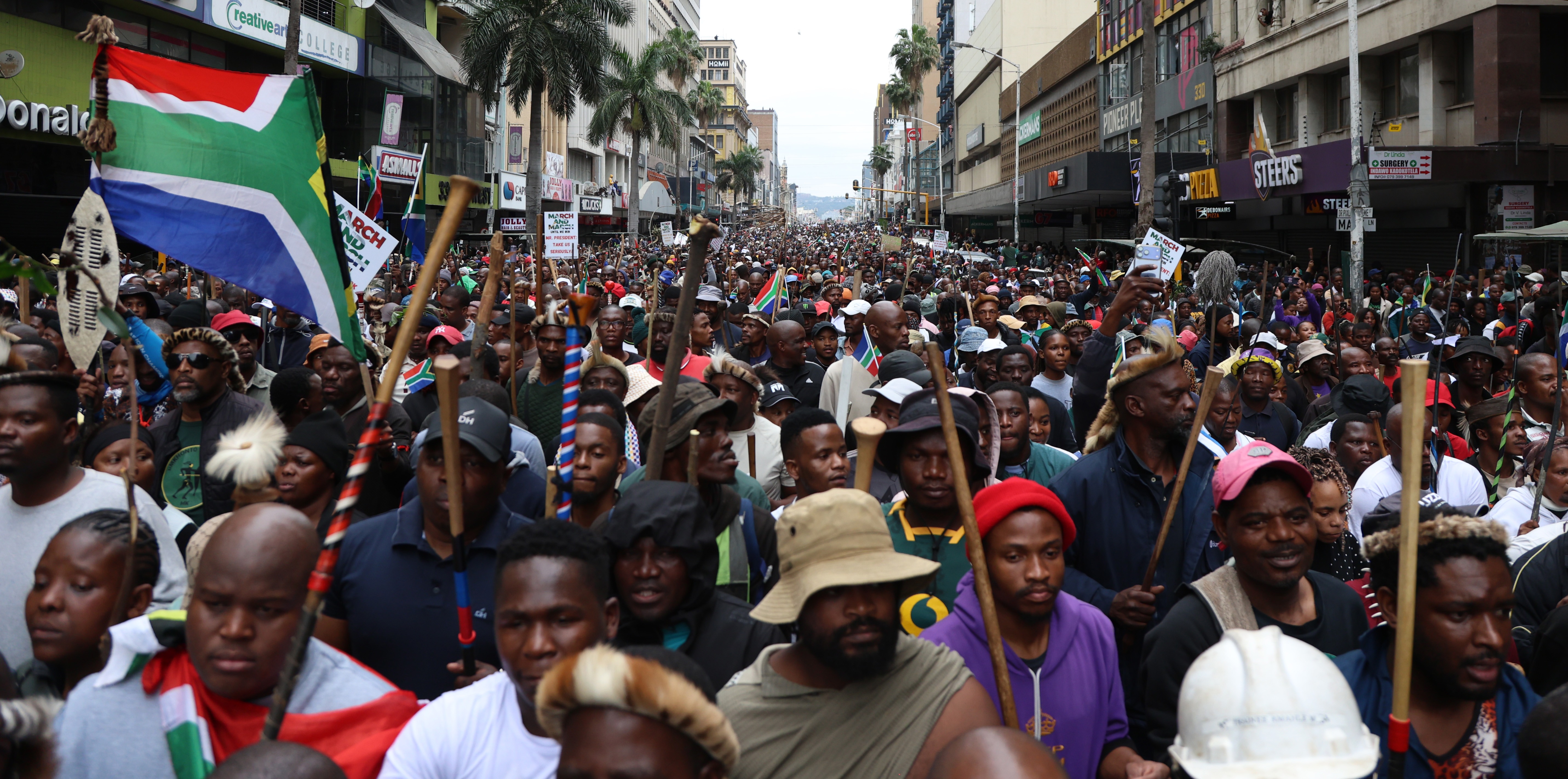
 Anti-migrant protesters march to the Point police station in Durban to hand over a memorandum on 30 June 2026. (Photo: Felix Dlangamandla)
 /file/dailymaverick/wp-content/uploads/2025/10/label-Op-Ed.jpg)
On 30 June thousands of black South Africans marched in the streets of its towns and cities, demanding that fellow black Africans, whom they have deemed “illegal”, must immediately vacate their country. Happily, the worst fears of widespread anti-immigrant violence appeared to have been avoided. President Cyril Ramaphosa, roused at last from the craven inertia of his government, had appeared to broker a late-night deal with some of the nativist leaders who have hitherto been violent in word and deed.
The day’s deadline for all of these “illegal” Africans to go back where they came from was the culmination of years of periodic convulsions, in which many immigrant strivers, most horrifically the Somalis, have been killed, their entrepreneurial inclinations a ready magnet for township resentment.
African migrants in South Africa have become the scapegoat for the country’s myriad ailments, some structural from apartheid origins, but mostly a result of the catastrophic failings of the ruling African National Congress, which has been in charge of the country since 1994.
In the first 15 years since that historic advent of democracy, South Africa was a country clearly on its way to the promised land. It was led by capable and even inspiring leaders. Its economic management in those years was perhaps the most progressive and effective in the country’s history. Over 10 years it moved fully a quarter of its population into the middle class – faster than even the Chinese managed. Despite notable failings, particularly in public education, most indications were pointing ever upwards. The economy saw periods of sustained growth. Even its sports teams, long denied legitimacy internationally, were riding the wave of an optimistic and united country. Bafana Bafana, the national football team, became African champions. Even more remarkably, South Africa integrated its beloved national rugby team, the Springboks, and has since gone on a successful campaign of world domination.
For the bottom half of South Africa that is really struggling, it is not that hard to lash out at the ready scapegoats – the immigrants living among them.
And then the ANC, the party of Pixley ka Isaka Seme, of Luthuli and Kathrada and Slovo and Tambo, decided to commit suicide in 2009 and handed the country over to Jacob Zuma, leading to an era of State Capture, institutionalised corruption and the hollowing out of public institutions. Its municipalities have failed one by one. Potable water, electricity and mass transit collapsed. The ANC has become more focused on renaming cities than running them. Unemployment rocketed to a third of the work force, including fully half of all young adults. A prolonged economic stagnation has sapped citizens’ confidence. The moral and intellectual collapse of the ANC has thrown the country into a sinkhole, from which it is now trying to emerge.
These are not conditions suitable for a well-mannered and happy land. For the bottom half of South Africa that is really struggling and senses that the bright promise of democracy has recently turned out to be a cruel joke, it is not that hard to lash out at the ready scapegoats – the immigrants living among them. These Africans, about 90% of them from neighbouring Zimbabwe, Malawi, Mozambique, Zambia, eSwatini and Lesotho, are surely to blame. They must have taken jobs and freeloaded on public facilities, and must be subject to the tender mercies of the mob. With the approach of local elections, and with the once-dominant ANC now bleeding to death politically, many politicians have jumped on the anti-immigrant bandwagon. For practical purposes, these “foreigners” are indistinguishable from citizens, since South Africa has more Basotho than Lesotho, more Tswanas than Botswana and more Swazi than eSwatini.
Many Africans, from Harare and Nairobi and Lusaka and Accra and Lagos, are looking on in utter horror. The spectacle of African governments having to hastily arrange the evacuation of their citizens from South Africa, in order to protect them from harm, strikes many as a kind of betrayal. So tattered is South Africa’s reputation right now in the rest of the continent that many of us cringed in embarrassment as people in African capitals cheered for Mexico and against South Africa on the opening day of the current Fifa World Cup, which Bafana lost. That must be the first time in memory.
How did we get here?
I first set foot in South Africa on 20 April 1992, having flown from New York to the then Jan Smuts Airport in Johannesburg. My mission was to open an Africa bureau for my then employer, New York Newsday. Nelson Mandela had been out of prison for two years. Formal negotiations to end apartheid with as little convulsion as possible were under way. Apartheid as a means of organising society was not yet formally dead, but it was most definitely in its death throes. My assignment, over the next four years, was to chronicle the birth of a new country in full democratic flowering – a country so stocked, as I came to find, with the world’s most extraordinary people at all levels of society, and across the canyons that then divided it.
On 27 April 1994 I stood but a few feet from Mandela to watch him cast his first vote ever, the same as millions of other black South Africans who were participating in that once-sacred civic ritual of choosing one’s own leaders. Later that morning I was back in Soweto, outside Johannesburg, and was witness to those improbably peaceful and inspiring miles-long lines of first-time voters. There I met 75-year-old Sylvia Radebe, who said to me that she was voting that day for her nephew. I asked if he was a candidate and she said no, he was among the thousands of young people who fled to the rest of the African continent after the bloody Soweto Uprising of 1976, where they were given refuge and an education and communal support until they could return to their own country. Mrs Radebe’s nephew was known to have fled to Tanzania, but was never heard from again and was presumed dead. It was in honour of his memory, she said, that she was voting that day.
“All of us are looking at them with sadness and shock, because they have just told the rest of us that we are not brothers.”
That very day, when South Africans gave birth to a new country, was the greatest day of my life, rivalled only by the births of my two daughters on either side of that year of freedom. If, as I am, you are a Nigerian born at a certain time, say around the dawn of independence in 1960, you’d understand that we grew up believing that our greatest mountain to scale was the freedom from colonial rule of the entire African continent. By the time Rhodesia became Zimbabwe on 18 April 1980, we all knew the final domino to fall would be South Africa. This was not an isolated elite feeling. Even Nigeria’s then military government was militantly progressive on the question of ending apartheid. Citizens funded the liberation movements by voluntarily donating a portion of their paycheques. Mine, interning in 1980 at the department of information in Lagos, was 5%. We felt like the proud vanguard of African freedom. Thabo Mbeki was for three years the urbane, pipe-smoking country rep for the ANC in Lagos in the late 1970s. He was a regular at Fela Kuti’s Afrika Shrine. Zombie was the soundtrack of the Afrobeat Rebellion.
Years later, after Mbeki was elected Mandela’s deputy and later succeeded him as president in 1999, it was a given that South Africa and Nigeria in particular were going to forge an enduring alliance to drive Africa forward. The two countries formed a binational commission, comprising their entire cabinets, which met annually to plot African integration and set standards. This level of collaboration reached its apogee when Oluṣẹgun Ọbasanjọ and Mbeki were president. It has been left to wither on the vine since the Zuma years.
Nowadays I spend much of my time in the rather pleasant surrounds of the Cape Winelands, where I also host an annual ideas festival. Stellenbosch for now exists in a kind of splendid isolation, where intellectuals and billionaire entrepreneurs, surrounded by regal mountains, dazzling vineyards and a twinkling sea, are accustomed to a kind of dance of the floreadores. We could not be farther from the urgent troubles of the world.
But even here, for the past several months I have fielded calls from panicked relatives and friends concerned for my safety and wellbeing. Many imagine the rampaging hordes have already descended on my verdant valley, armed with pangas and assegais and quite evidently without intending to entertain us with traditional Zulu dances and warrior chants. I have assured them, repeatedly but obviously unsuccessfully, that I am safe. Just this morning I received a call from a Nigerian friend, who in oligarch terms would have been right at home here in Stellenbosch.
“What are you still doing in that place,” he asked in evident astonishment. “All of us are looking at them with sadness and shock, because they have just told the rest of us that we are not brothers.”
For those of us who believe that an increasingly integrated Africa is our path to survival in a dysfunctional and hostile world, we have a lot of repair work to do. DM
Dele Olojede is a Pulitzer Prize-winning editor and writer based in Stellenbosch. He convenes the annual Africa in the World gathering in Cape Town, a pre-eminent pan-African meeting. This piece was first published by the Financial Times. Daily Maverick publishes it here with their permission.
/file/attachments/orphans/1433617815_198505.jpg "Dele Olojede, Aurora Prize Selection Committee member, at the 2022 Aurora Dialogues: Tribute to the 2022 Aurora Humanitarians in Venice, Italy, on 15 October 2022. (Photo: Victor Boyko / Getty Images for Aurora Humanitarian Initiative)")