




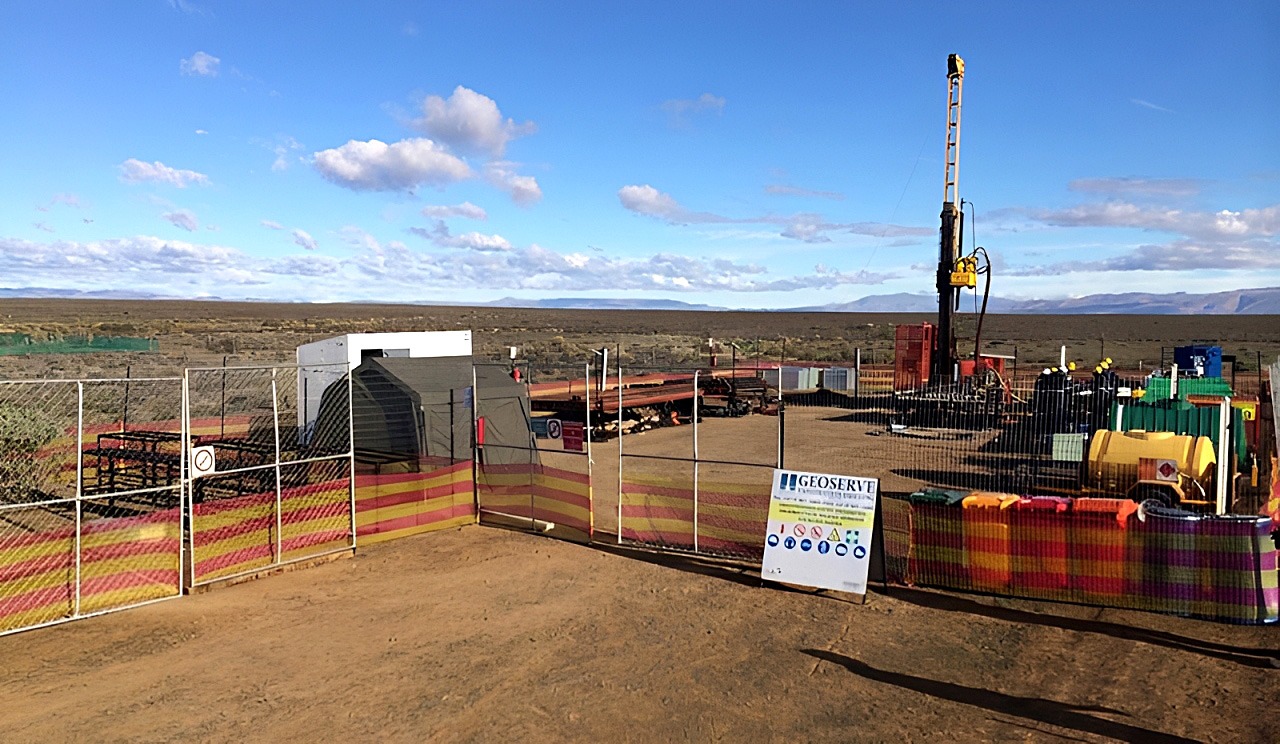
 A drilling site near Ceres, south of the Tankwa Karoo National Park. (Photo: Geoserve Exploration Drilling)
In March 2026, the government announced its intention to lift the long-standing moratorium on shale gas development in the Karoo Basin. The moratorium has been in place since 2011, introduced to allow time for the development of proper environmental and fracking regulations.
Minister of Mineral and Petroleum Resources Gwede Mantashe went further in his May budget speech, confirming an allocation of R48.1-million for the implementation of the Karoo Shale Gas Project and declaring that South Africa was “overly dependent on imported refined petroleum products”.The Petroleum Agency SA (Pasa) estimates the Karoo Basin holds some 370 trillion cubic feet of shale gas.
The government’s rationale rests on energy security and economic growth. Mantashe has called petroleum security “an economic necessity and a national imperative”, arguing that a country with significant mineral and petroleum potential should not remain exposed to external supply shocks.
The former Minister of Forestry, Fisheries and the Environment Willie Aucamp has spoken of ending “decision paralysis” on oil and gas exploration, while stressing the constitutional obligation to promote economic growth without compromising the environment.
These are legitimate goals. But legitimacy of purpose does not guarantee wisdom of method. The environmental and social risks of fracking in the Karoo are serious, well documented and far from resolved.
Here are some reasons why we should be guided by precaution in the face of dangers that could permanently damage the Karoo’s water, landscapes, climate stability and the communities that depend on them.
Water: The Karoo’s lifeline at stake
The single greatest concern is water. The Karoo is one of South Africa’s most arid regions. Communities and agriculture depend heavily on groundwater. Expert evidence from Dr Surina Esterhuyse of the University of the Free State confirms that many Karoo catchments were already experiencing extreme groundwater stress as early as 2016, and that surface water resources are largely unavailable without harming existing users and ecosystems.
Fracking is a water-intensive process. It depends on injecting massive volumes of water underground to fracture shale rock and release trapped gas. In some regions globally, the average volume of water per fracturing operation is around 42,500 cubic metres, roughly 20 Olympic-sized swimming pools. Using a strict comparison, just 21 shale gas wells would consume the estimated annual volume of water used for livestock watering across the entire Karoo shale gas study area.
The risks go beyond water quantity. Between 10% and 30% of the water used in fracking returns to the surface as “produced water”, which can contain radioactive material, toxic heavy metals and salts. The Karoo’s dolerite dykes and sills (the very geological features that provide its groundwater) can also act as pathways for contaminants to migrate from deep to shallow aquifers during extraction. Once groundwater is contaminated, the damage may be irreversible.
Induced seismicity and climate
Water is not the only risk. Expert evidence from Dr Ryan Schultz of the Swiss Seismological Service at ETH Zürich concludes that the Karoo Basin is “particularly susceptible” to induced seismicity (human-caused earthquakes triggered by fracking).
Dr Schultz warns that there is “no credible reason to expect that hydraulic fracturing induced seismicity would not occur in the Karoo Basin” and that the basin in fact exhibits more susceptibility indicators than other basins where such earthquakes have already been recorded.
Then there is the climate question. Methane, the principal component of natural gas, has a climate impact more than 80 times stronger than carbon dioxide over a 20-year timeframe.
Enabling new fossil fuel extraction stands in direct contradiction to South Africa’s climate commitments and the imperative of a just energy transition. The International Energy Agency has stated that, to avoid catastrophic climate change, no new oil or gas fields should have been developed from 2021 onward.
Fracking beyond the Karoo
It must also be borne in mind that the Karoo is not the only place where South Africa is being asked to accept the risks associated with fracking. In Lephalale, Limpopo, an extractives company has applied for environmental authorisation for a large-scale coal-bed methane project.
According to the project’s scoping report, fracking may be used to optimise gas production. While coal-bed methane extraction differs technically from shale gas extraction, both rely on fracturing underground geological formations to release trapped gas, and both raise serious concerns regarding groundwater contamination, induced seismicity, methane leakage and long-term environmental harm.
The Lephalale project shows why this debate should not be limited to the Karoo. If the government permits fracking in the Waterberg coalfields while also lifting the moratorium on shale gas fracking in the Karoo, South Africa risks making a controversial and potentially harmful form of extraction appear acceptable before key questions have been properly answered.
These include questions about environmental safety, effective regulation and whether further fossil fuel extraction is consistent with South Africa’s climate commitments. Rather than allowing fracking to expand into new areas, the government should apply the precautionary principle across the country and first consider whether new fossil fuel projects can be justified under the Constitution and South Africa’s climate obligations.
Constitutional rights and the precautionary principle
South Africa’s Constitution guarantees the right to an environment that is not harmful to health or well-being and requires the state to take reasonable measures to protect the environment for the benefit of present and future generations.
Civil society has urged that there is “no justifiable basis” on which these rights could be limited by plans for further fossil fuel extraction where less harmful alternatives are available. Any decision to lock the country into additional greenhouse gas emissions through fossil fuel exploitation would be in direct contravention of the state’s constitutional obligations.
A call for caution, not complacency
None of this means that South Africa’s energy challenges are not real. They are pressing and consequential. But the answer to energy insecurity cannot be to expose the Karoo’s scarce water resources, fragile ecology and vulnerable communities to potentially irreversible harm.
The moratorium was put in place for good reason. Lifting it should require more than ambition. It should require evidence, transparency and a genuine commitment to the constitutional promise of an environment that sustains, rather than diminishes, the lives of all South Africans. DM
Dr Jonty Cogger is a public interest attorney at the Centre for Environmental Rights whose work focuses on using legal strategies to challenge pollution and climate change.
Paul Wani Lado is an attorney at the Centre for Environmental Rights where his work focuses on the extractives industry, particularly upstream oil and gas projects.
Comments
Scroll down to load comments...