




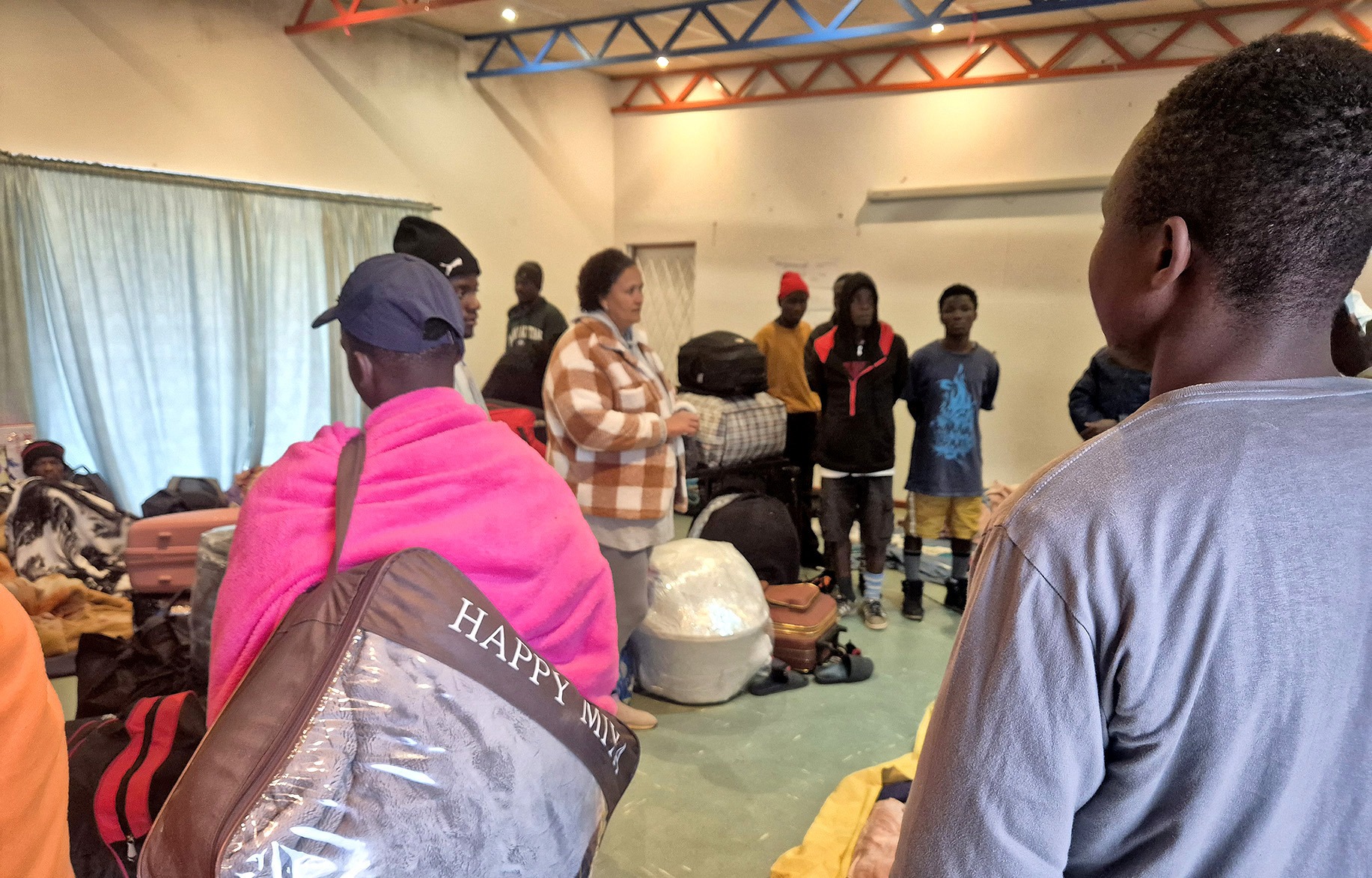
 The 88 men slept in the leadership academy at Goedgedacht. (Photo: Deon Snyman)
 /file/dailymaverick/wp-content/uploads/2025/10/label-Op-Ed.jpg)
The buses left Goedgedacht shortly after four o’clock this afternoon. For two nights our Leadership Academy became home to 88 men from Malawi, Zimbabwe and Mozambique who had fled xenophobic intimidation in parts of the Riebeek Valley. The buses are taking them to Musina and from there each man will somehow have to find his own way home. I arrived home exhausted. It has been a long and emotionally draining week. I thought I would be relieved once the buses had left, but instead I have found myself thinking about the men who stayed with us and about what this week has revealed, not only about the Riebeek Valley, but about South Africa.
There will be many explanations for what happened. Politicians will debate immigration policy. Others will point to unemployment, poverty and the slow pace of economic change. Those are important conversations and they deserve attention. But I have discovered over the past two days that it is difficult to think in abstract terms once you have spent time listening to people who have lived through something like this. The arguments disappear and the faces remain. That is what I have carried home with me this afternoon.
One of the men I met came from Malawi and had lived in the valley for more than five years. Like so many people who leave their homes in search of work, he had slowly built a life for himself. Over the years he had bought a bed, a television and eventually a fridge. There was nothing remarkable about his story. It was simply the story of somebody trying to improve his circumstances one small step at a time through honest work. When he fled, he left everything behind. Looking at me across the table he said quietly: “I lost everything. But at least I still have my life.” I have found myself returning to those words throughout the afternoon because they capture something of the sadness of this week far better than anything I could write.
The other conversations were different, but not really. One man worried about the passport he believed had disappeared after people broke into his room. Another spoke about the wife and child he had left behind in the confusion of trying to find safety. Others described what it felt like to discover that the community where they had lived and worked for years had suddenly become a place where they no longer felt safe. Every story had its own details, but every story eventually arrived at the same place. These men were frightened. It is difficult to explain what that means until you sit opposite another human being and listen to him trying to describe what fear feels like. Fear reduces life to very simple questions. Where will I sleep tonight? Will I be safe? Will I ever see my family again? Will I ever recover what I have lost?
/file/attachments/orphans/20260704_154155_713787.jpg "There was not enough space in the buses for all the luggage. The rest was stored at Goedgedacht. (Photo: Deon Snyman)")
When Goedgedacht was asked whether we could provide temporary accommodation, we had very little time to think. There were practical questions that needed immediate answers. Did we have enough beds? Where would we find blankets? Who would provide food? How long would the men stay? When would the buses come? None of us had been through something quite like this before and there was no manual on the shelf telling us what to do. We simply started responding to the needs that were in front of us, trusting that tomorrow’s problems could be dealt with tomorrow.
One of the first people to become involved was Anna Nobangela, one of Goedgedacht’s community workers. Anyone who knows Anna will know that she is not someone who enjoys being recognised publicly, and she will probably not thank me for mentioning her here. Yet I cannot write about the past two days without writing about her. Most weeks Anna spends her time walking alongside families in the Riebeek Valley. She works with schools, supports parents, responds to cases of gender-based violence and helps children whose lives are often much more complicated than they should be. It is quiet work that seldom attracts attention. This week she simply continued doing the same work under very different circumstances. She spoke to the police, worked with municipal officials, helped people phone their families, organised clothing and toiletries, answered questions about transport and, perhaps most importantly, she was simply present. I watched her move from one person to another, listening far more than she spoke. That is what good community workers do. They help people recover a sense of dignity at a time when dignity feels as though it has been taken away.
Anna was certainly not alone. One of the things that has stayed with me this afternoon is how many people responded once the scale of the situation became clear. The Riebeek Valley Ratepayers’ Association mobilised financial support almost immediately. Rotary members offered practical help. Restaurants prepared meals. Farmers, churches, businesses and ordinary residents arrived with blankets, jackets, shoes, toiletries and food. Dr Manning opened his home to women and children while Goedgedacht accommodated the men. Every hour somebody else would phone or arrive asking the same question: “What do you still need?” It reminded me that the Riebeek Valley cannot be described by only one story. There were people who intimidated vulnerable men and forced them to flee. There were many more who quietly decided that this was not the kind of community they wanted to be.
/file/attachments/orphans/Buses_483496.jpeg "The men board a bus to Musina at Goedgedacht. Buses were provided by the Western Cape government. (Photo: Deon Snyman)")
William Pulles, chairperson of the Riebeek Valley Ratepayers’ Association, expressed something that I suspect many of us were struggling to put into words. He told me that he was deeply conflicted. He was grateful that the community had been able to provide food, clothing and shelter and knew that it had made a real difference. At the same time he could not stop thinking about what still lay ahead for the men on those buses. Getting to Musina was one thing. Finding transport across the border and returning to the homes they had left in search of a better future was something altogether different. I recognised exactly what he meant because I felt the same conflict standing next to those buses this afternoon. We were relieved that the men were safe, but none of us believed that boarding a bus had solved the deeper problems that had brought them to South Africa in the first place.
As I have reflected on the past two days, I have also found myself thinking about our own history. There was a time when South Africans crossed these same borders seeking refuge from apartheid. Many of our neighbours welcomed us, often at considerable cost to themselves. They housed our political leaders, educated our children and gave shelter to ordinary South Africans who believed they had no future here. We remember that history with gratitude, and we should. It also places a responsibility on us. It asks whether we have remembered what it felt like to depend on the kindness of strangers.
None of this means that South Africa’s frustrations are not real. I have worked in community development for more than 30 years. I know what unemployment does to families. I know the anger that grows when corruption steals opportunities and when communities feel forgotten by those who govern them. Those frustrations are real, but listening to the men who stayed at Goedgedacht this week reminded me that it is possible to understand why people are angry without accepting that vulnerable people should become the targets of that anger.
/file/attachments/orphans/20260704_125543_409797.jpg "The 88 men at the entrance to the leadership academy at Goedgedacht. (Photo: Deon Snyman)")
The buses have now gone. By Monday morning the Leadership Academy will once again be used for meetings, training and the ordinary work of Goedgedacht. On the surface life will return to normal. I suspect, however, that many of us who were part of these past two days will not forget them easily. I know I will not. I have seen things this week that have left me deeply ashamed, but I have also seen neighbours helping strangers, police officers protecting vulnerable people, volunteers working until they were exhausted and a community worker quietly reminding frightened men that they had not lost their dignity. Those are also South African stories, and they deserve to be told.
I hope that when the men who left Goedgedacht this afternoon eventually arrive home, they will remember not only what happened to them, but also the people who stood alongside them when they needed it most. I hope they remember Anna Nobangela. I hope they remember William Pulles and the many residents of the Riebeek Valley who refused to stand by. I hope they remember that, even in a difficult week like this one, there were still people who believed that kindness is stronger than fear. That is the South Africa I want to live in, and it is the South Africa I hope we continue building together. DM
Deon Snyman is MD of the Goedgedacht Trust, a rural development organisation in the Western Cape. He has worked for more than two decades at the intersection of social justice, community development and leadership formation, with a focus on children, young people and families in vulnerable communities.