




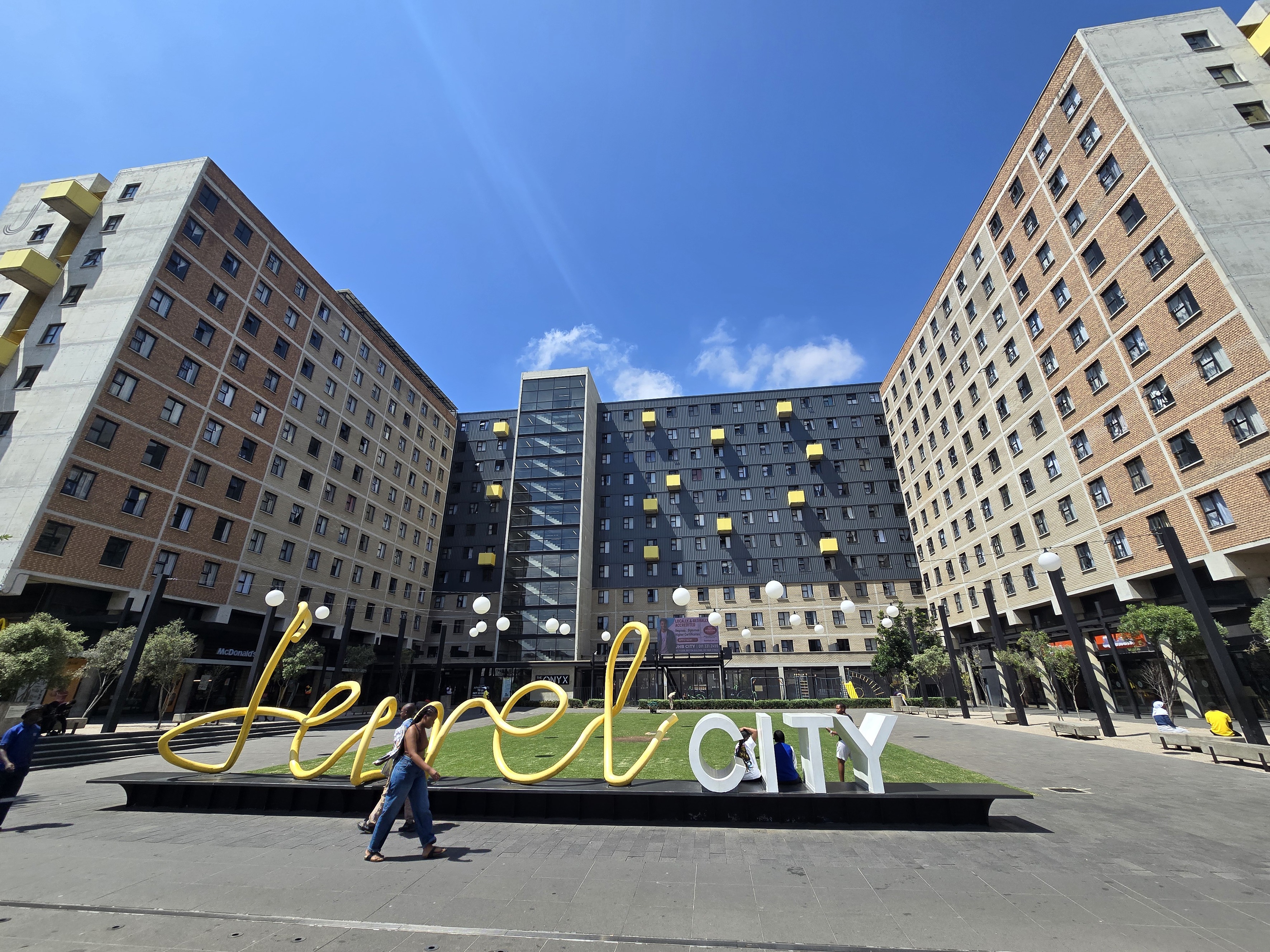
 Jewel City at a glance. (Photo: Bridget Hilton-Barber)
 The wider Maboneng Precinct is a high- density, mixed-use working-class area that is also home to thousands of students and young people. It is sliced and diced by highways and main roads, has a lively creative and weekend party economy, plus that special Jozi inner-city blend of taxis, street traders, spaza shops, garages, chop shops, hair salons, funeral parlours and African revivalist churches.
To the north is the sprawling Enkomeni taxi rank and to the south is the Kwa Mai Mai Market, one of Jozi’s oldest and most culturally significant traditional Zulu markets. Together with Maboneng’s main spine, Fox Street, it draws hundreds of people over the weekends. Wider Maboneng has petty crime, collapsing infrastructure, unreliable water services and erratic electricity – and in some areas, hijacked or semi-derelict industrial warehouses that have been informally occupied by low-income families.
One of the ways the precinct keeps it all together is through the work of the Greater Maboneng Improvement District (WMID), which is a city improvement district (CID). CIDs developed internationally in the 1970s as a way for property owners in a defined urban area to organise themselves, contribute resources and manage their surroundings.
The model expanded to South Africa – Gauteng has almost 60 CIDs – and although it has taken different forms in different municipalities, the basic structure is consistent: a defined area is established, property owners agree to work together and a formal entity is created to manage operations funded through levies.
/file/attachments/2994/08muralart_549599.jpg "Mural art. (Photo: Bridget Hilton-Barber)")
Chris Ndlovu is the precinct manager for the WMID and runs its operations through Urban Space Management (USM), a non-profit that specialises in the operations, turnaround and daily management of more than 10 CIDs in the city.
It is based at Jewel City, in the crown of wider Maboneng. There are supermarkets, pharmacies, green spaces, coffee shops, crèches and digital centres. Jewel City buzzes with people walking between creative Maboneng and the Absa Tower financial district.
Ndlovu and I met on the piazza outside Jewel City under a huge mural of a woman with a lamp – Maboneng means place of light – and, together with Norman Maluleke from USM, took a long walk around the precinct.
“Basically, the WMID works to bridge municipal service delivery gaps by providing localised, top-up safety, cleaning and maintenance services for the precinct,” says Ndlovu. “We are also involved in greening, beautifying and marketing.”
/file/attachments/2994/08viewofWiderMaboneng_755679.jpg "A view of wider Maboneng. (Photo: Bridget Hilton-Barber)")
The WMID provides an invaluable channel for residents and business owners who face service delivery issues.
“Although the WMID can’t legally replace the city government,” says Ndlovu, “we can act as a critical intermediary. When water pipes burst, streetlights break or traffic lights fail, individual citizens often struggle to get a municipal response. We can actively audit these faults, log them directly with Johannesburg metro departments and track them until fixed, so we serve as an organised buffer.”
There are highly visible teams of security guards and cleaning crew throughout the precinct. “These teams are not part of the City,” says Maluleke, “but are employed by the WMID. The uniformed security guards or ‘urban rangers’ patrol the streets, pavements and open spaces on foot, and are responsible for deterring petty crime, directing visitors and reporting things like broken streetlights or infrastructure issues.
“We also have guards in vehicles and CCTV camera networks, and the WMID acts as a liaison with the South African Police Service and Johannesburg Metropolitan Police Department.” Maluleke says the crime rate in the WMID is lower than the broader Jeppestown and Johannesburg Central police sectors.
The cleaning crews are localised groups of inner-city youth who are employed through a partnership with the Johannesburg Inner City Partnership and the Social Employment Fund. The crew clear street-level illegal dumping, sweep pavements daily, clear public refuse bins and remove unauthorised posters. They also gather in a public square on Main Street to do exercise every Wednesday afternoon – much to the delight of passers-by and motorists.
The WMID also helps to manage designated spaces for informal street traders – and Van Beek Street is a case in point.
This tree-lined avenue features colourful murals and a series of small, covered pavement stalls selling food, coffee and crafts, as well as Market Up, which is a retrofitted, mixed-use building for small enterprises and creative entrepreneurs.
Both Ndlovu and Maluleke walk these streets just about every day. For them, strong on-the-ground intel is essential for running the precinct. They know all the business and shop owners and staff, city managers responsible in the area, residents. They know every pothole, failed traffic light and cracked pavement – and how to go about getting it fixed. The key to a successful precinct, says Maluleke, is partnerships and collaborations.
/file/attachments/2994/cowartworkintheEnkomeniTaxiRank_412675.jpg "Cow artwork at the Enkomeni taxi rank. (Photo: Bridget Hilton-Barber)")
On the outer edges of the precinct, a few blocks southwest of Jewel City, one finds considerable deterioration. There are marginalised and homeless people burning rubbish on the pavements to keep warm, signs of drug use, and a few buildings that have obviously been hijacked.
“There are some things we can’t fix,” says Nldovu. There is very little the WMID can do about these socioeconomic issues, except keep a strict perimeter that is secure.
Some critics argue that this creates a shadow privatisation of public space, creating exclusive silos of safety surrounded by deep urban poverty.
Maboneng was once a completely abandoned, crime-ridden industrial zone that was transformed into an arts and culture precinct. It’s since transitioned from a highly polished, international hipster hotspot into a gritty local African urban hub – and remains a young and spirited place.
It’s a place for local music and photography and has a vibrant street culture and some of the best mural art in the city. Famous artists include Dbongz, Falko One and Rasty Knayles, whose works are showcased around the precinct and especially under the Maboneng bridge.
/file/attachments/2994/08cleaner_344670.jpg "A cleaning crew member at work in the precinct. (Photo: Bridget Hilton-Barber)")
Also under the bridge is the famous pissoir (urinal) of Maboneng, a wacky functional public art designed by artist Hannelie Coetzee in collaboration with urban designer Stefan van Niekerk.
It’s known as the Plant Pee Pot and uses a urine breakdown method called phytore-mediation science – an eco-technology where specific plant growth strategies are harnessed to naturally break down urine.
One of the goals of the WMID is to create more walkable networks in the area that can link Jewel City with other residential nodes like Hallmark House – a nearby upscale 15-storey building inhabited mainly by professionals – and student buildings like Platinum Place and 120 End Street, which are run by Afhco.
“In the tapestry of Jozi neighbourhoods that do and don’t have CIDs,” said a 2026 report by the Gauteng Precinct Management Association, an organisation representing CIDs in Gauteng, “those with CID interventions have shown visible improvements, with cleaner streets, 24-hour security and spaces that support opening new businesses.
“Gandhi Square, Jewel City and other parts of Joburg’s inner city [serve] as examples of what CIDs can do.
“How these kinds of structures could fit into a new, more effective way to manage a city seeking to turn itself around is an important issue for the next mayor of Johannesburg.” DM
Bridget Hilton-Barber is a freelance writer who writes for Jozi My Jozi.
This story first appeared in our weekly DM168 newspaper, available countrywide for R35.
/file/attachments/2994/DM-260626_643039.jpg)