




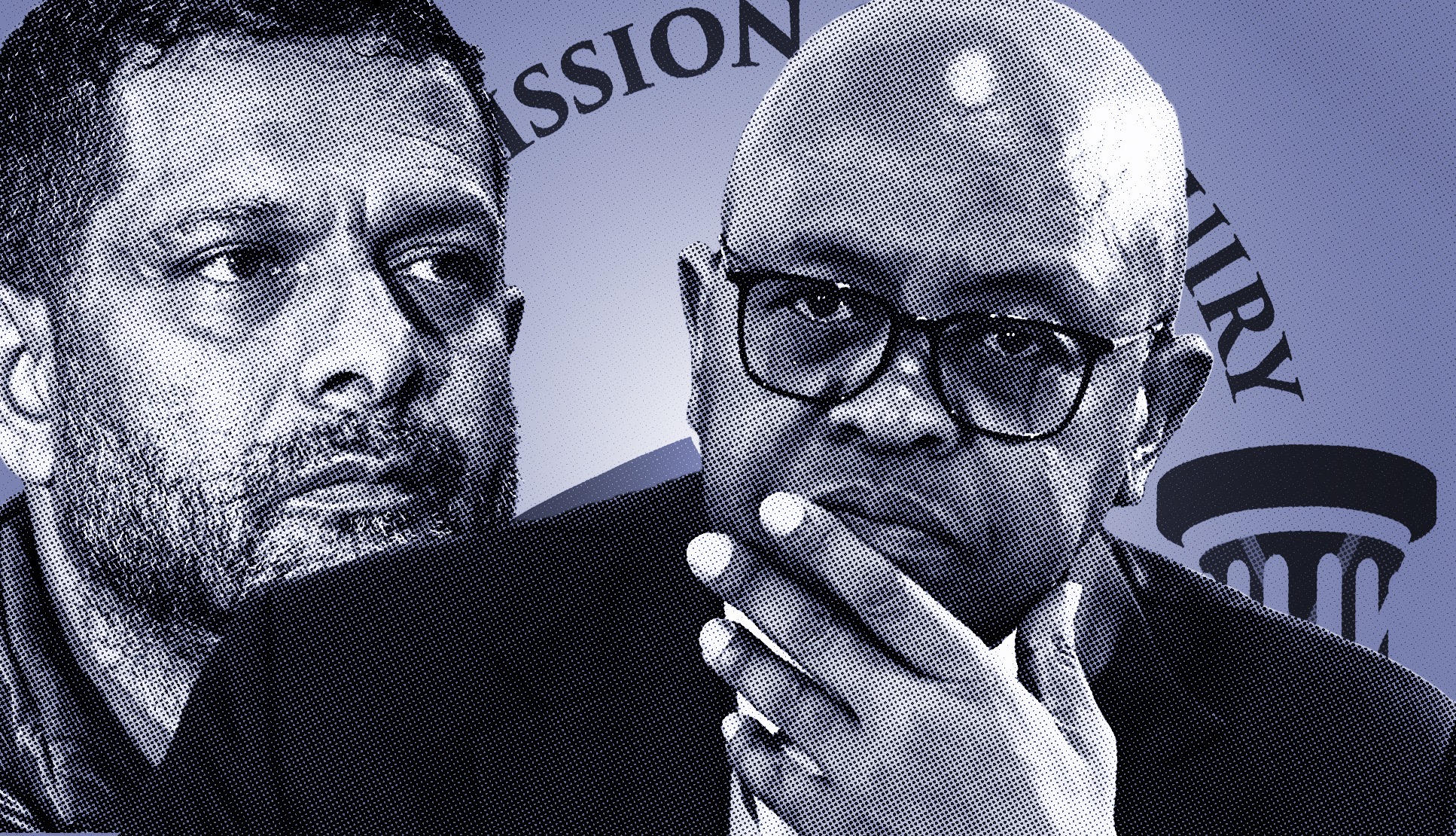
 Illustrative image: Senior Crime Intelligence officer Feroz Khan. (Photo: OJ Koloti / Gallo Images) | Chairperson of the Madlanga Commission, Mbuyiseli Madlanga. (Photo: Frennie Shivambu / Gallo Images)
A free press is not a courtesy the state extends to journalists. It is a constitutional load-bearing wall.
When journalists investigate the police — the institution society arms and empowers to protect its citizens — they do the work the Constitution anticipates and democracy requires. Any suggestion that state intelligence resources were turned against a journalist for doing that work is not a media-industry grievance. It is an attack on the public’s constitutionally enshrined right to know, and on every citizen who depends on that right. It is also potentially an attack on a key pillar of our democracy, which South Africa cannot afford to place at risk.
That is why testimony at the Madlanga Commission last week and on Monday should alarm every South African — whether or not they have ever read a word of Daily Maverick’s reporting. The allegations concern our associate editor, Marianne Thamm, and we do not pretend to be neutral about her safety. But the principle here is bigger than one journalist or one newsroom: if Crime Intelligence — a unit already dogged by allegations of slush funds and factional abuse — can be discussed as a “counter” to be “activated” against a reporter, the machinery meant to protect the public can be turned against it.
We must be as careful with the facts as we ask others to be. No conclusive link has been established between the WhatsApp exchange read into the record and the burglary at Thamm’s home weeks later. But the commission’s evidence leader, advocate Adila Hassim SC, says the sequence warrants further investigation — and we agree.
Here is what can be said with certainty: intimidation does not need a completed conspiracy to work. The threat is the point. Every reporter who learns that their name surfaced in an exchange like this, and every editor who weighs whether a story is worth the risk, feels it — regardless of what the commission ultimately finds.
Journalists who investigate power will always make enemies of the powerful. That is the job. But it is not free, and it is not safe, and it cannot run on goodwill alone. When you support Daily Maverick, you are not buying content — you are underwriting journalists’ capacity to keep asking dangerous questions on your behalf, and the institutional backing that stands behind them when those questions provoke a response. Defend Truth is not a slogan. This week, it is a case study.
What follows is what we know.
The timeline
On 17 January 2021, Daily Maverick published Thamm’s report on an alleged R200-million PPE procurement fraud investigation inside the SAPS, which centred on two officers assigned to probe the then Crime Intelligence boss, Peter Jacobs.

Evidence in the form of WhatsApp messages presented at the Madlanga Commission shows that on the day the article appeared, a colleague sent General Feroz Khan, then a Crime Intelligence divisional commissioner, a link to it. Khan allegedly replied that “this journalist is a good friend of Jacobs”, adding “and Vearey” — a reference to Jeremy Vearey, then head of Western Cape detective services, since controversially dismissed from the police service. The colleague allegedly responded: “Counter needs to be activated on this journo.”
The identity of that colleague has not been made public. Hassim first needs to establish whether he worked as an undercover officer.
Less than two months later, on the night of 13 March 2021, someone broke into Thamm’s Cape Town home and took two laptops, an iPad and jewellery. We reported on the break-in at the time. Thamm and Daily Maverick only learned of the WhatsApp exchange when it was read into the commission record last week — more than four years after the fact.
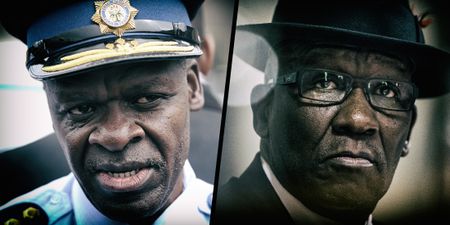
Police have effectively closed the burglary case. Hassim told the commission on Monday that the sequencing nonetheless demands scrutiny: “You can’t conclusively show it was linked to the WhatsApp exchange, but the sequence is alarming. It can’t just be a coincidence, in my mind.” She asked whether Khan or his colleague had distanced themselves from the burglary once they learned of it.
Hassim described it as “disturbing” that a senior Crime Intelligence officer appeared to be discussing measures to take against a journalist in contact with “particular senior police officers, one of whom happens to be General Khan’s superior” — Jacobs, in his capacity as head of Crime Intelligence.
Crime Intelligence, said Hassim, “is not a mechanism for monitoring and intimidating anyone, including journalists”. The exchange instead pointed to “a willingness to use Crime Intelligence capabilities, Crime Intelligence resources ... against a journalist” whose reporting certain officers disliked — and if so, that was “not a lawful policing objective” but the investigation of “a journalist whose view you don’t like”.
Hassim was equally clear about journalism’s place in a constitutional democracy: “We appreciate in the constitutional democracy that journalists play an important role in exposing wrongdoing within public institutions, including in the police. So, the broader systemic concern that I just wish to place before the commission is that the exchange reflects a danger that Crime Intelligence could be used for factional or personal and retaliatory purposes, and that is something that we should take note of in the commission.”
The Madlanga Commission will determine what this evidence proves and what it does not, including if it ultimately clears the officers involved. We will report that finding either way — that is the difference between journalism and the conduct described in these messages: ours is done in the open, under our own names, subject to correction and to law.
Whatever the commission concludes, the WhatsApp exchange has already told the country something it needs to hear: that people inside Crime Intelligence thought of a journalist’s reporting as a problem, and of state capability as the solution. A democracy cannot leave that thought unexamined. Neither will we. DM
Daily Maverick is an independent news organisation supported in part by 32,000 readers who make voluntary monthly or annual financial contributions. Click here to join them.
Comments
Scroll down to load comments...