




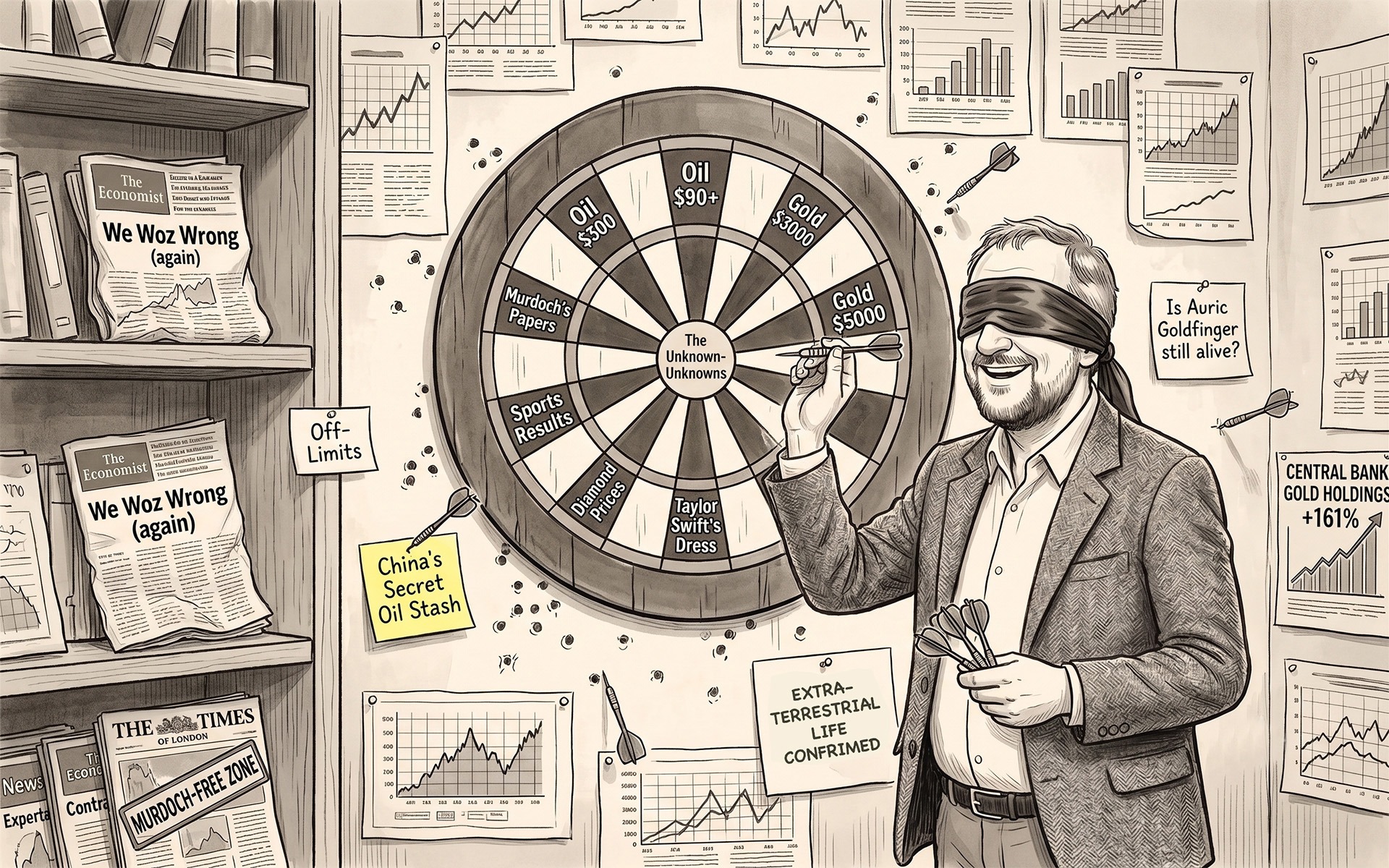
 Illustrative image: Generated with Google Gemini Flash Image 2.5
It is a strange habit of journalists, economists and general members of the commentariat to try to make predictions. It is, as I’m sure you know, a recipe for trouble.
But, if I may defend my tribe, it is also a habit among so many of us to read each prediction avidly.
From diamond prices to sports results to political dynamics and even what Taylor Swift would wear to her wedding, predictions are fun. It allows us to think “what if”, and to example the possible options at play and thus better understand markets.
Quite recently I’ve had some dark moments as I considered what might happen with oil prices. Part of this was sparked by a newspaper I read avidly.
The Economist has been a reading habit of mine since I lived in London as a much younger person. I can’t tell you exactly when I started reading it, but I realised by the time I was about 24 that this was lifelong.
Despite the fact that it takes up much more of my discretionary income now than it did then, I have been able to keep it up.
Other people I know spend that money on The New York Times or The Times (of London). But while I respect the NYT I just can’t give my money to the Murdochs so regularly.
So I was hugely disturbed a couple of months ago when The Economist started to make incredibly dire predictions about oil prices. They suggested those prices were going to stay incredibly high and traders “were living in la la land” if they thought they might go below $90 a barrel this year.
As they themselves put it last week, “We Woz Wrong”.
What makes it interesting is why they woz wrong. They did not know that China had stored as much oil as it had. The world now knows that China has been able to put oil underground and out of sight in huge quantities.
Very few people knew that before the war started. As a result, their demand was lower than predicted.
The other reason, of course, was that Donald Trump basically gave in to the Iranians very quickly.
It’s a great example of a very dire prediction that turned out to be wrong (thankfully).
Recently there has been a huge amount of speculation about gold prices. Last year there were some predictions that it would hit about $3,000 an ounce. Instead it went past $4,000 and then a few months later $5,000.
This has been massive for us. It’s not just that some of our gold producers are making a huge amount of money with all of the good consequences of that.
It’s that they ended up paying much more in royalties to the government, which helped National Treasury to pay back more of our primary debt. The result is that three ratings agencies have upgraded their rating or their outlook for South Africa.
That in turn makes our debt cheaper and, with a bit of luck, might help us to start a critical virtuous cycle of paying back more debt and so on.
This then makes predicting the gold price quite important for us.
For the moment it seems what traders call “range-bound” – stuck between $4,000 and $4,300. That’s high by historical standards but not as high as $5,000.
This is where a much more important factor comes into play.
One of the mistakes The Economist might have made is forgetting that the global supply of oil is quite high at the moment. Some experts have suggested that without Trump attacking Iran prices would have settled at about $65 a barrel.
That’s where supply would meet current output.
While gold prices are affected by US interest rates (to oversimplify: when traders think the Federal Reserve will cut interest rates the dollar will lose value and gold will be a safer place to put your money; when they hold or raise rates your capital will get more value in dollars than gold) there is another factor keeping gold prices high.
The rise of geopolitical risk has led more central banks to buy more gold. They don’t want to rely on the dollar, or any currency, and thus want to keep gold.
Australian academic Luke Hartigan recently quoted the IMF as saying that since 2006 central banks have increased their gold holdings by 161%. As he says, in the 50 years to 2006, emerging market gold holdings grew by only 50%.
This means that gold demand will stay relatively high.
At a time when gold supply is not increasing very much.
So that should be good for us.
The problem, of course, is that I don’t know for sure. If China was able to store that much oil in a previously unseen way, who knows what could be going on with gold supplies? What if Auric Goldfinger is still alive somewhere and about to mess with global gold supplies?
That’s what makes markets so fascinating. The known-knowns and the more interesting unknown-unknowns.
And why you, and I, will keep reading predictions. Especially if they could be wrong. DM
Comments
Scroll down to load comments...