




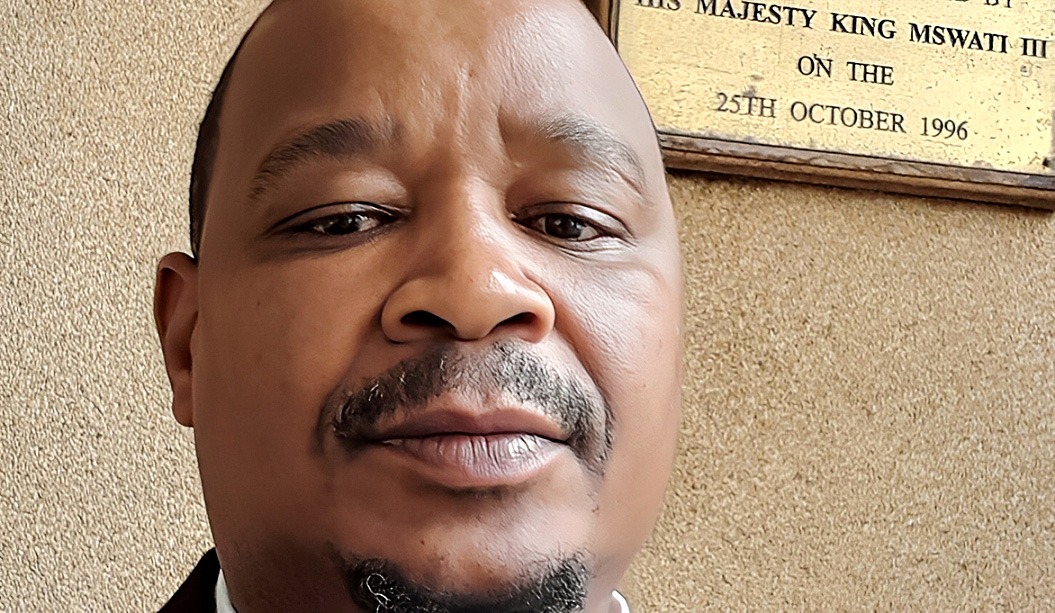
 Lawyer Maxwell Nkambule. (Photo: International Observatory of Lawyers / Wikipedia)
On 11 May, after a long and arduous process, the French authorities recognised Maxwell Nkambule, a well-known Eswatini human rights lawyer, as a refugee.
Nkambule’s asylum application included information about an assassination attempt made on his life, documented in the International Commission of Jurists’ 2025 report “No Situation is Permanent: Repression, Intimidation, Harassment and Killing of Lawyers in Eswatini”. Relying on this report, as well as information provided by a range of other international and local organizations, and on a communication to the Eswatini authorities by the UN Special Rapporteur on the independence of judges and lawyers, he told the French authorities that his life — and that of others in a similar position — was at risk simply for providing legal representation in cases considered political and/or controversial by the Swazi authorities.
The Eswatini government has yet to respond to the communication issued by the Special Rapporteur (dated 7 April 2025), nor did it engage with her during her visit to the country for the purpose of holding dialogues with Eswatini human rights lawyers later the same month.
In a letter responding to questions raised to the minister of justice and constitutional affairs by the International Commission of Jurists (ICJ) before the publication of its report, the minister said, “Eswatini endeavours to provide a safe and respectful environment for everyone to exercise their human rights in the ambit of the law.”
Seemingly responding directly to the case of Nkambule, the minister continued: “However, there was once a report to the police by a lawyer that he was allegedly followed by an unknown foreign-registered motor vehicle and felt his life was under threat. Subsequent to that, investigations were instituted, but unfortunately nothing came out due to insufficient facts.”
The letter concluded: “To be precise [there is] no repression and harassment of lawyers in the Kingdom of Eswatini.”
Cold comfort
The minister’s response provided cold comfort for human rights lawyers in the country. It flies in the face of the evidence documented by the ICJ, accepted by the UN Special Rapporteur as credible, and relied upon by the French authorities in Nkambule’s asylum application.
Making matters worse, in a letter responding to the ICJ’s report (dated 13 January 2025), the Law Society of Eswatini simply states, “Lawyers in the country carry out their functions free from intimidation, harassment, reprisals and other human rights violations. Lawyers operate independently and are able to determine which cases to take and which clients to represent.”
It is obvious that Nkambule’s life was at risk. There was clearly an attempt made on his life on 7 December 2022. At the time, in addition to his other human rights work, Nkambule was representing clients who had been accused of “terrorism” and murder of a police officer. The subsequent targeted assassination of
/file/dailymaverick/wp-content/uploads/2024/01/IMG-20230122-WA0006-e1674380081122.jpg "Murdered Eswatini human rights lawyer Thulani Maseko. (Photo: Supplied)")
Thulani Maseko, another prominent human rights lawyer, in his home on 21 January 2023, further illustrates the very real danger Nkambule and other lawyers are facing in the country.
In neighbouring South Africa, where we live and work, the cases in question would be considered the run-of-the-mill daily work of a human rights lawyer, providing legal representation to those who are targets of persecution or prosecution — whether legitimate or otherwise.
In addition to the actual threats on their lives, the ICJ’s report documents other challenges faced by human rights lawyers in Eswatini, including:
- Lawyers are followed, harassed, threatened and intimidated.
- Women lawyers are threatened with sexual violence.
- Lawyers are associated or identified with the actions or causes of their clients solely for carrying out their legitimate professional functions.
- Lawyers face adverse economic consequences for taking on cases or clients perceived as “political”.
- Lawyers perceive there to be challenges in respect of the Law Society of Eswatini’s execution of its mandate.
- Lawyers indicate that legal professionals operate in an environment that inhibits their ability to act independently.
- Lawyers allege that the judiciary is not independent.
- Lawyers consider that the chief justice abuses his power.
- Lawyers experience significant obstacles and pressures in relation to cases arising from the June 2021 civil unrest, when hundreds of mostly young people were arrested, and many were injured or killed.
- Lawyers are adversely affected by the killing of Thulani Maseko.
Shrinking of civic space
In addition, a dramatic shrinking of civic space more broadly has taken its toll. Although, as Sibusiso Nhlabatsi pointed out in his column in The Nation (April 2026), in-fighting within progressive organisations advocating for democratic change has contributed to the dwindling of civil society, so too has the iron hand of the state in its implementation of the Suppression of Terrorism Act. In an earlier column (September 2025), Nhlabatsi notes, “The Suppression of Terrorism Act was not enacted to fight genuine terrorist threats, but rather to legally codify the repression of the pro-democracy movement.”
Whatever the intention behind the Suppression of Terrorism Act, and irrespective of the Supreme Court’s ill-considered decision to uphold its constitutionality, time and time again the Eswatini government has been told by United Nations treaty bodies and independent human rights experts that its law is inconsistent with international human rights law commitments made by Eswatini under numerous treaties.
In November this year, the Eswatini government will again report to a UN body, this time the United Nations Human Rights Council. Submissions by various international and local organisations highlight, once again, the chilling impact of the Suppression of Terrorism Act on civic space. In addition, the ICJ’s own submission focuses on the very real threats to and attacks on both lawyers’ and judges’ independence.
A crisis in the judiciary
Over several decades, the ICJ has consistently documented structural reform needed for Eswatini to comply with international safeguards for judicial independence, which remain sorely lacking. These broader problems are exacerbated by serious concerns about Chief Justice Bheki Maphalala’s abuse of his powers, highlighted in the Law Society of Eswatini’s December 2022 complaint against him.
Some lawyers interviewed by the ICJ during our research went so far as to indicate that the damage done by Maphalala to the judiciary is even more severe than that by his now disgraced predecessor, Chief Justice Michael Ramodibedi, who was removed from office.
The Law Society’s complaint, similarly to other investigations, into, among others, the killings and injuries at the hands of the authorities during the June 2021 unrest, the killing of Thulani Maseko, and the attempt on Nkambule’s life, appears not to have progressed at all. If it has progressed, the authorities have provided no evidence of such progress.
Surprisingly, the Law Society of Eswatini has also failed to engage substantively with concerns raised by the ICJ regarding the independence of the judiciary.
If the killing of and attacks on its members did not motivate the Law Society to take appropriate action, then the ongoing crisis within the judiciary should by now have done so. After all, the president of the Law Society, Mangaliso Magagula, is currently being subjected to a highly reprehensible abuse of judicial power through which ongoing and unlawful contempt of court proceedings are being used to threaten his own independence as a lawyer. Such contempt proceedings, which have become increasingly common practice, seemingly take the lead from the chief justice himself, and compromise the independence of the judiciary even further.
The people always prevail
In an interview in May, Nkambule told the ICJ: “I’m saying that I have not paid the ultimate price. I’m still here, I can still talk. Others are held in prison, they cannot talk, they do not have freedom. Others have died; we don’t know where they were buried, but they’re fighting for us.”
While Nkambule has not paid the “ultimate price”, he has paid a hefty one. He has lost his livelihood, his practice, his home, his community and the ability to live in his own country. He now faces the significant day-to-day difficulties of existing as a refugee in a foreign land and rebuilding his life brick by brick. He describes the procedure he went through to be granted asylum in France itself as a “brutal process”.
From France, Nkambule plans to continue bringing attention to human rights issues in Eswatini and to the need for democratic reform; he hopes that his efforts and those of others result in internationally “putting faces” to these issues. This, he says, will make it impossible for the international media to deny the reality of the situation, because “the world must know” what is happening in Eswatini. He stresses the importance of giving “strength and an unwavering commitment to continue to fight”. After all, he concludes, “we are on the side of the people, and the people always prevail”. DM
Timothy Fish Hodgson is senior legal adviser at the ICJ and Kaajal-Ramjathan Keogh is Africa director of the ICJ.
This article was first published by The Nation.
Comments
Scroll down to load comments...