



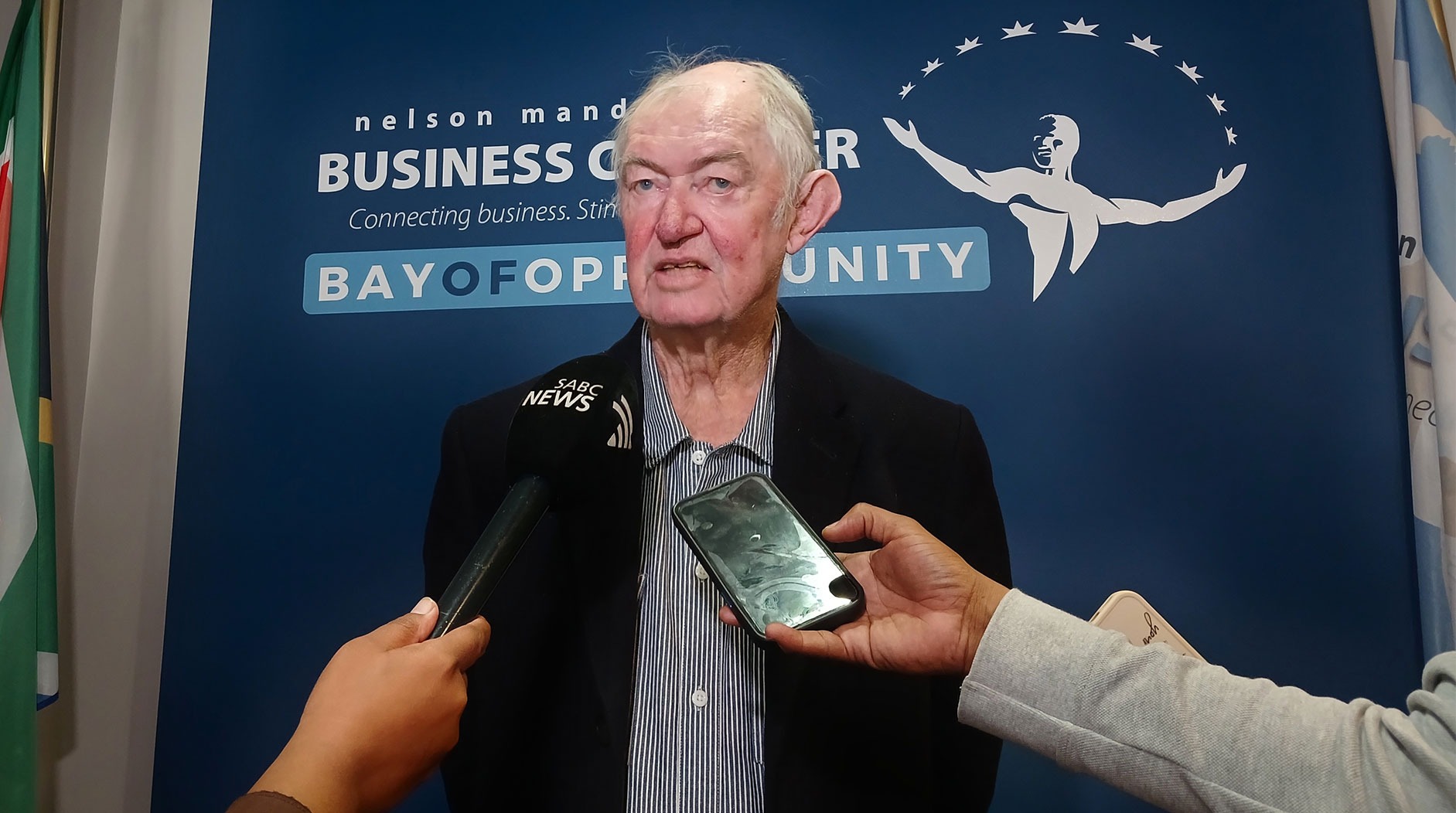
 Former minister of public enterprises Alec Erwin says Nelson Mandela Bay is uniquely placed to be a major role-player in the global automotive sector. (Photo: Riaan Marais)
 With an eye on identifying and expanding on Nelson Mandela Bay’s most valuable industries, civil society is drawing on the expertise of leaders in their respective fields to bring out the best in the Bay.
The NMB Civil Society Coalition has announced its plan to host an economic summit in the metro later this year, and has embarked on a series of engagements to better inform itself about the challenges and opportunities in the city.
The first in its series of engagements saw former minister of public enterprises Alec Erwin address the coalition’s members on NMB’s crucial role as an automotive hub for the rest of South Africa.
He said Nelson Mandela Bay was ideally situated with existing manufacturing capacity while sitting at the end of a road freight line, with goods coming and going from the ports of Port Elizabeth and Ngqura.
“It is important to understand what is possible and then move to get it done. South Africa, and Nelson Mandela Bay, could play an important role in the supply chain of components and vehicles. But nothing ever changes by sitting on your backside.”
Further unpacking the intricacies of the global automotive industry, Erwin explained the importance of finding a balance between local manufacturing and importing.
/file/attachments/orphans/GettyImages-912982160_424462.jpg "The Nelson Mandela Bay Civil Society Coalition has identified the automotive sector as one of the key opportunities for the metro. (Photo: Waldo Swiegers / Bloomberg via Getty Images)")
“The automotive sector is an unusual global trading system. South Africa imports about as much as it exports, with global brands dividing the manufacturing of certain models among its various plants worldwide. The notion that manufacturers compete country by country does not really work in this sector.
“So the Eastern Cape, and more specifically Gqeberha and its ports, will be a very important part of that global system.”
With the push for alternative-energy vehicles, Erwin sees even further growth opportunities for the South African automotive sector.
“The logic is clear. There will be a move towards new energy vehicles, and those vehicles require a different component base and mineral mix, and South Africa’s got the advantage in resources and the required minerals.
“In the past we tended to export them raw, so the challenge and opportunity that is being looked at by industry and government is what steps can we take to process more of these minerals ourselves, and to become a supplier of manufactured components.”
Vital step
Erwin said an initiative like the Civil Society Coalition, and the series of engagements it is planning in the coming months, is a vital step towards getting the business community involved in the economic development of the region.
“The Civil Society Coalition cannot allow local government to lose sight of the fundamental importance of being a good service provider.
“Successful countries make sure that they invest in social capital and empower their citizens to contribute to the economy. They then utilise that social capital to manufacture the equipment needed to build the economy,” said Erwin.
He explained that investment in crucial infrastructure, such as better roads, electricity networks and water supply, will also contribute to the absorption of labour, which in turn ensures the sustainability of the local economy by contributing to the decrease in poverty and attracting potential foreign investors.
A member of the coalition, the Nelson Mandela Bay Business Chamber, helped to facilitate the engagement with Erwin.
Chamber CEO Denise van Huyssteen said one of the key takeaways from discussions with Erwin was the proactive role organised business and organised labour can play in influencing the direction of economic development.
/file/attachments/2986/Screenshot2025-12-15at145307_748755_485995.png "Denise van Huyssteen. (Photo: Facebook)")
“The Eastern Cape and Nelson Mandela Bay are automotive hubs, with half of the sector’s manufacturing coming from this province. However, things are trending in the wrong direction, and we are at risk of deindustrialisation.
“One major challenge is infrastructure — energy, water and logistics — and we need to see improvements in these areas if we wish to become more competitive.”
Civil Society Coalition spokesperson Zukile Madikane said their members drew great inspiration from Erwin and his insights into the automotive industry. In the coming months, they hope to attract prominent figures from other sectors crucial to the metro’s economy.
“This was the first in our series of engagements before we look to host our economic summit later this year. We are also looking to bring experts from tourism and agriculture to further broaden our discussions,” said Madikane. DM
Comments
Scroll down to load comments...