




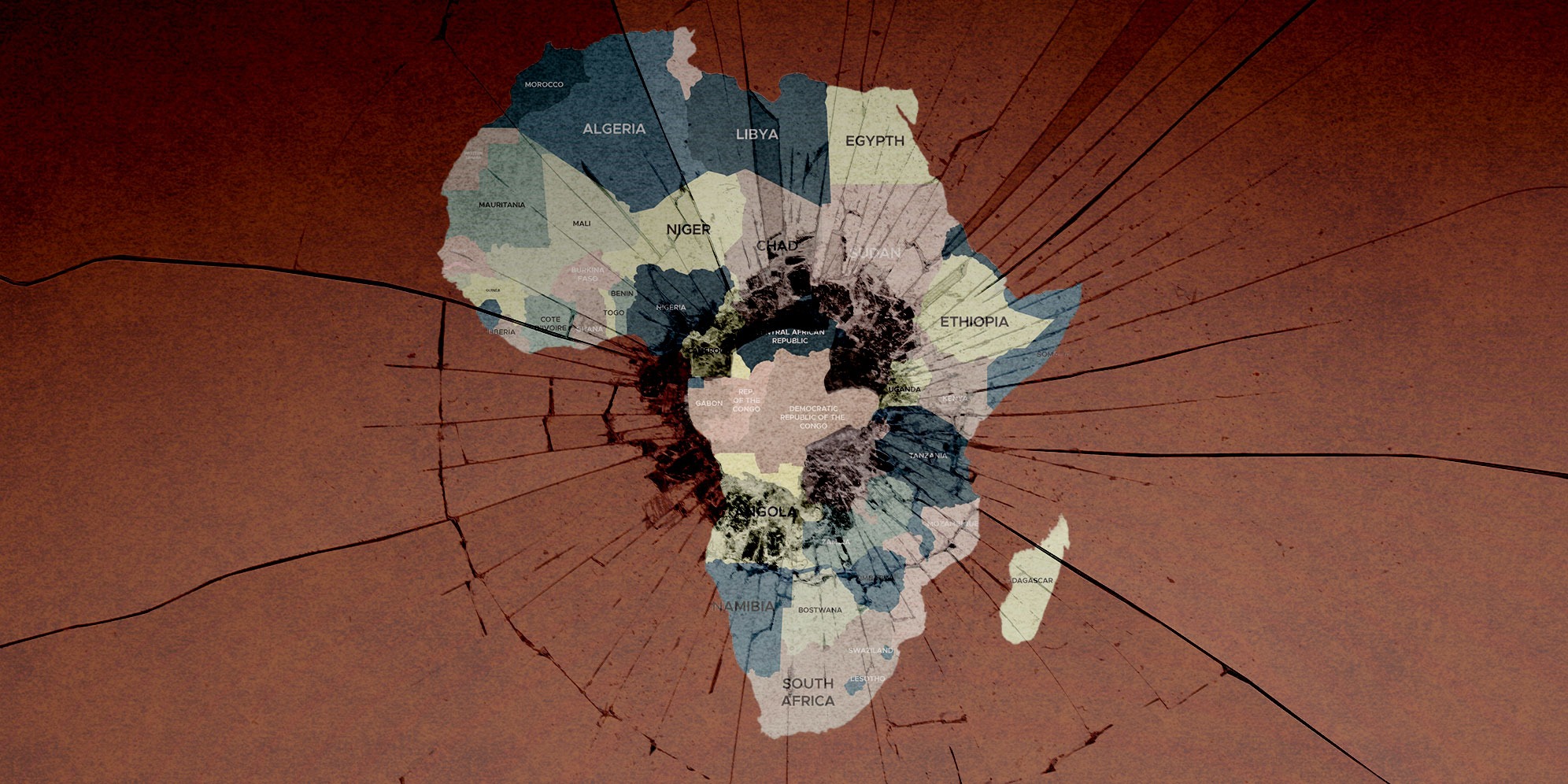
 Illustrative image: African continent. (Image: Freepik) | Cracked glass. (Image: Freepik) | (By Daniella Lee Ming Yesca)
 Goodness knows MTN shareholders have experienced it themselves. The share price traded above R200 in early 2022 before eventually bottoming out around R75 in mid-2024. By that stage the investment thesis had been burned to a crisp and all the focus was on the group’s ability to service its debt at holding company level.
Today, MTN is trading at R230 per share and nobody is talking about the debt. Those who bought the 2024 disaster have now tripled their money. That’s less to do with MTN’s brilliance (although management has obviously played a role), and more to do with external factors (like Donald Trump’s policies giving African currencies some breathing room).
The macroeconomic elements are critical when you’re looking at any business, but they are especially important in emerging and frontier markets that tend to be more vulnerable.
Another very important risk category in Africa is geopolitical risk, as the continent is filled with countries that face issues ranging from regulatory surprises through to violent conflict. We’ve had a good reminder of these risks in the past week in the form of updates from Optasia and Gemfields.
At Optasia, the investment case was severely impacted by recent Nigerian regulations that disrupted the firm’s airtime credit business. Optasia doesn’t work exclusively with MTN in that country, but MTN’s decision to suspend Optasia’s services in response to the regulations gave South African investors clear line-of-sight of the risks.
To make it worse, MTN commentary on the issue largely brushed off the impact, assuring MTN investors that the performance in Nigeria wouldn’t be materially affected. This was a horrible look for Optasia’s business case, as the market being told that your product is rather unimportant is never going to widen your moat in the eyes of investors.
To add to the bearishness around Optasia, the founder sold a huge chunk of shares to FirstRand before the share price started to really plummet. Insider selling is important to consider in a bear case.
The pressure on Optasia’s share price (and the egg on FirstRand’s face) has moderated slightly. It started with the founder buying more shares recently, as did the CEO. This proved to be a useful signal to the market, as the subsequent operating update from Optasia showed that the group is far more versatile than just the airtime credit business in Nigeria.
With a focus on microfinancing solutions (72% of group revenue in the latest period), Optasia still achieved revenue growth of between 50% and 60% for the period despite the regulatory pressures. Margin mix is important to keep an eye on, as net income grew by between 30% and 40% – a strong growth rate overall, but well below the revenue growth rate.
Investors will need to weigh up the growth opportunities against the risks of further regulatory issues. And as though Nigerian risk isn’t bad enough, Optasia recently expanded into South Sudan of all places. That’s about as wild as geographical exposure gets!
At least technology platforms tend to span multiple territories, so there’s some inherent diversification of risk. The same can’t be said for Gemfields, where the operations are focused on ruby mining in Mozambique and emerald mining in Zambia. The Zambian government has given Gemfields some serious headaches along the way regarding taxes, but it’s the Mozambique business that has now elevated these problems to a migraine.
It’s hard to fully explain just how broken the Gemfields story is. The share price has lost nearly 80% of its value over three years. They’ve already tapped the market for capital, having executed a rights offer in 2025 at about R1.07 per share. The share price is now at R0.69, so investors who supported the rights offer have been hammered.
The risks in the company are just too difficult to stomach relative to the rewards. The company mines natural gemstones, so the quality that comes out of the ground varies tremendously. This makes it nearly impossible to forecast the performance – for example, the recent rubies in Mozambique have been suffering from a decline in grades.
To add to these issues, the company has experienced commissioning issues at the second processing plant in Mozambique, with the group flagging a “material adverse impact” on ruby auctions for the rest of the year.
If you can believe it, the situation gets even worse. Conflict remains a problem in Mozambique, with villages between 15km and 35km from the mine being attacked by rebels. There are also huge problems with illegal mining. To add to the cash flow woes, the company is owed $28.3-million in VAT refunds by the Mozambican government, with no sign of this cash coming through.
The CEO, Sean Gilbertson, isn’t surviving this nightmare, with a mutual separation having been agreed. CFO David Lovett steps up from CFO to interim CEO, a job that I certainly don’t envy.
Africa remains as exciting and dangerous as the wildlife that we all know and love. Losers and winners usually end up at extreme ends of that spectrum, with Africa creating paupers and kings in the ordinary course of business. DM
Comments
Scroll down to load comments...