




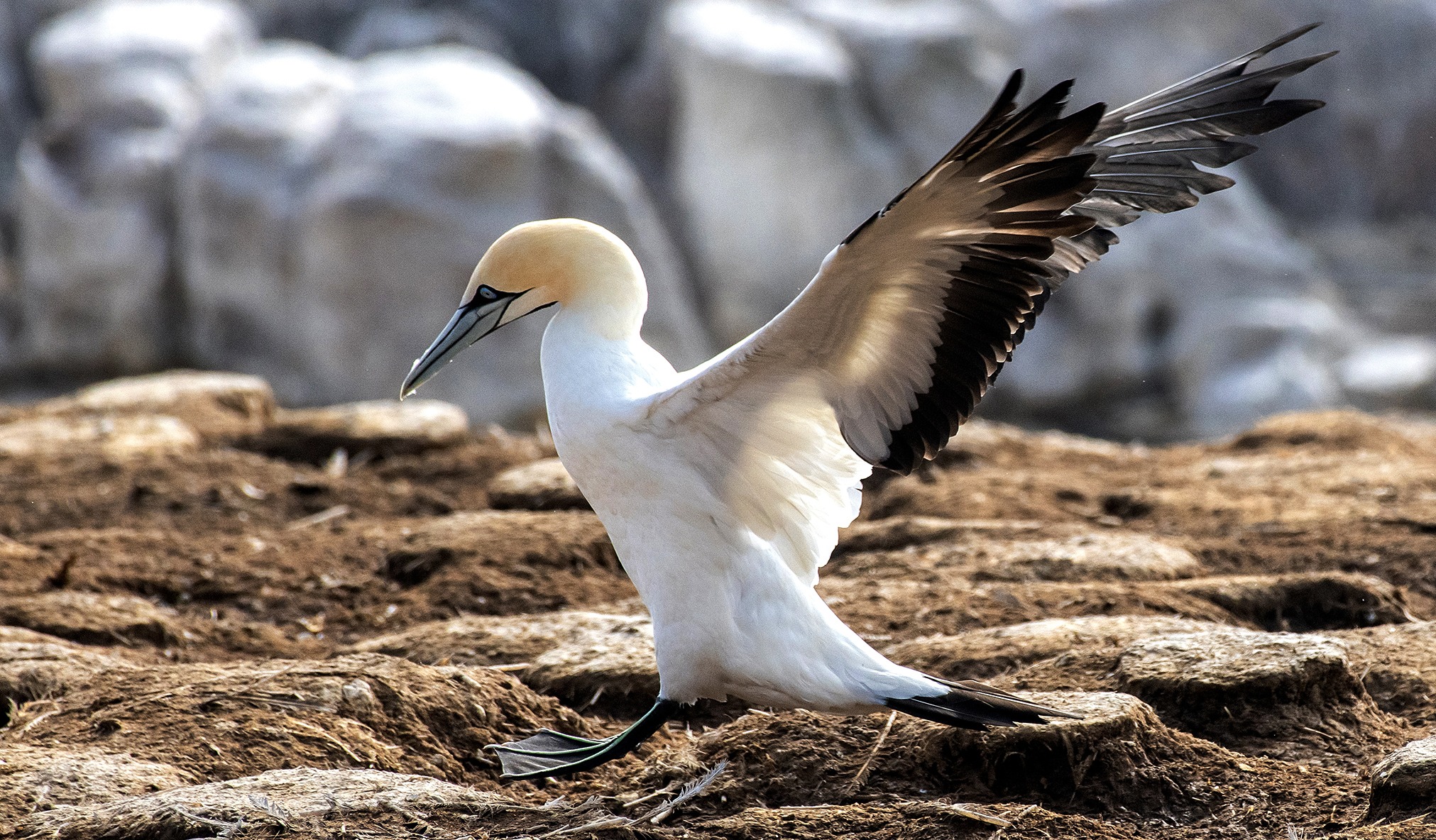
 A Cape Gannet lands at Bird Island in Lambert’s Bay. (Photo: John Yeld)
The first inkling I had that matters might not quite live up to my eager expectation was the surprisingly neutral countenance of the perfectly polite young woman in the ticket booth at the start of the Lambert’s Bay jetty.
I mean, here she was, endorsing my entry to what was one of South Africa’s truly great nature spectacles: the huge Cape Gannet breeding colony on “The Island” just 100m away, but she wasn’t showing any sign that she shared my breathless enthusiasm and excitement.
Hmmm…
The gannet colony is the showpiece element in CapeNature’s three-hectare Bird Island Nature Reserve that also supports small African Penguin, Crowned Cormorant and Swift Tern colonies and, sadly, also attracts unwelcome predation by Cape fur seals. It was indeed once an island but has long since been joined to the mainland by the causeway that is now a jetty, built to support the village’s pelagic fishing industry that was thriving at the time.
I’d been alerted to the vast number of gannets breeding there this year by a CapeNature press release of 26 March that was headed “Over 43,000 Cape Gannets on Lambert’s Bay Bird Island this breeding season”. It was understandably upbeat: “Bird Island is alive with the sounds and spectacle of seabirds… Early indications suggest this could be one of the strongest gannets fledging seasons in several years. To date, 7,647 fledglings have been recorded, with several weeks of the season still to go.”
43,000 gannets! This was something I just had to see, and so my wife Martine Barker and I started arranging a getaway to Lambert’s Bay.
Lulled by the reassuring phrase “several weeks of the season still to go”, there was no particular hurry and so we weren’t desperately concerned when a couple of delays repeatedly kept us from making the 330km journey to the West Coast town.
Finally, on Saturday, 23 May, we found ourselves on the road to Lambert’s Bay, accompanied by an old friend who also loves birds.
/file/attachments/orphans/CapeGannetsflyingoverthegannetcolonyatBirdIslandLambertsBay10_778488.jpg "Cape Gannets fly over the gannet colony at Bird Island, Lambert’s Bay. (Photo: John Yeld)")
I appreciated that eight weeks had passed since CapeNature’s press release – perhaps longer than the phrase “several weeks of the season still to go” might imply. But still… I’d happily settle for even half the promised spectacle, of a few thousand gannet chicks learning to fly and the accompanying thousands of adult birds with their beautiful plumage – snow-white bodies, golden heads and napes – and startling blue eyes.
It was a slow trip up because of dense fog along the way, and finally, after what seemed like an age after our 6am Kommetjie start, we drove into Lambert’s Bay. Potato processing is now the main economic activity of the town, following the demise of the fishing industry, and it smells a lot better than it had during the heyday of pilchards and anchovies when I’d last visited in 2013.
Perhaps that should have been another clue for me, because back then the guano-producing gannet colony on The Island had honked even worse than the town, which was bad enough. But as we parked on the jetty and walked the few paces across to the ticket office at the entrance to the island, I didn’t immediately appreciate the significance of the fresher and much more benign ocean tang in the air.
It was when we reached the office that the true (well, horror is too strong a word) but devastating truth was laid bare.
/file/attachments/orphans/ACapeGannetflyingovertheBirdIslandgannetcolonyatLambertsBay_893750.jpg "A Cape Gannet flies over the Bird Island gannet colony at Lambert’s Bay. (Photo: John Yeld)")
/file/attachments/orphans/CapeGannetflying18_799399.jpg "A Cape Gannet flying. (Photo: John Yeld)")
“There are probably about 20 birds there,” the friendly young ticket collector remarked matter-of-factly as she checked our booking.
Clearly, I’d misheard her.
“Sorry?”
“There are only about 20 gannets on the island now,” she repeated.
What? What? TWENTY?
I hadn’t felt as devastated since half a century previously when another young woman had bluntly rejected my nervous invitation to a dance. “No, I don’t think so,” she’d replied coolly, before putting down the phone without so much as a “But thanks for asking”. I gave my full 2026 stricken attention to the helpful ticket checker.
“Twenty thousand?”
“Twenty.”
“That’s impossible! Your press release said there were 43,000!” I stuttered in disbelief.
I was praying for her to say “just joking”, but she didn’t. Perhaps feeling sorry for me and my all-too-obvious distress, she tried to alleviate the pain: “Maybe there are a few more. About 40?” she suggested. And a colleague walking down the pier towards us offered what she thought was a helpful comment about the missing birds: “Hulle het begin trek,” she said in Afrikaans.
Begin trek? Clearly, the situation was way, way past just begin trek. Much more like klaar getrek!
/file/attachments/orphans/LittleEgretontheBergRiver4_666718.jpg "Little Egret on the Berg River. (Photo: John Yeld)")
/file/attachments/orphans/LittleEgretfishingintheBergRiverestuary3_190758.jpg "Little Egret fishing in the Berg River estuary. (Photo: John Yeld)")
/file/attachments/orphans/GreyHerontakesofffromajettyontheBergRiver3_503467.jpg "Grey Heron takes off from a jetty on the Berg River. (Photo: John Yeld)")
When I finally started breathing again, there was nothing else to do but to walk the 100m or so to the island and, through misty eyes, see for ourselves what the actual situation was.
I’m happy to report that the ticket collector had grossly exaggerated. There must have been… ooh, at least 30 gannets on the island and perhaps another 10 or 20 in the air doing slow circuits around the otherwise deserted colony.
Occasionally while we watched over the next hour or so, one of the circling birds would make a desultory landing, while another might take off – facing away from us, thanks to an unhelpful wind direction. A small group of about six or eight birds was doing whatever it is that Cape Gannets do in a colony, including a bit of mutual and very affectionate grooming, but with a lot of space available in which to do it. The paucity of bird numbers notwithstanding, we loved watching that small handful of gannets and the slightly more numerous terns. Sadly, the penguins were also AWOL. I took a few photographs. It was peaceful and beautiful and lovely.
But a mass spectacle of 43,000 it was not.
However, the weekend wasn’t wasted.
We spent the night at CapeNature’s beautiful and peaceful Rocherpan bird reserve a bit further south down the coast where we did some more bird watching before enjoying the avian-rich Berg River estuary and surrounds for several hours the next day. Among many lovely sights were a Southern Double-collared Sunbird in full breeding plumage and voice, sporting a bright silver ring. We saw two cormorants having a tug of war over a hapless small shyshark in Lambert’s Bay harbour; we watched scores of Black-headed and Grey Herons fishing in the Berg River. We were mesmerised by the pure white beauty of egrets on the river banks and in the shallows. A big squadron of Great White Pelicans circled high overhead at one point, and we were lucky enough to see two large grey mongooses excavating a grassy bank at Rocherpan while being closely tracked by half-a-dozen or more dikkops (thick-knees) looking for discards.
But the best of all was the view from Rocherpan’s lookout point on the crest of the primary dune, into the northern section of St Helena Bay. Here, massive shoals of pelagic fish were being targeted by scores of blowing whales, hundreds of seals and many thousands of cormorants in huge rafts, as well as gulls and – perhaps, it was too far to see identify them – gannets.
/file/attachments/orphans/White-backedMousebirdsatRocherPannaturereserve1_954454.jpg "White-backed Mousebirds at the Rocherpan nature reserve. (Photo: John Yeld)")
/file/attachments/orphans/SwiftTernsroostingatBirdIslandLambertsBay3_669006.jpg "Swift Terns roosting at Bird Island, Lambert’s Bay. (Photo: John Yeld)")
/file/attachments/orphans/SouthernDouble-collaredSunbirdatRocherPannaturereserve4_917269.jpg "A Southern Double-collared Sunbird at the Rocherpan nature reserve. (Photo: John Yeld)")
Satiated birds, mainly Cape Cormorants, were resting in great groups on the beach in both directions as far as the eye could see. There must have been tens of thousands of them visible from our vantage point. Oh yes, at least 43,000, and possibly double that number.
The gannets will be back at Bird Island again during next year’s breeding season, and we’ll try to meet the “missing” 42,950 of them then. But in the meantime, the memory of the much more obliging cormorants has at least made up for the disappointment this time around.
That’s birding for you! DM
/file/attachments/orphans/CapeCormorantsmassingonaWestCoastbeachinStHelenaBay1_962679.jpg "Cape Cormorants massing on a West Coast beach in St Helena Bay. (Photo: John Yeld)")
/file/attachments/orphans/CapeCormorantstussleovershysharkinLambertsBayharbour5_656925.jpg "Cape Cormorants tussle over shyshark in Lambert’s Bay harbour. (Photo: John Yeld)")
/file/attachments/orphans/CapeCormorantsmassingonthenorthernbeachesofStHelenaBay4_854637.jpg "Cape Cormorants massing on the northern beaches of St Helena Bay. (Photo: John Yeld)")


Comments
Scroll down to load comments...