



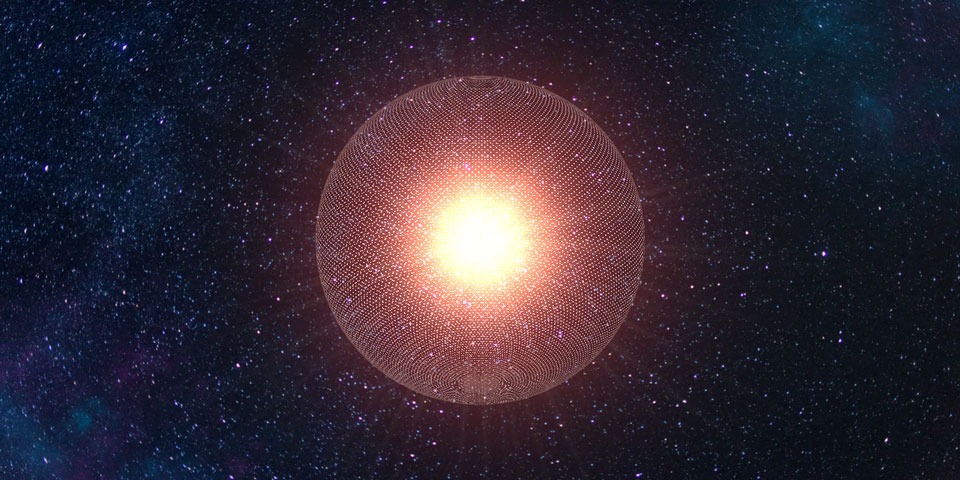
 (Image: Dyson swarm / Віщун via Wikimedia Commons / Creative Commons)
 In 1937, the British philosopher and science fiction writer Olaf Stapledon published Star Maker, one of the most influential science fiction novels of all time. In it, advanced civilisations dismantle their planets and wrap their suns in shells of orbiting, energy-harvesting machinery, drinking starlight directly at the source. Two decades later, the physicist Freeman Dyson, who credited Stapledon, formalised the idea in a paper for Science — any sufficiently advanced civilisation, he reasoned, would eventually need more energy than its planet could supply, and would begin surrounding its star with a swarm of orbiting solar energy “collectors”.
Astronomers, he suggested, should look for the infrared signature of such swarms as evidence of alien intelligence. The Dyson swarm is a shorthand for a mature civilisation that has moved beyond its planetary mother to start sucking at the cosmic energy teat.
It was, for 70 years, a lovely abstraction. It is now, improbably, the unstated (and stated) business plan of a growing slice of the global economy. Which brings us to the suddenly white-hot business of launching things into space, driven largely by the market created by SpaceX, and now being populated by many new aspirants bubbling up in its wake.
Rocket launch was, until SpaceX, a niche industry — strategically vital, economically marginal, dominated by governments (US, USSR/Russia, France and China). That has changed with startling speed, and the reason is a very old economic force — scarcity.
Orbits, it turns out, are property, a kind of real estate. Not legally (the Outer Space Treaty forbids national ownership of outer space), but in practice it amounts to the same thing. The International Telecommunication Union allocates spectrum and orbital slots on a use-it-or-lose-it basis — file for your satellite constellation, then launch a substantial fraction of it by a deadline or forfeit the rights.
China, for instance, must loft roughly 6,500 satellites of its planned 13,000 Guowang constellation by 2032 to protect a filing made in 2020. The result is a global “land” grab conducted at 28,000 kilometres per hour, in which the limiting factor is not money or satellites (both are abundant) but rides — how to get from here to there.
In short, launch capacity has become the tollgate to the most valuable unclaimed real estate in human reach.
It is not a spoiler that this sudden gold-rush fever has taken hold because artificial intelligence has arrived, ravenous. Terrestrial data centres are colliding with the limits of the physical grid. For instance, grid interconnection queues in Northern Virginia and Germany stretch towards a decade. Not to mention citizen backlash, regulation and critical supply chain shortages of downstream items like generators. Space offers what Earth increasingly cannot — unmetered solar energy, no planning permission, no Nimbys or anti-AI activists.
The filings have turned surreal. SpaceX has proposed up to a million (!) orbiting data-centre satellites. Another company called Starcloud — which last year trained a large language model in orbit (a sentence that would have been gibberish in 2020) — has filed for 88,000 computing satellites. A five-month-old startup called Orbital wants 100,000, delivering 10 gigawatts of computing. Google has demonstrated radiation-hardened chips, addressing one of the core engineering problems of space-based compute. China has gestured at a 200,000-satellite compute constellation.
The sceptics note, correctly, that the economics do not yet make sense — orbital compute remains perhaps three times the cost of terrestrial compute, and even its boosters concede everything hinges on launch prices collapsing from today’s several thousand dollars per kilogram towards somewhere around $100.
Everyone, from Musk on, is working towards that goal, developing fancy new tech to vastly reduce the weight of the payloads, new rocket manufacturing technologies (like 3D printing), reusable multistage rockets, cheaper propellants, all driven by the fuel of innovation and increased competition. The rocket, not the chip or the software, is the bottleneck. So it is no wonder the launch business is white-hot.
A crowded field
SpaceX still sits atop the entire industry — its June IPO, the largest in history, merely converted dominance into a ticker symbol — but the interesting story is everyone else, because for the first time “everyone else” is a real category. It is the first time that SpaceX will face any real competition (about 60 funded companies to date, worldwide).
Who are they?
Rocket Lab, the US-New Zealand outfit run by the knighted Peter Beck, is the clear second. Its small Electron rocket has successfully launched to orbit more than 80 times, and its medium-lift reusable Neutron — aimed squarely at the Falcon 9’s market — is scheduled to debut late this year, with a $2.2-billion order backlog behind it.
In June, the company made its intentions clear, agreeing to buy the satellite-phone stalwart Iridium for $8-billion — acquiring, in one stroke, spectrum, a 66-satellite network and recurring revenue. The company called it a shortcut. It is also a confession — launch alone is a commodity; launch plus constellation plus services is a cash cow (Amazon evidently agrees, having paid $11-billion for Iridium’s old rival Globalstar months earlier).
Behind Rocket Lab stands a queue. Blue Origin, Jeff Bezos’s quarter-century labour of patience, has its heavy New Glenn flying (although it recently exploded during a ground test, so they are redesigning).
Firefly Aerospace, now public, is the second private company ever to have landed on the Moon. United Launch Alliance is targeting up to 25 Vulcan flights this year. Stoke Space and Relativity Space, with fully reusable and 3D-printed rockets, respectively, wait in the wings. A decade ago, the phrase “launch startup” was nonsensical. Today it is becoming a capital sector.
And there’s China. Beijing has elevated commercial space to a “pillar industry”. Electric vehicles received the same designation, and now China is the world leader; when the Communist Party chooses a strategic pillar, beware — state capital is endless, and pressure never lets up.
The country flew a record 92 orbital launches in 2025 and is targeting roughly 140 in 2026 — a pace of one launch every two and a half days, sustained across two dozen rocket families, mostly shrouded in secrecy. Anyone who ignores them is not paying attention.
A doomsayer’s nightmare
All of which brings us to this concerning spectre. In 1978, the Nasa scientist Donald Kessler described a nightmare of orbital mathematics: above a certain density of objects, collisions generate debris faster than the atmosphere can clean it, each impact seeding hundreds of thousands of what are essentially speeding bullets that cascade to further collisions, potentially rendering entire orbital bands unusable for generations.
The Kessler syndrome was, like the Dyson swarm, a theoretical construct. It is rather less theoretical now that Starlink already numbers more than 10,000 satellites, China’s constellations would roughly triple the non-Starlink population, and multiple other entities have filed paperwork for hundreds of thousands of orbiting data centres sporting large, radiator-winged machines that are particularly exposed to debris.
This is a doomsayer’s nightmare — building and launching a junkyard’s worth of disposable supercomputers into a shooting gallery with debris-mitigation rules that remain largely voluntary and jurisdictionally incoherent. Nobody serious dismisses the risk, but it does not seem to be slowing anyone down.
And yet. Step back far enough, and the shape of the thing becomes visible. Solar collectors by the hundred thousand, wrapped around Earth, harvesting raw sunlight to power machine intelligence — it is the start of our own Dyson swarm, assembled not by the wise, unified civilisation depicted in a 1937 science fiction novel but by quarterly earnings calls, ITU deadlines and the naked terror of being second. Stapledon imagined star-girdling intelligence as the project of species-wide maturity. We are attempting it as a land grab, financed by bridge loans and the eager investors in public stock markets.
That may be the most human detail in the whole story. Science fiction always assumed we would reach for the stars once we grew up. Instead, the marriage of science and science fiction is being consummated for the oldest reasons on the books — scarcity, rivalry and rent. Dyson, one suspects, would have laughed. And Kessler, I fear, may yet have the last word. DM
Steven Boykey Sidley is a professor of practice at JBS, University of Johannesburg, a partner at Bridge Capital and a columnist-at-large at Daily Maverick. His new book, It’s Mine: How the Crypto Industry is Redefining Ownership, is published by Maverick451 in South Africa and Legend Times Group in the UK/EU, available now.