



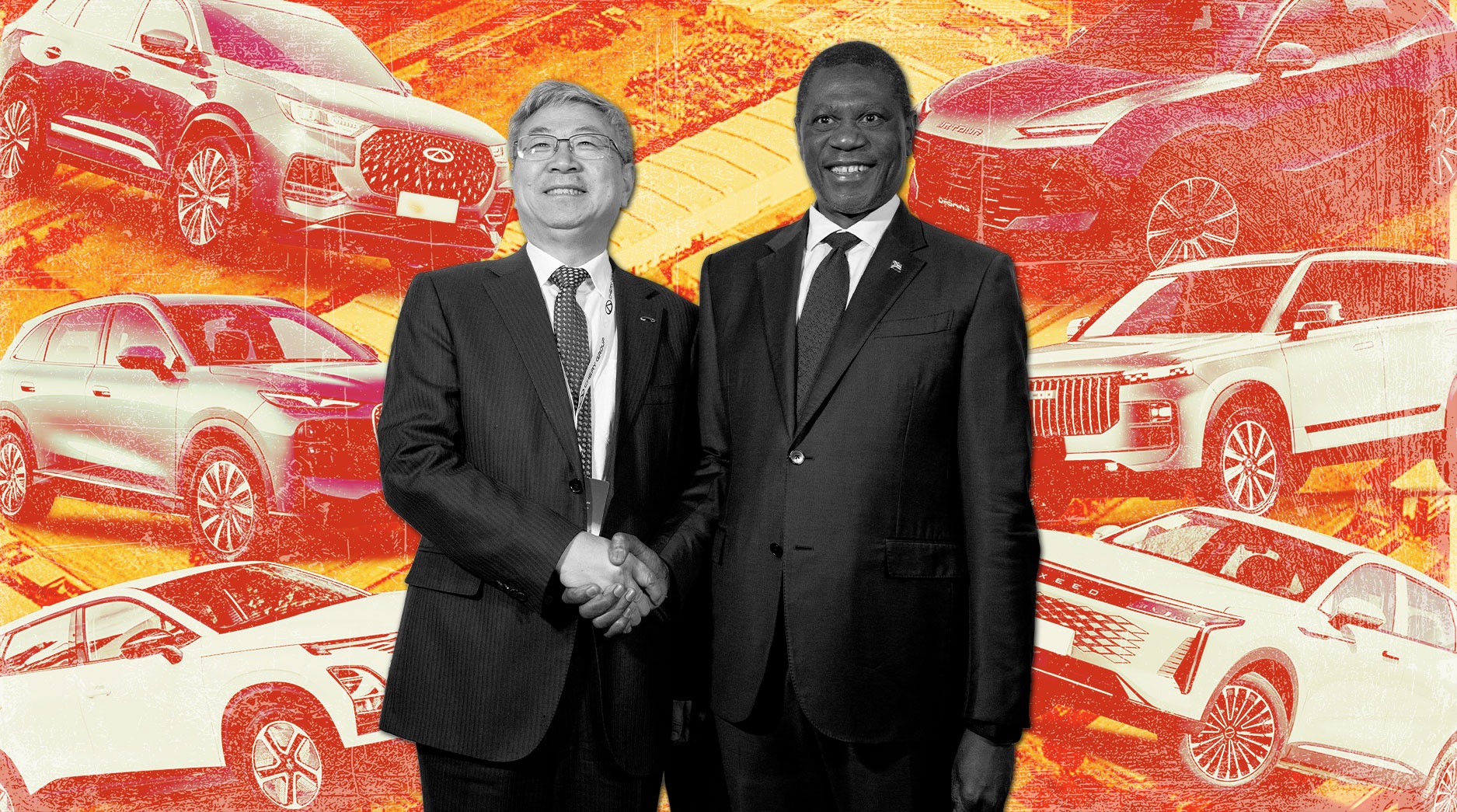
 Illustrative image: Nissan’s Rosslyn Plant outside Pretoria (Photo: Nissan Global) | Chery Tiggo (Source: chery.co.za) | Lepas L8 (Source: lepasinternational.com) | Omoda C5 (Source: omoda.co.za) | Jetour Dashing (Source: jetour.co.za) | Jaecoo J7 (Source: jaecoo.co.za) | Exeed RX (Source: exeedinternational.com) | Chery Automobile Chairman Yin Tongyue shakes hands with South African Deputy President Paul Mashatile. (Photo: Reuters / Ihsaan haffejee)
“Nissan already did a tremendous job demolishing and tearing down the equipment and machineries,” Chery Automobile executive vice president Zhang Guibing told a group of South African media in a press conference at the official celebration of the Rosslyn plant’s new ownership on Friday, 3 July.
Zhang was leading a delegation of Chery executives which the local staff affectionately called “the big dogs” in hosting Deputy President Paul Mashatile, the Director-General of Trade, Industry and Competition Simphiwe Hamilton and Gauteng Premier Panyaza Lesufi.
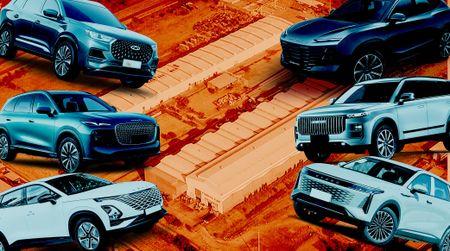
The press conference and the official proceedings all took place inside the eerily vacant old Nissan production plant in Rosslyn, Pretoria. You know, the site of the R3-billion investment the embattled Japanese carmaker made in 2019 to give the Navara production a new home.
At the time, then Nissan SA managing director Mike Whitfield said his unit had to beat other global Nissan production operations to win the right to produce the Navara – a victory for his unit and also South African President Cyril Ramaphosa (who was in attendance at that announcement) ahead of elections in May 2019.
A branch in the timeline
Automotive assembly or production lines can take anywhere between two and 12 months to decommission and dismantle, so the Nissan plant job was either completed in record time, or the deal was in the works long before the official announcement in January 2026.
While the above paragraph reads as a theoretical version of events, it gained credence when Deputy President Paul Mashatile took a significant stretch of time in his speech to take credit for getting the ball rolling during his working visit to China in November 2023.
“I express appreciation to the Department of Trade and Industry for expediting the facilitation of this process, which has reached fruition less than three years after our November 2023 working visit to China. To provide context, during that visit we engaged with the leadership of Chery International, focusing on promoting South Africa as a prime investment hub and enhancing local automotive manufacturing and supply chains.”
At least the view of the Presidency is for greater involvement from the international automotive manufacturers, beyond just assembly of cars in various forms of knock-down.
“Assembly by itself may provide only shallow employment, but prospects are better with localisation because it creates significant job multipliers, broadens industrial ripple effects and promotes skill development across generations,” said Mashatile.
/file/attachments/2994/IMG_20260703_161543_789885.jpg "Deputy President Paul Mashatile had an interesting timeline to share during his address at the Chery Rosslyn launch. (Photo: Lindsey Schutters)")
That echoed the Competition Commission’s statement rubberstamping the deal in June 2026, where it recommended that, to ensure the deal benefited the local economy, the merging parties had tendered binding public interest conditions.
These conditions legally enforce the commitments surrounding employment preservation (protecting the transitioning Nissan workforce) and local supply chain development (incorporating local suppliers into Chery’s value chain).
Chery will absorb all 692 workers who were still employed at the Rosslyn plant.
Two-year ordeal
“For many of us, Rosslyn is far more than just a manufacturing facility,” said one former Nissan employee in a heartwarming montage video shown during the celebration.
“It is where careers have been built, skills have been developed, friendships have been forged, and generations of employees have contributed to the success of the South African industry.”
Those words really hit hard, considering the ordeal the factory had been through over the past two years. When this writer interviewed the former MD of Nissan SA, Maciej Klenkiewicz, in October 2024 (one year into his tenure), there was no hint of how things would turn out.
At the time, the Rosslyn plant was reeling from shutting its NP200 production after a 16-year run, and he had to navigate the downsizing waters.
“We were going from a difficult time from the perspective of human resources, as we were running our Section 189 in the factory, but in the whole organisation as well. So, this was, of course, influencing a time which I spent here. On the other hand, having … very bold plans in terms of the growth for our best-selling Navara, as well for the other models, we are successfully delivering [those] plans.”
Klenkiewicz vacated that position at the end of 2025, around the time of SA Auto Week, where Chery South Africa CEO Tony Liu first revealed that the Chinese carmaker was keen on setting up local production and seeking to take over an existing factory.
Local component operations
The other thing that the international executives revealed – which the Naamsa sales numbers refuse to accept – is that Chery does not see the multiple brands in its stable as different at all. The nameplate on the factory reads “Chery” and the first cars slated for production in 2027 are the Jetour T2 and Jaecoo J5, with the Chery Tiggo Cross potentially joining, depending on the outcome of further market analysis.
They are also targeting a 40% local content rate for vehicles manufactured at the Rosslyn plant, which could swell direct and indirect jobs associated with its operations to an ambitious 3,000.
Chery also plans to invite its primary Chinese component suppliers – particularly those specialising in electric vehicle components and smart/intelligent technologies – to establish operations in South Africa. These suppliers are being encouraged to enter joint ventures with established local suppliers or set up direct subsidiaries.
/file/attachments/2994/IMG_20260703_105123_901804.jpg "Chery made all the right commitment noises and gestures at the official celebration of its Rosslyn acquisition. (Photo: Lindsey Schutters)")
That targeted 40% local content rate also aligns with a highly strategic trade policy: as of 1 May 2026, China implemented a zero-tariff policy for South African auto parts and vehicles exported to China, provided they hit the 40% local content threshold. This will create a lucrative, tariff-free export corridor back to the Chinese market.
The biggest of the “big dogs”, Chery Automobile chairman and president Yin Tongyue, had the best description of the vision and mission of the global expansion in his address:
“We live by one philosophy: somewhere for somewhere to be somewhere. It means wherever we invest, we are committed, we become part of the local economy, part of the community, part of the country’s future. Our job is not just to grant it, but to plan it, to strengthen it, and to ensure it delivers value for the people of South Africa.”
If you stare at the details and sequence of the deal to secure the fate of the Rosslyn plant for too long, it reveals a web of inconsistencies and understatements.
But from the perspective of the workers and greater community in the far west of SA’s capital city, this is the best outcome. Especially when Silverton and Mamelodi (on the other side of Pretoria) is the area Ramaphosa selected for the automotive Special Economic Zone after he won the 2019 elections. DM
Comments
Scroll down to load comments...