



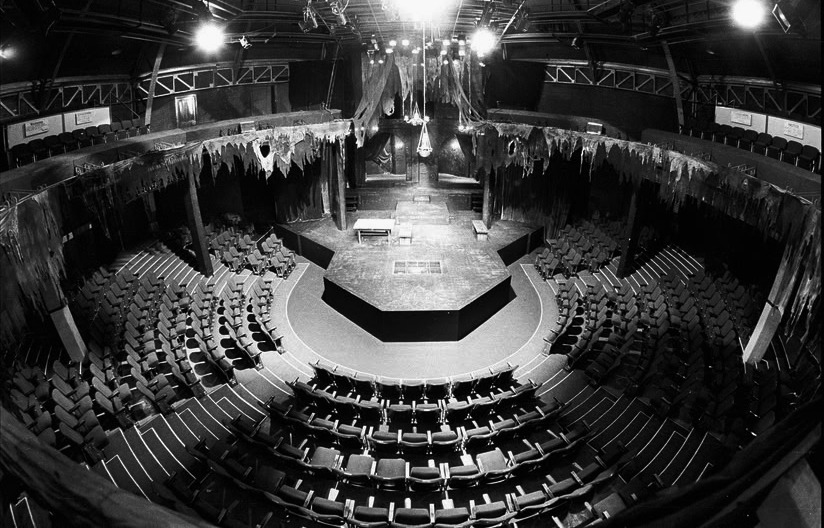
 The 50th anniversary performance titled, Let's Meet At The Market, told the story of the Market Theatre through choreography and dialogue at The Market Theatre over the 20-21 June 2026 weekend. (Photo: Supplied / Market Theatre
 The South African cultural landscape and its challenges under apartheid in which the Market Theatre would come into existence were very different from the challenges in today’s cultural life. Helping set the scene for how it was, then, Basil Arendse, a black South African theatre activist now retired and living in the US, recalled for me:
“I did not participate in any of the Civic Theatre [now the Joburg Theatre] events except for one lapse when I saw ‘Equus’. For the most part, we boycotted events at the Civic Theatre on those occasions when we were allowed to attend performances sponsored by nonprofit groups such as the Association for the Coloured and Indian Blind. For the most part, our attendance and participation in performing arts events was restricted to the Wits Great Hall and the Coronationville Hall [in a Coloured neighbourhood], which was a poor excuse for a theatre venue.”
In the late 1960s and early 1970s, the South African cultural efflorescence of the 1970s and 1980s by musicians, dramatists, artists and choreographers who became increasingly powerful voices resisting apartheid was only beginning to gain momentum. Meanwhile, most white South Africans remained oblivious to black cultural activities.
A sternly segregated Johannesburg had an active mainstream theatre world, but it barely acknowledged its location on the African continent, save for a work like Todd Matshikiza’s King Kong. Johannesburg’s Civic Theatre offered operas, ballets and musicals, and there were also the segregated commercial theatres such as His Majesty’s, The Empire and The Colosseum, as well as smaller theatres and nightclubs offering cabaret and stand-up comedy in Hillbrow and the nearby suburbs. The Johannesburg City Hall was the venue for the SABC orchestra.
Non-segregated performances were largely limited to occasional performances at the University of the Witwatersrand’s Great Hall, the South African Institute of Race Relations hall in Braamfontein (for Athol Fugard’s early plays) or at two legendary cultural and teaching sites downtown – Dorkay House and the Bantu Men’s Social Centre.
/file/dailymaverick/wp-content/uploads/2025/03/000073056.jpg "South African playwright Athol Fugard, a week before the opening of Master Harold and the Boys on 22 August 1983 at the Market Theatre. (Photo: City Press)")
While most white theatregoers were unaware of works by black theatre entrepreneurs such as Gibson Kente and Sam Mhangwani, their dramas played to black audiences in townships throughout the country. There were also more politically pointed works by Molefe Pheto and others, but their work largely operated below the radar.
However, the 1976 student uprising set the stage for dramatic changes in South Africa. And amid that upheaval the dreams of the Market Theatre’s cofounders – Barney Simon and Mannie Manim – became realised on 19 June 1976, with the new theatre’s opening performances of Anton Chekhov’s The Seagull, soon followed by Arthur Miller’s The Crucible. (These initial productions were actually staged by Simon’s independent theatre collective, The Company, in the new space.) A new cultural and political force came into being in Newtown, Johannesburg, but it had taken several years of preparation – and some luck – to achieve.
Cast and crew of the early productions recall the sounds of police helicopters heading towards Soweto competing with the actors’ words in those productions. In that second work, there also were fears whether community activist and cast member, Bernadette Mosala (as Tituba, the servant accused of witchcraft in The Crucible), would arrive each night, or if she had been arrested instead.
/file/attachments/orphans/MarketTheatre-HeritagePortal-2014-2_711174.jpg "The Market Theatre.
<br>(Photo: Wikipedia)")
(Photo: Wikipedia)
The origins
Sixty years previously, Newtown was a light industrial zone. After the South African War, Johannesburg officials evicted a nearby community of African residents in an effort to make the downtown “white”. But Newtown’s poor drainage made it unsuitable for intensive commercial or expensive, white residential purposes. Instead, in 1913, the City erected a wholesale agricultural produce market and abattoir facilities and Johannesburg’s early electricity generating plant.
Then, 60 years later, the City decided the complex had outlived its utility and moved the market to a larger facility elsewhere. The Johannesburg City Council – pushed by Progressive Party councillors such as Dr Selma Browde, supported by city engineer Maurice Norton – called for interested parties to bid on redeveloping the building for “artistic and cultural activities”.
/file/attachments/orphans/images_624734.jpg "Built in 1913 and founded in 1976 within Johannesburg’s old Indian Fruit Market, the Market Theatre became known as South Africa’s “Theatre of the Struggle,” giving a voice to the voiceless through art during apartheid. (Photo: Market Theatre)")
Despite other bids, to their surprise, Manim and Simon, respectively a young theatre technician and a playwright/director, won the rights to the building. In their proposal, they said:
“We see the Market not only as a venue where we can mount plays; but as a Community Arts Centre – where the public will be able to find the best available live entertainment at a price everyone can afford… [Listing all other venues in Johannesburg] what is patently lacking from this list is a venue with a resident group, committed to creating a truly South African theatre in its broadest sense.”
/file/attachments/orphans/MannieManimBarneySimonin1976-TheatreimagebyGiseleWulfsohn1_784868.jpg "Mannie Manim (left) and Barney Simon (right) founded the Market Theatre in Newtown in 1976. (Photo: Gisèle Wulfsohn)")
In August 1976, just weeks after the Market Theatre had opened, speaking at a national theatre managers conference, Manim spoke about the challenges and opportunities faced by live theatre, now that television had come on the scene – and amid the nation’s upheavals.
He said:
“In these times there are those prophets of doom who are saying that theatre is dead and that the private sector is about to disappear, making way for a subsidised theatre only or (even worse) bowling alleys or, probably (and worse still) demolition. Our media daily carry tales of woe by entrepreneurs who say they have lost money for all the usual reasons – from inflation to the border situation, not forgetting rugby and the weather, and always including that biggest target of them all recently – television….
“… Looking at what is happening in theatre in the Black townships, at recent trends in Afrikaans theatre and at the plays of Athol Fugard and Pieter-Dirk Uys, it is apparent that the South African theatre-going public likes to see plays about its own place and time, plays with which it can identify, plays which give it a new look at its everyday life, plays which look at the world from the South African point of view and not only British or American drawing room comedies, thrillers or farces.”
The founders’ inspirations and ideas
These two founders – Simon and Manim – had come from very different circumstances, but were drawn together out of a desire to create something important for South Africa’s cultural life.
Manim, growing up with a mixed Afrikaner-Portuguese heritage in a white, working-class neighbourhood, had learnt the technical side of live theatre through increasingly important jobs for commercial theatre operators in Johannesburg, at the Civic Theatre, and, finally, with the Transvaal government’s Performing Arts Council (Pact). There, he was a manager in its drama wing at the Alexander Theatre.
One of his projects had been to bring live drama to segregated black townships, such as Lenasia (the distant area designated under apartheid for Indian South Africans). Recalling how it all began for him, Manim described the moment he was confronted by community organisers at a meeting in Lenasia who had gathered to hear his upcoming theatre plans. Instead, they turned the tables on him to ask why he was not working to make Pact dramas open to all audiences in its professional facilities, rather than sending out second-tier work to makeshift venues.
/file/dailymaverick/wp-content/uploads/MAINCongo.jpg "The Trial of King Leopold II during its run at the Market Theatre. (Photo: Lungelo Mbulwana)")
In a memoir for the Market Theatre’s 40th anniversary volume, Manim explained:
“These guys tore into me…[saying that] under these circumstances they didn’t want to have any part of this anymore. After an hour of unsatisfactory discussion, he ‘spilt his guts’. ‘I told them the things I had been doing over the years, what my plan was how I was hoping to be able to take all the plays into the townships and really enable everybody to see everything.’”
After his cri de coeur, Manim was dispatched to the veranda to await the verdict. And he said that was when his mind was made up. He would leave Pact and start a new theatre – one that would be open to everybody.
“This was probably in 1971/2,” Manim said. “But what continued to happen for the next 20 years was that I got total support,” beginning with the group in that room, who embraced his statement with absolute enthusiasm. “I told Barney, and we got some of the actors that we thought might like this idea, and we had a meeting at Barney’s house. We all didn’t know what the blazes we were going to do – but we were going to go off and be independent.”
Soon after that, Johannesburg City engineer Maurice Norton phoned Manim to tell him the Johannesburg market was moving to bigger premises, and he thought the old building would make a fine theatre.
/file/attachments/orphans/0000194143_416940.jpg "The Market Theatre in 2013 (Photo: Gallo Images / Foto24 / Lucky Maibi)")
The wellsprings of Simon’s theatrical life and thinking were quite different. Early on, he had been fascinated by film, and he had also attended the Yiddish-language theatre still alive in Johannesburg, as well as other literary aspects of a largely secular but socialist-inflected Yiddishkyit cultural world.
Meanwhile, Simon began to build a career on the fringes of Johannesburg’s theatre world, but with productions in makeshift venues, with his drama collective, The Company. This cooperative gathered together young, idealistic actors prepared to work nearly for free (They were, however, fed a diet of hearty soups made in Simon’s kitchen).
/file/dailymaverick/wp-content/uploads/2024/11/Zizana-%E2%80%98Zizi-Peteni-and-Pulane-Rampoana.jpg "Zizana ‘Zizi’ Peteni and Pulane Rampoana in Lala Ngenxeba/Of Love and Revolution at the Market Theatre. (Photo: Market Theatre)")
Earlier, in the 1960s, Simon had worked with left-wing director Joan Littlewood in Britain, and had spent a year in New York City (returning to Johannesburg in 1970 to work in advertising). In the US, he became enthralled by local theatre in New York’s Latino and African American communities, while his day job was assistant editor of a literary journal.
Then, back in Johannesburg, Simon began experimenting with the ideas of politically engaged dramatists like Bertolt Brecht, Dario Fo and Jerzy Grotowski. One project was Edward Albee’s The Death of Bessie Smith, another was the musical Phiri, based on Ben Jonson’s Volpone. Both were staged at Dorkay House, the integrated cultural oasis located in a former clothing factory.
Describing Simon’s method, actor Robert Colman explained:
“If an actor had related this story [of a train journey] to Barney Simon he would have asked for detail: the colour of the train seats, walls, floor? Time of day? Did the mother look tired, sad, happy? What was she wearing? Expensive, second-hand, new; modern or traditional? Only one child? Did she enjoy having her hair plaited? How could you tell? How did you feel watching it?
“With these questions he would have begun, and have got the actor to begin, thinking about politics/class (second-hand, new, expensive clothes: class); textures (colours); emotions and character biography (the daughter’s response, my response, tired, sad, happy), etc. He would have begun looking for the potential complexity and layers of story in an ordinary event.”
/file/attachments/orphans/MarketTheatre50th84_870661.jpg "The 50th anniversary performance, titled Let's Meet At The Market, told the story of the Market Theatre through choreography and dialogue at The Market Theatre over the 20-21 June 2026 weekend. (Photo: Supplied / Market Theatre)")
Coincidentally, Manim and Simon had both arrived at personal and career crossroads. Manim no longer believed his work with Pact and those segregated performances in townships were morally right. Simon, meanwhile, was desperate to find a permanent base for the theatre he wanted to create by and for South Africans.
Coming together, they drafted their proposal to take over the old fruit and vegetable market, estimating R60,000 (in 1975 rands) would see them to the point where the project could begin – an amount off by at least an order of magnitude. They were advised to go forward anyway since a partially completed project would attract funders more than an architect’s rendering.
Right from the beginning, fundraising for operating expenses and productions was a perpetual preoccupation for management and the trustees. Bit by bit, funding sources eventually included domestic and foreign corporations, individual donors, foreign and domestic philanthropic foundations and NGOs, and foreign embassies.
But, until after the end of apartheid, no element of the South African government contributed towards sustaining the theatre, save for a concession by the City to charge a minimal “peppercorn” rent. Finally, in the early 2000s, at the nadir of the theatre’s financial fortunes, the national government finally agreed to make a multimillion-rand contribution and, in return, the theatre became a national cultural institution, with an annual government appropriation and a council appointed by the arts and culture minister.
/file/dailymaverick/wp-content/uploads/2023/06/000060258.jpg "A billboard displaying the Sarafina musical during its run at the Market Theatre in Newtown. (Photo: Gallo Images)")
Thinking back to the early days, Simon had described the run-up to the Market’s earliest days: “Actors were working for as little as forty rand a week and Trustees had also helped. Multiracial audiences were still illegal and the intention was to let anybody in who bought a ticket. The police investigated. And we found that because the Market is in an industrial area, we are actually zoned for multiracial use. We are legal! There’s no logic to it. You just push your luck. You develop a kind of cockroach instinct for survival.”
Newtown and the Market Theatre become the place to be
Newtown soon was more than just the Market Theatre. Within two years other cultural groups began arriving. The first was the school and gallery of the Federated Union of Black Artists. Its Black Consciousness-supporting founders had come together in the wake of the “Black Friday” events of 16 October 1977 when many black activists and organisations were arrested or banned.
Eventually, the Market Theatre and its immediate environs hosted other activities such as its Photo Workshop, the Lab (teaching arms) and its gallery, as well as restaurants like Harridans and Gramadoelas. There was the Kippies jazz club and the legendary pub, the Yard of Ale. The Market’s Saturday Flea Market attracted crowds, making a real contribution to the theatre’s finances.
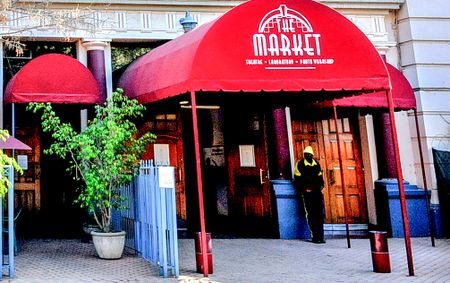
At the apogee of the Market Theatre’s prominence during apartheid, works developed under the guidance of artistic director Simon such as Woza Albert became a model of a new South African style of dramatic structure. Weaving together physical theatre, song, music, dance and dialogue, they were the outcome of intensively workshopped efforts, rather than straight from fully written scripts.
There was a practical point that many actors or playwrights coming to the Market were not fully comfortable operating within the more Western, written-out script tradition. But with a full script at the ready, government censorship authorities could parse it to be censored in whole or in part, making it nonviable. But a workshopped effort without a script could not be assailed that way since there was little to censor until the work was in performance. Ironically, the Market Theatre was in line of sight from John Vorster Square, the feared police headquarters.
Fortuitously, as Market Theatre administrators and trustees discovered, the original market was zoned as commercial space, outside applicable national laws such as the Group Areas, Separate Amenities and Population Registration Acts that categorised people and residential property, delineating residential or public accommodations and transportation by race.
By virtue of that zoning, the theatre was not legally restricted over who might be on its stages or in its stalls. From this extraordinary beginning, the remarkable trajectory of the Market Theatre was under way, continuing into its second half-century.
Meanwhile, the tale of the theatre’s bar – and what theatre is complete without a lively bar? – is a fascinating tale as well. But that’s for another day. DM