



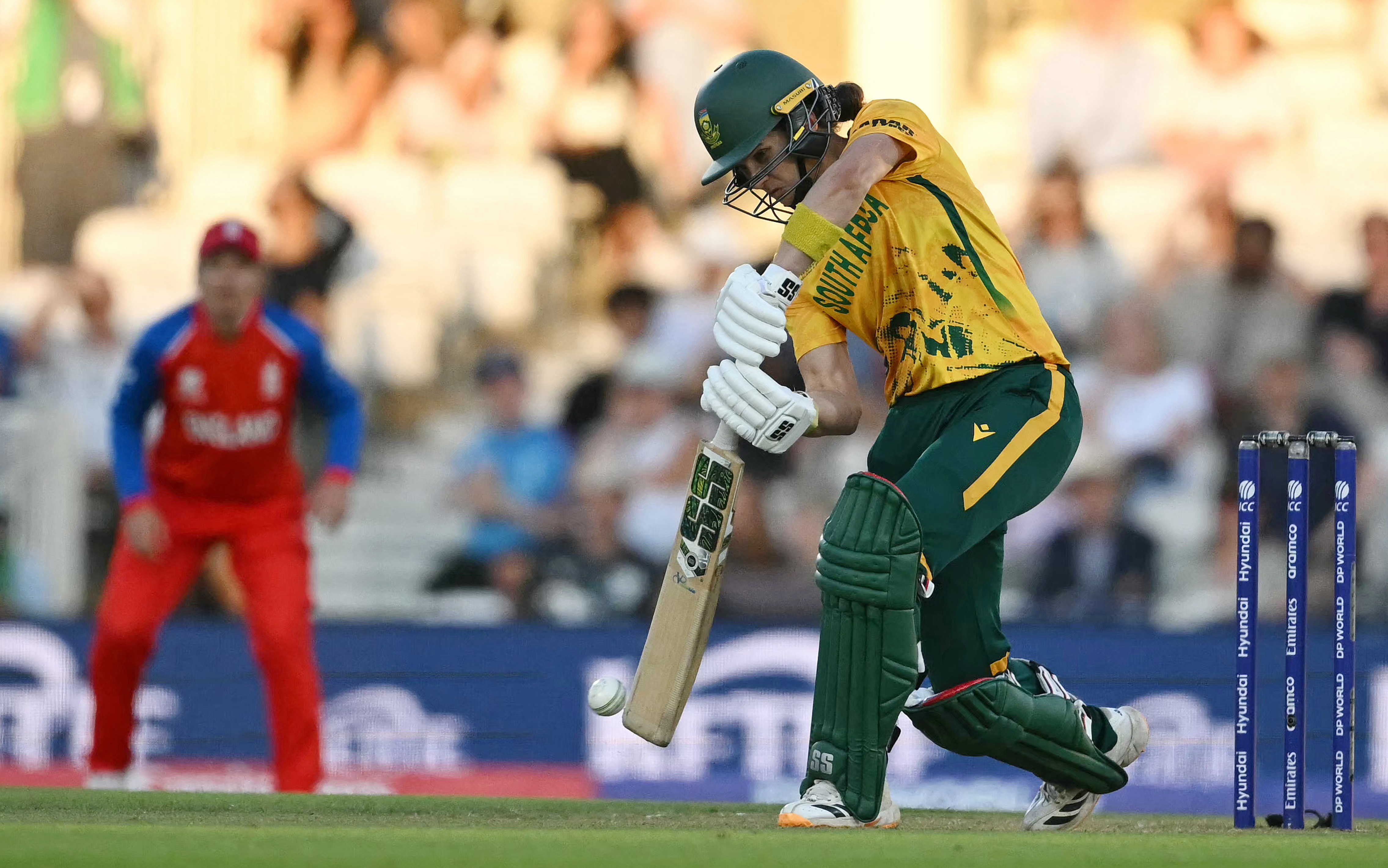
 South African captain Laura Wolvaardt and her team will be disappointed after being knocked out in the semifinal of the 2026 T20 World Cup against England on 2 July 2026. England beat South Africa by 40 runs to book their place in the final. (Photo: Justin Tallis / AFP)
Following an underwhelming T20 World Cup campaign, South Africa’s tournament came to an end with a 40-run semifinal defeat to England at The Oval on 2 July in front of a packed home crowd.
It is the first time in three years that South Africa have failed to progress to the final of a cricket World Cup – they made the T20 World Cup final in 2023 and 2024 and the One Day International final in 2025.
Despite a blistering start from the opening bowlers Marizanne Kapp and Shabnim Ismail, the rest of the bowling unit struggled to make further inroads and England, who were 23 for three in the fourth over, capitalised.
By the time South Africa claimed another wicket in the penultimate over of England’s innings, the damage had been done.
/file/attachments/orphans/2284362862_523127.jpg "Marizanne Kapp of South Africa celebrates the crucial wicket of the tournament’s leading run-scorer, England’s Danni Wyatt-Hodge, during the T20 World Cup semifinal at The Oval on 2 July 2026. (Photo: Sameera Peiris / Getty Images)")
Their total of 169 proved a daunting target and would have been a historic run-chase. However, the South African batting line-up has struggled for consistency throughout the tournament, as well as their partnerships, which never materialised in this game.
“I’m very disappointed,” said captain Laura Wolvaardt. “It was just not meant to be for us today. We were outplayed today by a really good England side.
“I think the main difference between our innings and theirs is they had so many more partnerships. We started really well with the ball, and then they had that really big partnership, and we just didn’t have any partnerships to speak of and didn’t really have any batters that got going.”
Tazmin Brits anchored the innings, reaching her half-century with a 44-ball 51, but was dismissed the very next delivery. Brits has arguably had the most fruitful tournament of the batters. After coming off the bench to play against India, she scored 40, followed by an unbeaten 114 against the Netherlands and 20 against Bangladesh.
/file/attachments/orphans/2284373615_535096.jpg "South Africa’s Tazmin Brits scored her second half-century against England in the T20 World Cup semifinal. However, this was not enough to power her side to the final. (Photo: Dan Istitene / Getty Images)")
However, she received little support from the batters around her. Captain Laura Wolvaardt was dismissed for 17, Dercksen managed just three and Kapp was out for five.
After three matches on the sidelines, Suné Luus was given a chance, but failed to capitalise, falling for 11.
The required run rate continued to climb beyond reach as England excelled with both bat and ball, while also producing a sharp fielding display. South Africa managed just 14 boundaries compared with England’s 21.
The defeat brings an end to a disappointing campaign for the Proteas, who never quite found the consistency required to challenge for a place in another World Cup final.
Powerplay attack
For the first time in the tournament, South Africa won the toss and elected to bowl, hoping to replicate the formula that had worked against Pakistan, India and Bangladesh by restricting England to a chaseable total.
Kapp and Ismail once again produced a statement Powerplay performance against the tournament’s only unbeaten side, taking three wickets in the first four overs. Kapp was again economical and relentlessly accurate, claiming the key wicket of leading tournament run-scorer Danni Wyatt-Hodge for 12.
Ismail struck earlier to remove Amy Jones, although the breakthrough was followed by an expensive over as Wyatt-Hodge briefly counterattacked. Ismail quickly responded by claiming the wicket of Alice Capsey to maintain South Africa’s momentum.
However, experienced campaigners Nat Sciver-Brunt and Heather Knight bailed England out by rebuilding the innings.
The pair shared a record fourth-wicket partnership of 133 runs, disrupting South Africa’s attack and undoing much of the pressure created during the Powerplay.
/file/attachments/orphans/2284369619_919983.jpg "Nat Sciver-Brunt of England celebrates a half-century during the T20 World Cup semifinal against South Africa at The Oval. (Photo: Dan Istitene / Getty Images)")
An expensive 11th over from Chloe Tryon proved pivotal as England began to accelerate. Ayabonga Khaka also endured a costly outing, conceding 40 runs, while Nadine de Klerk, who often provides crucial breakthroughs, was unable to make an impact.
Once settled, Sciver-Brunt and Knight shifted through the gears and South Africa struggled to find a way back into the contest. No bowler was able to break the partnership until Nonkululeko Mlaba finally dismissed Sciver-Brunt and Knight at the beginning of the 19th over.
By then, however, England had already built a platform that South Africa proved unable to overcome.
/file/attachments/orphans/2284362815_333986.jpg "South African quick Shabnim Ismail had a belligerent comeback, claiming eight wickets overall in the 2026 T20 World Cup. (Photo: Philip Brown / Getty Images)")
“Upon reflection, our batting never really fired throughout the competition. We had some glimpses here and there, some special innings throughout the tournament, but I think as a whole we just weren’t quite taking,” said Wolvaardt.
“But I think our bowling and our fielding were pretty good throughout. So, I think we’ll have a look at what we’ve done wrong and hopefully be better next time.” DM
Comments
Scroll down to load comments...