




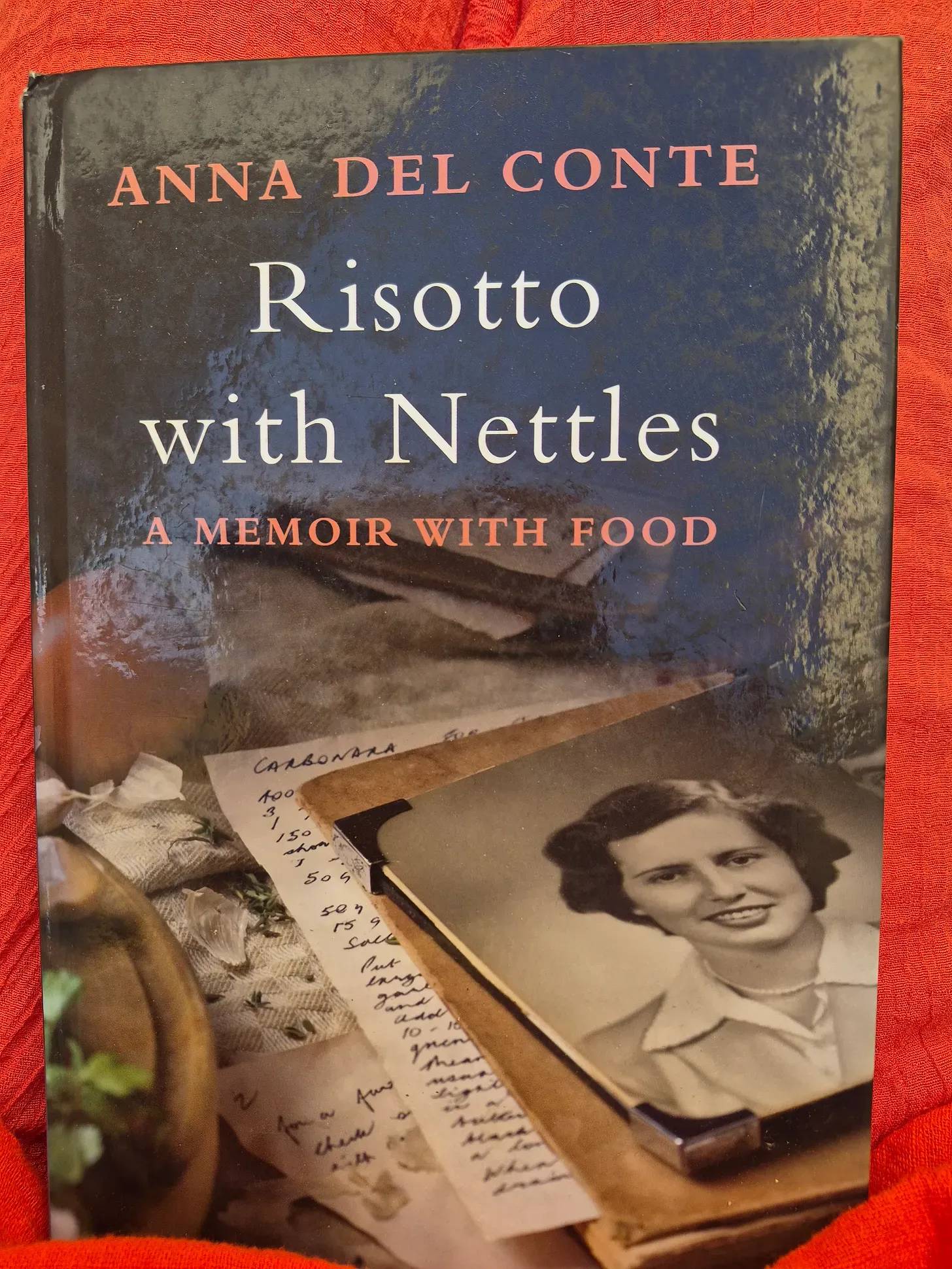
 Anna Del Conte's A Memoir With Food. (Image: Supplied)
 I’m always slightly embarrassed when I call myself a forager. Not that there’s anything wrong with the ancient activity of finding free food in nature, but it has become such a trendy hashtag thing on social media that I sometimes wonder what our foraging ancestors would have thought if they could time-travel to our era.
Foraging was not something to brag about, it was simply what poor people and indigenous people did to survive. You made use of whatever nature gave you, you ate “weeds” and leaves, fungi and flowers, snails and frogs and just about every living creature in the sea. Nowadays, if you live in cities and suburbs, foraging is much more complicated, but if you’re lucky enough to live in the countryside, it’s hard to resist the lure of free food. And I don’t mean stealing fruit from your neighbour’s orchard. I’m talking veldkos, food from fields and forests, of which there is still an astonishing variety where I live.
In spring we can pick dandelions and nettles, magnolia petals and violets and elderberry flowers, wild garlic and wild asparagus; while summer brings berries, blackberries in hedges and mulberries in trees and sometimes even a few shy strawberries hiding under leaves on the ground, herbs like rosemary and sage, wild plums and plump figs and hibiscus flowers. In autumn we can collect chestnuts and walnuts, wild apples and mushrooms. (Though I’m so bad at identifying edible mushrooms that I’ve more or less given up, preferring to buy mushrooms from locals whose harvest won’t poison me.)
Even in winter I could forage – but I usually don’t. The glorious black truffle of Périgord is a winter product, but I don’t have a pig or a trained dog to sniff out truffles for me. And when the trees lose their leaves and shiver like skeletons in the cold, and my breath becomes clouds as it escapes my lips, foraging seems far too much like an extreme sport. I would rather stay inside next to the fireplace – and enjoy the jams and preserves made from products foraged in milder seasons.
One of my all-time favourite dishes involving foraged “weeds”, is risotto with nettles. We also make a delicious emerald-green nettle soup, with swirls of liquid cream like white lace on green velvet, but nettle risotto is in a class of its own. Although nettles grow in profusion right through summer, they taste best in spring, when the leaves are still young and soft, so last month I went foraging around our house with my basket and my indispensable pair of rubber gloves. My South African-French friend Lynn showed me a way to pick the tender top leaves without gloves, but since I’m not brave enough to risk suffering for the food I love, I always wear gloves to protect my hands against the stings and arrows of outrageous fortune. (To misquote the Bard.)
/file/attachments/2994/a2_768677.jpeg "Freshly harvested nettles. (Image: Supplied)")
And since I hadn’t made any nettle dishes for a whole year, I quickly googled risotto with nettles to check the quantities. Imagine my surprise and delight when Google showed me not a recipe, but the cover of a book titled Risotto with Nettles, the memoir of the Italian-British food writer Anna Del Conte. Although I’m learning to control my lifelong habit of impulsive book buying, I immediately knew that I needed to own this one. I love well-written memoirs and I love well-researched food writing, so of course this “memoir with food” (including recipes!) would be utterly irresistible.
During the past month I’ve been reading the story of a long life filled with unforgettable food, leisurely, one chapter at a time, like a fabulous meal consisting of many courses that you eat as slowly as you can. The writer was born in Milan in 1925 and married an Englishman in 1949, spending the rest of her life in England, without ever losing her Italian accent or her passion for Italian food. Her memoir was published almost 20 years ago, when she was already in her eighties, so I assumed she would be long gone by now. To my astonishment I learned that she is still alive, at a venerable 101 years, and living in Dorset in the English countryside.
Anna Del Conte is credited with bringing Italian food to the British public. The first of her popular and prize-winning books on Italian cooking was published in the seventies, when most Brits only knew spaghetti bolognaise – which, ironically, was brought over from the US, not Italy, since no self-respecting Italian would have eaten spaghetti with meatballs. She was the mentor of modern food writers like Nigella Lawson, of whom she wrote: Nigella knows Italian food better than any other British-born cookery writer. A few years after their meeting she quoted Sir Walter Scott’s words to the young Nigella: Now the pupil has eclipsed the master.
She has an extraordinary culinary memory and manages to weave the story of her life around specific dishes tasted at specific ages, ending each chapter with a few mouth-watering recipes. She describes childhood picnics during idyllic pre-war holidays, with white tablecloths spread on summer grass and delectable dishes of cold food placed on the cloths.
I always made a beeline for the costolette alla Milanese – fried veal chops Milanese style – which tasted even better cold. I’d pick up the chops with my hands and gnaw around the bone for the best bits. To finish, there were baskets of perfectly ripe peaches and apricots, into which we bit greedily, the juice dripping down our chins, while balia Teresa and balia Antonia (the nannies) ran after us with napkins to wipe away the juice which would spoil our pretty smock dresses and the white shirts of the boys.
Although she was an urban child from a bourgeois family with nannies and a beautiful apartment in the centre of Milan, she knew all the edible wild foods from a young age. In spring she and her friends would cycle to the prati – meadows – which were then only half an hour away from her home. We picked wild rocket, summer savoury, dandelions, borage, hop shoots, Clematis vitalba shoots and nettles to make salads and risotti and soups... With the flowers of acacia and elder my mother would make crunchy, crackling fritters covered in icing sugar, which looked like Valencienne lace and tasted divine. (See my previous post, in Afrikaans, for my version of elder flowers looking like lace: Verleiding en verskrikking.)
Their luxurious lifestyle came to an end during World War 2, when they were forced to flee Milan, losing their home and most of their belongings in a bomb attack. They were fortunate, though, to find refuge with friends in Emilia-Romagna, a fertile agricultural region around the foothills of the Apennines, where they never went hungry – even in the last terrifying year of the war when they were caught in the middle of the fights between the occupying Germans and Italian fascist on one side and the partisans on the other. Her older brother was one of many young men who deserted the Italian army to join the partisans in the mountains. She was locked up in prison twice by the fascist authorities and narrowly escaped attacks by Allied fighter planes – a good example of being stuck between the devil and the deep blue sea. Or, in one particular case, of being stuck between fighter planes and stinging nettles.
As soon as I heard the noise of the planes diving, I immediately threw myself to the ground, which was covered with nettles – old nettles which have a powerful sting. My face, neck and hands were on fire, but it was nothing compared with the terror... I often remember that burning sting when I go out, here in Dorset, to collect nettles to make one of my favourite spring dishes – risotto with nettles – but I remember even more those planes diving towards us as they spat their lethal fire.
/file/attachments/2994/a3_395258.jpeg "My version of Risotto alle Ortiche, or nettle risotto in plain English. (Image: Supplied)")
No wonder, then, that of all the evocative dishes described in her memoir, she chose this one as the tempting title of the book. (If I didn’t already love nettle risotto, I would certainly have fallen in love with it after reading Anna Del Conte’s story.) But the best memoirs always have bits with which the reader can personally identify, even if the reader’s life has almost nothing in common with that of the writer. In my case it was nettle risotto that literally led me to the book, but some sentences and paragraphs were like truffles making a good dish taste even better.
By the way, Del Conte has loved truffles since her early childhood, proof that she must have been an adventurous eater from the start. Although my children also grew up in truffle regions, none of them wanted to bring the smelly tuber anywhere near their mouths when they were small. (Admittedly, I never tried too hard to tempt them, since it has always been a rare luxury which I can’t really afford.)
One of these truffle paragraphs in the memoir, causing a moment of instant recognition when I read it, is when she confesses that she often agonises over small and insignificant choices, like a dress or a meal, but the really important life-changing decisions she takes instinctively. Getting married to a foreign man, living in a foreign country, buying and selling houses, and changing jobs, were all decisions made impulsively, like throwing myself into inevitable voids. Aha, I thought. After a lifetime of anxiously sweating the small stuff and recklessly throwing myself into exactly the same inevitable voids, I know what she means.
By now the nettles growing around my house are probably too old for a perfect risotto, so I’ll have to wait until next spring before I taste Risotto alle Ortichi again. But there are some lovely and easy-looking recipes in the book that I can try out while I’m waiting: Tagliatelle al Prosciutto e Piselli (tagliatelle with prosciutto and peas), Polpette alla Casalinga (beef rissoles), Risotto al Limone (risotto with lemon)... Perhaps it’s just the Italian names that make these simple dishes sound so pleasing – but how will I know if I don’t taste them? I might even be tempted to make my own gnocchi for the first time.
In fact, this might be the beginning of a beautiful new friendship with Italian food, all because of those nettles I foraged.
Sound of the week: Youth Day was very special this year, not only because it was the fiftieth commemoration of the Soweto uprising on 16 June 1976, but because the radio station France Musique honoured Abdullah Ibrahim who’d died the previous day. I’ve admired his music for decades and was fortunate to attend two live concerts, one in the old Three Arts Theatre in Plumstead, Cape Town, sometime in the late eighties or early nineties, and the last one at the prestigious Roque d’Anthéron piano festival in France only four years ago, when he was already close to 90 years old. A frail figure on a huge outdoor stage enchanting a sophisticated international audience.
That night, under a starry Van Gogh sky in Provence, I was almost moved to tears by the long, long road travelled by Adolph Johannes Brand, previously known as Dollar Brand, from the streets of Cape Town to the most famous stages of the world. And this week on 16 June I could no longer contain my tears as I listened to the Cape jazz sounds of his iconic Mannenberg – composed only two years before the Soweto uprising – in the heart of the French countryside.
/file/attachments/2994/a7_254116.jpeg "Our radish leaf pesto – with the green ‘ice lollies’ in the background. (Image: Supplied)")
Taste of the week: Not nettle risotto – that was last month’s creamy delight that I could taste in my imagination while I read Del Conte’s memoir – but the real taste of the week had some connection with free food. While foraging is difficult for city dwellers, there is another option which we can consider as foraging’s more accessible cousin. No matter where you live, you can still honour the tradition of waste not, want not, the age-old habit of using every possible edible part of the plant or animal on your plate.
Last week we bought a huge bunch of fresh radishes from a local farmer, and the thought that we’d be throwing away two-thirds of the plant – all those lovely green leaves that are left over after we cut off the small red radishes – depressed me even more than usual because the bunch of leaves was so much bigger than usual. When I mentioned this to my Frenchman, he proposed improvising a pesto – and what a sensational improvisation that turned out to be!
I can’t believe we’d never thought of this before. Pesto can be made of just about any edible leaves, as we should know after enjoying a truly memorable spekboom pesto in South Africa, made by Barbara Weitz of Stirlings, a hidden gem of a restaurant across the street from Miss Helen Martin’s Owl House in Nieu-Bethesda. Meanwhile we’d attempted dandelion pesto (more free leaves, what can I say?), but I found it too bitter, even though I usually appreciate bitter food like rocket or endives or Brussel sprouts. This week’s pesto from disposable radish leaves, dumped in the blender together with a selection of herbs growing in pots next to our back door and a handful of pine nuts and a steady drizzle of olive oil, was something else.
We spread some of it on tiny and tender spring potatoes, used more of it in a salad dressing, and froze the rest (it was an enormous bunch of leaves) in the little plastic containers that we’d used to make ice lollies for the kids a long time ago. Last night we defrosted one of our pesto lollies to flavour a tomato tart, and it was so good I could almost imagine licking the frozen radish leaf pesto straight from the freezer like an ordinary lolly.
/file/attachments/2994/a4_883879.jpeg "The small stone statue of Christ. (Image: Supplied)")
Sight of the week: There is a stone wall in the next street, possibly older than seven centuries like most of the walls in the village, that I’ve passed hundreds of times. Just another ancient wall of an uninhabited building – or that’s what I thought, until I happened to look up, and for the first time I saw a small stone statue in a niche.
This little Christ on a cross has probably been hanging there for centuries too, but nowadays neither villagers nor tourists notice it, because our eyes are mostly on our feet or on our phone screens. Once you’ve seen it, though, you can’t unsee it. Now I look up every time I pass that wall.
But I wonder how many other arresting sights I’m still missing on my daily wanderings – until suddenly one day I’ll see something that has been there all the time. DM
Republished from Marita van der Vyver’s Substack. Read more of her Substack pieces here.