



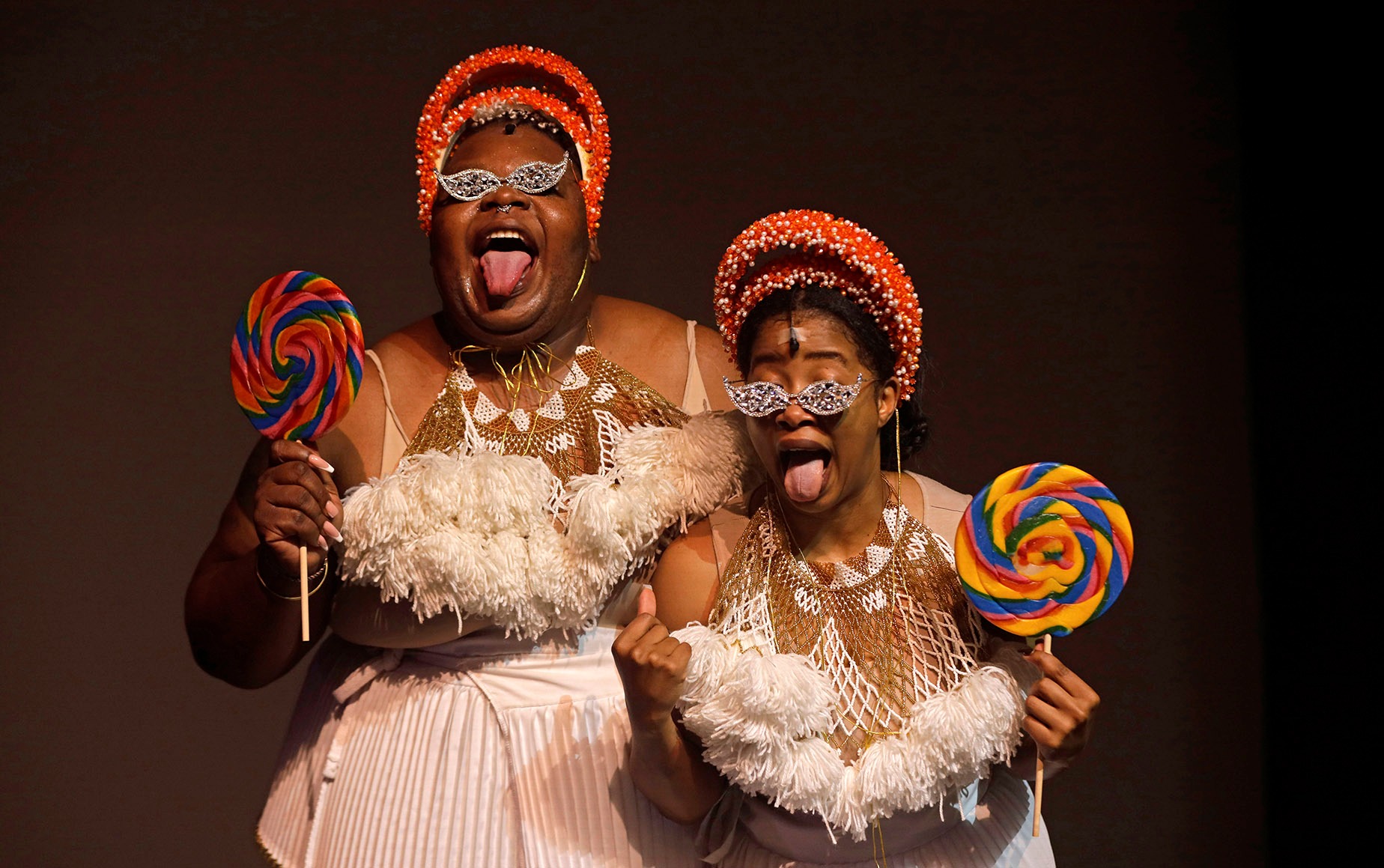
 A scene from Dear Museum! The Truth of the Matter It Seems Everything Was Better When We Were Not Telling the Truth. (Photo: Mark Wessels)
At the National Arts Festival protest is back, though not in the hateful language of xenophobic marches or politicians rallying the masses around the cause of turning Africans against one another.
At this year’s festival, now just past the halfway mark, the voices of protest have been pro-humanitarian, pro-humanity, pro-human.
And they’ve been resoundingly pro-African.
It started for me with Albert Ibokwe Khoza, whose new multidimensional experimental cabaret-like two-hander, staged and performed together with Julia Burnham, is titled Dear Museum! The Truth of the Matter It Seems Everything Was Better When We Were Not Telling the Truth.
The show’s title is a mouthful, and the show itself also defies description.
/file/attachments/orphans/DearMuseumattheNationalArtsFestival2026_MarkWessels_892744.jpg "Dear Museum! at the National Arts Festival 2026. (Photo: Mark Wessels)
<br>")
Khoza, an internationally celebrated interdisciplinary performance artist who identifies as a “non-binary, womanly man and a sangoma” and whose work is known to provoke and sometimes outrage as it delivers urgent and meaningful critiques, creates difficult-to-describe work that masterfully transcends artistic categories.
The show, which combines dance, singing, ritual, pageantry, archival and documentary footage and live video performance (in scenes where the action heads “backstage” and into what appears to be the artists’ dressing room), is also slightly angry.
And rightfully so. It has something poignant to say about the frustrating lack of acknowledgement from various northern hemisphere nations and their cultural institutions about their complicity in the darkest travesties and tragedies of the colonial project.
In it, Khoza wonders out loud what it will take for various European museums to finally acknowledge their involvement in the pillaging and plundering of Africa for cultural artefacts, so many of which continue to line the walls and trophy cabinets of institutions in faraway lands.
Khoza achieves this “protest” not in a screamy, outraged or threatening manner. There’s not an undignified moment in the show, in fact.
Instead, it’s a heartfelt – and emotionally urgent – plea from the depths of Khoza’s soul. The audience experiences the work, and the artists at its centre, at their most emotionally honest and real; it is a genuine entreaty to whomever will listen to simply do the right thing and make amends for the extensive stealing, massacring, murdering and – yes – rape conducted in the name of colonialism (and under the banner of civilisation) on the African continent.
/file/attachments/orphans/AlbertIbokweKhozasDearMuseum_MarkWessels_124440.jpg "Albert Ibokwe Khoza's Dear Museum! (Photo: Mark Wessels)")
The show also includes some incredibly powerful (and downright fun) audience participation subroutines.
It takes interactivity to a pretty extreme place, in fact. And while I usually roll my eyeballs at audience members being dragged into the fray during live performances, and loathe the sense of suddenly being put on display, in Dear Museum! that inevitable feeling of awkwardness is to some extent the very point of the show.
In Khoza’s production, it’s the (privileged) audience that – in a cleverly choreographed reversal of roles – gets colonised, becomes for a time the object of observation and study and curiosity.
At one point, I became the randomly selected audience member “forced” to perform, to dance and jump and occasionally bark like a dog and produce a high-pitched cry like a fox. And, in that moment, I was given the opportunity to experience what it feels like to have the gaze turned on me.
It underscored how, for centuries, European and other foreign institutions have placed African art and cultural artefacts on display as “ethnography”, shown them to their publics as trophies of conquest that are essentially evidence of their own culpability in the centuries of looting conducted in the name of so-called “civilisation”.
More than that, the show made me think, made me laugh and at more than one point, made me cry. The tears were because there were moments of such intense beauty in the performance. But also because it was impossible to escape the inherent truth in what Khoza had to say.
A completely different form of “protest” underpinned the debut run of Majaivan, a dance show devised and choreographed by 2026’s Standard Bank Young Artist Award winner for Dance, Lee-Ché Janecke.
/file/attachments/orphans/MajaivanAMovementStoryoftheLifeofLee-CheJaneckeatthe2026NationalArtsFestival_MarkWessels_828577.jpg "Majaivan – A Movement Story of the Life of Lee-Ché Janecke at the 2026 National Arts Festival. (Photo: Mark Wessels)
<br>")
/file/attachments/orphans/ThedebutrunofMajaivanAMovementStoryoftheLifeofLee-CheJanecke_MarkWessels_868408.jpg "The debut run of Majaivan – A Movement Story of the Life of Lee-Ché Janecke. (Photo: Mark Wessels)")
As an MTV-awarded, Grammy-acknowledged collaborator on music videos for recording artist Tyla, he is perhaps the most “commercial” choreographer yet recognised with this award, and so expectations around what he would unleash at Makhanda suggested that the performance could have gone either way.
Instead of opting to prove his naysayers wrong, or going against his own instincts, he leaned unapologetically into the dance language he’s made a personal signature and showed festival audiences (and, quite frankly, the world) precisely how powerful the moving body can be as a medium of expression.
Subtitled “A Movement Story of the Life of Lee-Ché Janecke”, the work metaphorically enacts a deeply personal autobiographical journey of the choreographer from innocent boy to globally celebrated creative powerhouse.
In it, the choreographer has ramped up the explosive energy of his multivalent style, unleashing what in many ways feels like a sophisticated, gut-level-honest homage to the culture of the streets, and also to the cut-loose sexiness and energy of dance-club hedonism, and to the heated dance battles where so much unvarnished creative innovation often happens.
Invoking a wild, wide-ranging swath of choreographic influences and at one point transforming the entire theatre into an interactive vogueing ballroom experience seething with attitude and pure pizzaz, his cast of never-less-than-extraordinary dancers pulled off something of a coup, their skill, athleticism and tangibly sexual energy simply off the charts.
/file/attachments/orphans/MajaivanAMovementStoryoftheLifeofLee-CheJanecke_MarkWessels_901688.jpg "Majaivan – A Movement Story of the Life of Lee-Ché Janecke. (Photo: Mark Wessels)")
His first show without a brief and designed purely for a theatre audience, what Janecke has created for the National Arts Festival is an absolutely electric, sexy, sumptuous articulation of his own emotional and professional coming out.
It’s as beautiful as it is stirring – and it had audiences in an absolute frenzy. If you were there, you walked out of the Rhodes Box theatre intoxicated, transported, filled with pride at having witnessed such a feat of world-class South African artistry. I floated out, walking on clouds, heart pounding.
Janecke, who is known professionally as Litchi HOV and has no formal dance training, crafted not only a love letter to the many layers of influence and inspiration that have infused his own life’s journey, but also served as a definitive response to that eternal debate over the difference between what constitutes “art” and what is designated “entertainment”. In his reckoning, the two are inextricably intertwined, entirely compatible.
The show, which felt deeply personal and intimate and self-reflective, also struck a nerve in terms of what it said about the visibility of queer culture and LGBTQI+ identity. Janecke was not holding back; there was a large, functional box on stage and in this production everything that needed to come out was granted the freedom to express itself in front of a willing audience.
It was also a form of positive reinforcement: a pro-human protest illuminating the power of dance as something that is both life-affirming and can be a potent fuel for survival. Janecke might be a well-known entity in the high-stakes dance world of music videos and Hollywood entertainment, but this show also revealed an early career artist with something to say.
/file/attachments/orphans/OnenightonlyperformancebyMsakiandtheALTBLKPanAfricanCollective_MarkWessels_381506.jpg "One night only performance by Msaki and the ALTBLK>>Pan African Collective. (Photo: Mark Wessels)<br>")
/file/attachments/orphans/MsakiandtheALTBLKPanAfricanCollectiveattheNationalArtsFestival2026_MarkWessels_135862.jpg "Msaki and the ALTBLK>>Pan African Collective at the National Arts Festival 2026. (Photo: Mark Wessels)")
Another thread of pro-human, pro-African protest ran through a once-off Friday night concert by the phenomenally talented singing sensation Msaki, another artist with a commercial voice and with something important to say.
The performance she curated, Msaki and the ALTBLK>>Pan African Collective, was a collaborative staging of voices and musicians from around the continent. As beautiful and uplifting as the concert was, though, what spoke perhaps loudest of the political moment we’re in was the absence of several musicians who’d been scheduled to be part of the concert but whose visas had been denied. Twice.
Rather than angry speeches and finger pointing, though, Msaki evoked the spirit of those who were not with us in person. They were made manifest through pre-recorded video, through music, and through humbling words of encouragement and reconciliation from Msaki herself.
She spoke of the unifying power of music and reminded us that those who use their politics to divide Africans do not have the best interests of Africans at heart.
Elsewhere, among the festival’s diverse and multitudinous fringe offerings, curious and unexpected protests have been happening everywhere and in utterly unexpected ways. Theatre-maker Shannon Hendry’s oddball one-woman production, Mlungu, is not only a wayward, uncategorisable (and ridiculously funny) protest against white privilege, but felt to some extent like a protest against genre itself.
/file/attachments/orphans/ShannonHendryinMlungu_MarkWessels_964991.jpg "Shannon Hendry in Mlungu. (Photo: Mark Wessels)")
Hendry, who initially created her show as a postgraduate student production, referred to it as “cabaret”, but it is also akin to an avant-garde stand-up comedy performance, even a form of anti-cabaret, a protest against the strictures of the form and against the labels that are too easily put on things.
Not only that, but the young actor pulled off something astonishing in that at no point in her show was it ever evident what was about to happen next. Nor if we had not, as she occasionally hinted with her sly smile and shifty eyes, in fact landed in a cult recruitment session.
There have been plenty more shows at the festival that have felt similarly urgent and vital, and among those that struck a nerve was the AI-generated “dance opera” created by Darkroom Contemporary, a company whose work blurs the boundaries between dance and digital experimentation.
/file/attachments/orphans/autoplaycreatedbyDarkroomContemporary_MarkWessels_689353.jpg "autoplay created by Darkroom Contemporary. (Photo: Mark Wessels)")
Entitled autoplay, it’s a kind of collaboration between humans and algorithms, albeit an ironic collaboration that ultimately serves as a protest against the artificial intelligence revolution that is rapidly dragging humanity towards an unknown and unknowable future.
Though as a work of art it is beautiful and ambitious, and the dancing at its core is breathtaking, it is also a show that is in many ways terrifying. Its visuals and narrative foundations are clues to the kind of miserable, soulless post-apocalyptic wasteland that might emerge as we continue to hand over our autonomy to the AI bots.
And yet the physical intensity of the performance and the skill and prowess of the dancers and musicians involved in autoplay are the purest possible evidence that there are things – such as being at a festival featuring thousands of living, breathing artists – that no machine can ever replicate. Thank God for that. DM
Comments
Scroll down to load comments...