



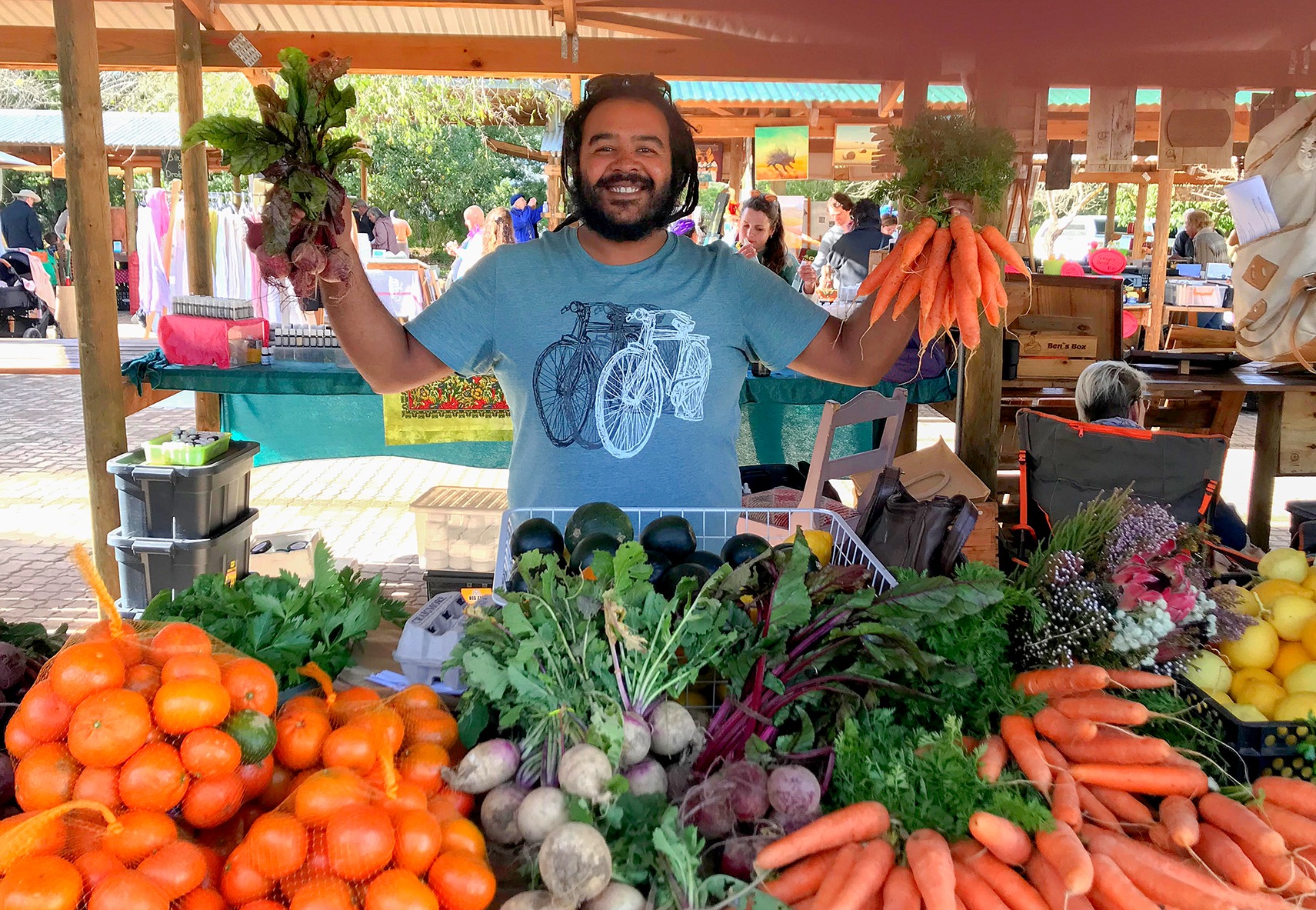
 Marshall Rinquest at a stall with the local produce from the Genadendal gardens. The area had a strong farming community just a few decades ago, and he is trying to bring back that knowledge. (Photo: Chezideck Rinquest)
 It was while performing animal welfare duties around the town of Genadendal, Western Cape, that Marshall Rinquest was confronted with the brutal realities of informal pig-rearing.
Rinquest, the outreach manager for the Greyton Farm Animal Sanctuary and a founder of the Greyton Transition Town Movement, said he often had to pick up dead piglets out of pigsties at informal piggeries.
As an environmental educator for the six schools in the area and a long-time vegan, he was saddened by the preventable deaths. Rinquest said he was especially motivated to start the Pigs to Plants initiative after his son began questioning pig-rearing practices.
After walking past cramped and unhygienic pigsties every day on his way home from school, his son asked: “How is it possible that humans can be so cruel?”
Rinquest realised that it was not what he could say or explain to his son, but what he could do.
So began the Pigs to Plants initiative – a non-punitive approach to transitioning pig farmers into becoming vegetable producers.
Background
The Pigs to Plant initiative is part of the work done by the Greyton Farm Animal Sanctuary, about 7km outside Greyton. Started by by Nicola Vernon and Rohan Millson in 2009, the sanctuary evolved into a farm-animal rescue organisation over time, with Marshall Rinquest serving as the outreach manager.
Earlier, Rinquest and Vernon had started the Greyton Transition Town Movement in 2006 to look at small-town sustainability, including waste management and food security as well as environmental and humane education.
“It is basically looking at how small towns can sustain themselves. […] The [Covid] lockdown was a very good test run for us because we’ve put all these things in place, but when do we ever test them? That’s always my question when we work around building resilience,” Rinquest said.
As fundraising for sanctuaries dried up during the lockdown, Humane World for Animals South Africa stepped up to support the Greyton Farm Animal Sanctuary with a disaster relief grant, according to Candice Blom, senior specialist for farmed animal welfare and protection at Humane World for Animals.
The organisation now also supports the Pigs to Plants initiative with an annual grant.
Food gardens replacing piggeries
The Pigs to Plants project began with baseline surveys to establish needs and suitability. It then provided market access for vegetable growers, including two weekly farmers’ markets.
Rinquest said pigs take about six months before they are able to be sold for slaughter, but markets ensure people get income twice a week. As of 2020, South Africa’s formal pork sector had fewer 200 pork producers, while in the informal sector 208,312 households were involved in pork production.
Rinquest said once a few people in the area tried farming vegetables, their neighbours began asking to get involved. High-value crops now include purple basil, rhubarb and marrow. People have two gardens – one for personal consumption and another for sale. He said families are now able to enjoy gardening together, and their homesteads are cleaner.
The African Swine Fever that swept through the Bredasdorp area in 2025 provided another motivator for people in the area to switch to food gardens. Rinquest said the swine fever killed all 1,000 pigs being kept by different people on a one-hectare municipal plot.
The Pigs to Plants initiative is also piloting a programme to farm shiitake and oyster mushrooms as another business model for people with limited space.
/file/attachments/orphans/credit-MarshallRinquest_247200.jpeg "Spinach and other vegetables are taking the place of informal piggeries in the town of Genadendal, Western Cape. (Photo: Marshall Rinquest)")
Blom said what she loved about the project “is that when we look at animal welfare, we don’t only have to think about how we improve conditions for animals while we exploit them, or what standards we put on paper and expect farmers to meet in caring for their animals; sometimes, taking animal welfare seriously means removing animals from the equation altogether”.
She said: “I love it because it’s not just about reducing animal suffering. It’s a powerful example of how solutions that are better for animals can also be better for people. […] Farmers can benefit economically, involve their families, reconnect with the land and discover a more meaningful and rewarding way of farming.”
Blom added that one of the reason for the initiative’s success is that the team works directly with farmers.
How vegetables bridge gaps
A Wednesday market was established in 2011 as a bartering-based system to bridge socioeconomic gaps and remove the farmers’ dependency on money, creating a more inclusive community.
If people had a surplus of a specific vegetable, they could trade it for another they needed.
In bridging the gap between rich and poor, or different cultures and beliefs, Rinquest said he has focused on common things that everyone needs and depends on.
“In most small towns that I visit, you have the one group that’s quite wealthy, and across the other side you have the complete opposite. We had this idea of how do we bridge this? It’s not just about growing good organic food that’s accessed by the community. It’s about how we catalyse things so that people can start talking to each other… It’s how do we tell the story so people see the value in what we do?”
“We started that market and that brought people to the market because they immediately realised [that] we took the money out of the equation and their value is basically what they can make, what they can bake, what they can grow,” Rinquest said.
What Feeds Us documentary
Rinquest features in the documentary What Feeds Us, directed by Alex Hendricks (with cinematography by Jonathan Hendricks and editing by Mayur Vallabhjee). The film critiques the industrialised food system while highlighting the people who are going against the grain.
In addition to Rinquest, it features Busiswe Mgangxela, an agroecology farmer in East London, and Method Gundidza, director of EarthLore Foundation.
/file/attachments/orphans/Screenshot2026-06-22at175750_104948.jpg "Marshall Rinquest and a woman work in the gardens in Genadendal as part of the Pigs to Plants initiative, featured in the documentary What Feeds Us. (Photo: Alex Hendricks)")
“I hope this documentary can contribute to centring indigenous and community-led knowledge on how we relate to land, animals and food,” Hendricks told Daily Maverick.
“I believe that addressing the mass suffering of animals in our food system is intrinsically linked to eradicating the violence our wider societal systems inflict on us as humans.”
Humane World for Animals funded the documentary.
“South Africa’s social justice issues and systems of domination aren’t separate from one another. They share the same root cause, based on colonial logic that allows the oppression of certain groups for the benefit of others. So we can’t talk about food justice without talking about animals,” Blom said. DM