



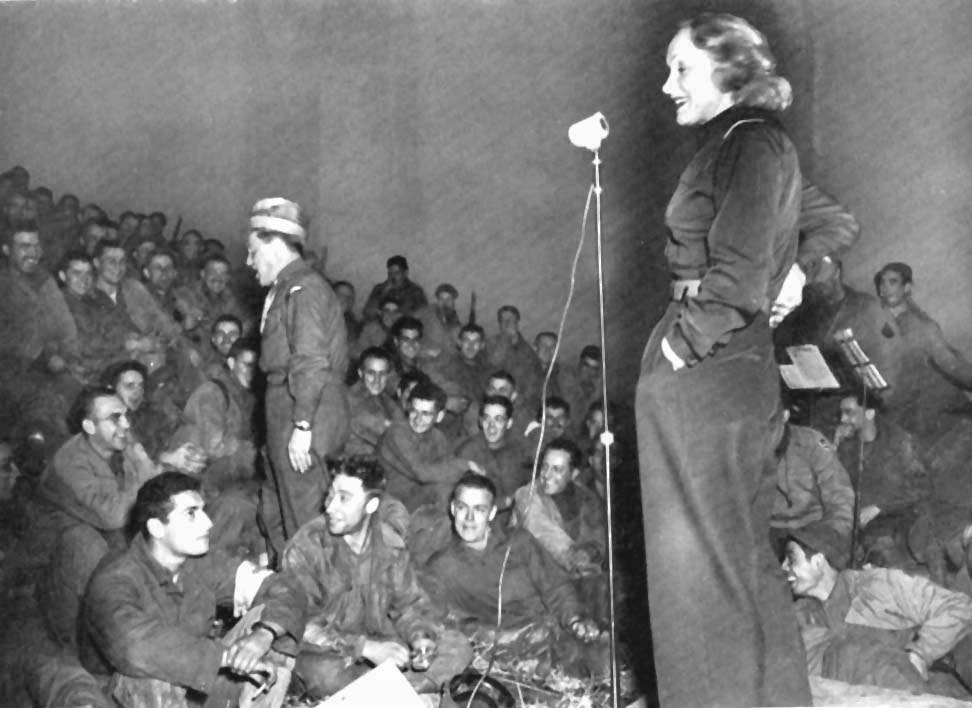
 Marlene Dietrich entertaining frontline soldiers of the Third Army in 1944. (Photo: Public domain image via Wikimedia Commons)
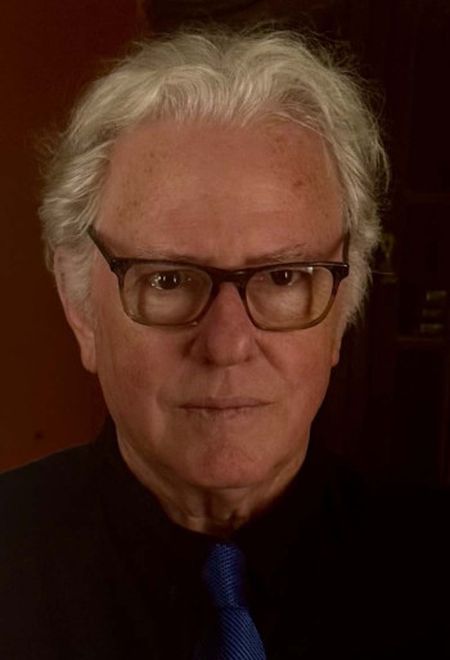
Noel Coward called him “dear boy”. His close friend Cameron Mackintosh owns a slew of the theatres in London’s West End. And one night, during dinner at West End theatre director Frith Banbury’s five-storey house on Regent’s Park, Ingrid Bergman arrived at the front door on a bicycle.
Pieter Toerien can tell stories such as these because of the life he has lived and is living, in the way he chose to live it, and because he has pulled off so many unlikely things, all of them difficult – and frighteningly expensive – to achieve.
But there’s one moment – one fine, still day in Paris a breath away from the Champs Elysee – that made Toerien the man he is and set him on the path to everything he has achieved since. And South Africa owes him a round of applause to shake the rafters.
It’s not a name-drop to say that occasionally he invites me to lunch. We have known each other since the late 1970s and he has taken me to lunch now and then over all those years. Theatre is a part of my life, and for me it’s a chance to indulge that side of myself, the part of me that writes plays and loves being both in the auditorium and the wings.
And oh my, his conversation is rich. Whereas the likes of me (and, I dunno, you?) “knows” heroes of the British theatre by their reputation, their works and footage and images of them, Pieter actually knows or knew them. He has anecdotes about Noel Coward, for goodness sake, and lest you think he throws these associations at me, I have to draw them out of him.
Coward called him “Dear boy”, what else. Have I heard of Terrence Rattigan, Pieter asks me. Of course, I reply, The Winslow Boy (I read it in my teens but have never seen it staged).
Rattigan told Toerien once, about writing, that “the hardest thing for him was having the idea”. Once he had that, he could write the play.
“He (Rattigan) came to South Africa twice, and the second time he gave me a notebook, which I’ve still got at home, a notebook in which he’d scribbled all sorts of books and ideas, and the odd line, all there.”
Noel Coward, whom Toerien refers to as “the other writer I knew very well”, was quite different. “He said, no no no no no, dear boy! It just pops in my head. And then I just write it. The whole thing, completely. It’s like you have a muse.”
Coward told Toerien he wrote Private Lives in three days. The legendary playwright, performer, songwriter and recording artist (read his Wikipedia entry for more) seems like a larger-than-life player from another time to us now, but, in the memory of the 81-year-old that teenage boy in 1965 has become, it’s almost as if he’s still with us. He certainly is in our lunch time reminiscences at this seafood restaurant at the Mount Nelson.
/file/attachments/2994/retrokaroo1_233595.jpg "To buy a copy of Tony Jackman’s Retro Karoo Food (Penguin Random House) signed by the author in gold, send an email to him at tony@dailymaverick.co.za. Or buy it through the Daily Maverick shop.")
Cameron Mackintosh seems to be with us too, along with Madame Dietrich and Terrence Rattigan, and for a brief second I imagine Ingrid Bergman arriving at the Nellie’s revolving doors in a whiff of l’Air du Temps and dismounting from her cycle. If only memories could become reality.
I’m a decade younger than Pieter, so I had less chance of meeting most of these people even if I had been lucky, but I did meet Cameron Mackintosh, thanks to Pieter. He brought Cameron out in the 1990s and invited me to meet him. I interviewed him for Top of the Times, the department of the Cape Times that I edited at the time, and we ran a full-colour front page story on him with the interview in the centrespread.
He was just lovely, utterly modest and charming. What I didn’t know was that in the intervening years (or decades) Mackintosh has become a pound billionaire and owns eight of the theatres in the West End. I didn’t ask Pieter, this time, the cheeky question I usually ask him: Is it true that you own 5% of Cameron Mackintosh? I always get the wry Toerien chuckle after that.
But I wanted him to talk about Marlene Dietrich. “Marlene”. He was a teenager – just – when he made the most remarkable move, a risk, a gamble, a bold chance worthy of a movie, and pulled it off. Despite multiple rejections.
Honestly, this man is underrated. King Charles ought to knight him, and I mean that. (I hope he’ll still invite me to lunch if it happens.) I’m chuckling wryly as I write, because while I never got to meet Coward or Rattigan or Alan Ayckbourn and wish deeply that I could meet Dame Judy, I did meet the king when he was a prince, 30 years ago last month. It was one month before Diana was to die in Paris, and his life was about to change.
But, while our waitress takes our orders for the special winter menu at Amura, let’s get back to Toerien and Dietrich. He had already had some success before 1965, bringing out British stage personalities of the era to perform in South Africa.
Then, in 1965, while in London, he asked an agent friend, Terry Miller, if he could wangle him an introduction to Dietrich. Contemplating the bread and charcuterie set before us, the 81-year-old turns his mind to his 19-year-old self.
/file/attachments/2994/bread_358182.jpg "Quenelles of ‘fish nduja’, a variation of nduja but without pork. It looks like the pork-based spread but is coloured with red spice. It tasted simply of fish and I honestly didn’t see the point of it, or of the rounds of fishy nduja that, similarly, is all about fish. I loved the bread. (Photo: Tony Jackman)")
“In those days, Time magazine was the way we got international news. And one day, Time magazine arrived and there was a centrespread: Marlene Dietrich in Moscow. A spectacular story, and the success she had had. Of course, she was a huge movie star at that time. That concert performance was at the tail end of her career.”
Pieter found himself in London, and spoke to Terry Miller, asking him, “Will you ring her manager in Paris, Alex Valdez – which he did.”
Would Miss Dietrich like to come on a tour to South Africa?
No. Miss Dietrich regrets.
Okay – can I go and see her in Paris? Miller thought it was worth a try.
“So I went to Paris, and I went to see him. Nice guy. So he said, ‘She’s already said no, but I’ll try her again.’”
And he rang her. And she said no.
“So I said, could I go to visit her?” Now that’s chutzpah.
“He said, ‘Sure, 12 Avenue Montaigne. Down the Champs Elysées.’”
Toerien’s eyes must have popped out of his head.
It was a four-storey building, and her apartment was on the fourth floor. When the elevator doors opened, there were the doors to her apartment, and a couch.
“So I presented my card to the maid who answered the door.”
Today this would be impossible. But life was simpler then – imagine, a 19-year-old could get to Marlene Dietrich’s front door.
“I went at 10 o’clock in the morning, because I thought it was civilised.”
The maid would come to the door and say, “Sit there.”
“I sat there until 5 o’clock. Nobody came or went in the apartment. You didn’t even know if she was in there.”
He went back to his hotel and at 10am next day he was back, presenting his card to the maid once more. He sat there all day, again, returning to his hotel at 5pm.
On Day Three, he was back at 10am and two hours later, at noon, the front door of Marlene Dietrich’s apartment opened.
Stepping inside, he was mesmerised by the view through the windows in their pointed nook towards the Champs Elysées and all the traffic going by.
“Suddenly there was this voice behind me: ‘How do you like your eggs?’
“And there she was, white shirt and jeans.”
She cooked scrambled eggs for them both, while he stated his case.
She asked him a few questions, why he was there, why he wanted her. And Pieter feels the need to address me with emphasis: “There are some things in life there is no explanation for. How did I know, how did I instinctively know how big her show was as a one-woman show?” (The Time magazine account of the Moscow concert in 1965.)
Dietrich told him she could not do one-nighters. Others including African Consolidated Theatres had invited her to tour the country and she’d turned them down because that was what they expected. Travel, stop, perform, sleep, repeat. But she would agree if it was one theatre every night.
He invited her to fly out to perform at the Civic Theatre in Johannesburg for four weeks. The Civic had 1,000 seats, and she did 10 shows a week, Monday and Tuesday at 8pm, Wednesday to Saturday at 6pm and 9pm.
“And she sang for over an hour, every show, and she must have liked it, because she said, I’ll come back, and if you want me to go to Durban and Cape Town I’ll go there.”
And a year later, madame was back, and even though Toerien had brought out a few British cabaret stars and recording stars before 1965 – including Jon Pertwee of The Navy Lark fame, Anne Shelton who toured British bases during World War 2, pop singer Dickie Valentine and multitalented performer Roy Castle – that day in an apartment in Paris, when Marlene Dietrich cooked him scrambled eggs, was the day his career arc changed forever.
There had been the necessary interruptions during our two-hour lunch, and we accept that serving staff have no choice but to describe the food they are placing before us, but do they have to interrupt a conversation that is nearing the punchline? This happens often, even at the finest level of restaurant in the Mother City, and I think some training is needed. We can see that they are approaching the table, we are courteous people, but sometimes we just need to finish a sentence before looking up and saying, “Ooh, that looks nice, what is it?” Or something to that effect.
A pintxo tapas skewer of oddities called Amura Gilda contained anchovy, olives, sundried tomato, smoked fish and pickled green chillies, and this was very nice as a Basquaise tapas first bite, but isn’t it a bit ordinary for a fine seafood restaurant at the Mount Nelson? It wasn’t all that arresting to the palate, although what came shortly after was smashingly good.
/file/attachments/2994/sashimi_944351.jpg "Beautiful sashimi. (Photo: Tony Jackman)")
The yellowtail sashimi was madly succulent – “Dear boy, this is enchanting!”, Coward seemed to whisper from the empty chair alongside us – and that sauce, my goodness, and we both concurred (or at least two of us) that we would endure any number of interruptions for more of it. Sweet yet sour, tangy yet sensuously refined, zesty, subtly spicy. And served cold of course. Isn’t it simply marvellous how a dish served cold seems to taste even better, dear boy?
I’m not sure who said that, but in a moment the recent death of David Hockney reminds Pieter that the artist’s works were hung – along with paintings by Francis Bacon – on the walls of the stairwell up all five storeys of Frith Banbury’s Regent’s Park home. Banbury came from a wealthy family, hence that massive house.
“Frith said they were two great personal friends, but (at that time at least) they had no money. He said, ‘I had some, so I bought their pictures so they could eat.’”
Banbury died 10 years ago. What must have become of those Bacons and Hockneys, now worth millions of millions…
While I wonder who the lady is at the table next to me who is very obviously eavesdropping, Pieter is telling me about the evening he was dining at Frith’s place when the doorbell rang and – just as it’s about to open to reveal Ingrid Bergman on her bicycle – the yellowtail is placed before us.
“Erm, just one second please…”
/file/attachments/2994/squidink1_379835.jpg "Sorry, your story will have to wait. Here are your squink ink croquettes. (Photo: Tony Jackman)")
While Madame Bergman is presumably being shown her seat at the dinner table, squid ink croquettes topped with garlic aioli are placed before us. We’re advised to gobble them in one mouthful, lest the black ink squirt in our eyes, but I need to see inside, so I slice through carefully to reveal the raven-hued interior. They eat deliciously, though Mr Coward is quietly browsing through the liqueurs menu by now. I fancied that I heard him order a vodka martini while Pieter-dear-boy continued.
/file/attachments/2994/squidink_283078.jpeg "They were delicious. (Photo: Tony Jackman)")
He’d brought a book with him (Pieter, not Noel), and there was something on top of it so I couldn’t see the title. He turned it towards me and it was Fings Ain’t Wot They Used T’be: the Life of Lionel Bart, the brilliant songwriter best known for the musical Oliver! and – did you know? – the Cliff Richard hit Living Doll.
And here comes a connection between Pieter Toerien, Lionel Bart, Cameron Mackintosh, and in a tiny way even myself, only because Oliver! is my favourite musical, Oliver Twist is my favourite Charles Dickens novel and the first book I ever read, and guess who is bringing Oliver! back to South African theatres in the near future?
The book has been lent to me and once I’ve read it I am likely to be writing something in a few months time, but for now, it’s a bit of a sad tale for Pieter.
Once a millionaire thanks to his royalties, by the 1970s Bart was bankrupt, after selling the rights to Oliver! – to Max Bygraves, the English stage star who was my mother’s favourite and whose album of naughty Nursery Rhymes for Grown-Ups was on the turntable endlessly when I was growing up in Oranjemund in the 1960s. (His take on The Grand Old Duke of York makes fascinating listening today.)
My mother was beside herself one morning in the early 1980s when I told her I was going to the President Hotel to interview Bygraves before his concerts. Ushered to his bedroom, he welcomed me wearing a red dressing gown and slippers, a genial showman ready to charm.
Bart had written Oliver! first for the stage and later adapted it for the screen, and a younger Toerien met him “three or four times”.
“Funnily enough, I always used to bump into him in somebody’s dressing room, because he was an inveterate first-nighter and such a popular man. So he would be invited by Anna Neagle, all the leading ladies of the time, to their opening nights, and then afterwards he’d be in the dressing room, drinking champagne.”
Enter, from Stage Right Cameron Mackintosh – again.
“And so, down the line, Cameron bought half of the rights to Oliver! back from Max Bygraves. And he gave a quarter – a quarter of a half – back to Lionel Bart.”
Mackintosh was even more generous to Bart at a later date, Pieter explaining simply that “that is who Cameron is”.
Pieter and Cameron are in touch “all the time” in a friendship that has spanned decades. For a quarter of a century, Toerien has taken massive risk after gargantuan gamble to mount the world’s great musicals in South Africa. He persuaded powerful corporate players to build the huge 16,000-seater Teatro at Montecasino with the promise that he would fill its seats again and again and again, which he has done and will continue to do. Right now, with Cats, and soon, with Oliver!
/file/attachments/2994/seabass_353253.jpg "Brilliant! Interruptions are all forgiven. Well, nearly all. (Photo: Tony Jackman)")
And that sea bass – dry aged for four days – has been served by the perennially kind-natured staff, and I tell Pieter it is as perfect as a piece of fish could be, so succulent, the skin so crisp, and it’s anointed with tamarind and soy, and napped to one side is a little chimichurri. Well, the chef is Spanish (chimichurri is Argentinian) but I suppose that’s close enough. Or is it? I was disappointed not to find a more unusual sauce, chimichurri being everywhere these days.
/file/attachments/2994/choco_373353.jpg "Sweet endings that perfectly illustrated the warmth and convivial mood of the lunch. For all three of us. (Photo: Tony Jackman)")
There is so much more conversation than I have space to recount. I have to stop somewhere. So I’ll just taste a little of this many-layered chocolate delight and bid Pieter, and Noel, farewell, as we merry three step out of the revolving door past the whirr of a bicycle wheel and a whiff of l’Air du Temps. DM
Comments
Scroll down to load comments...