




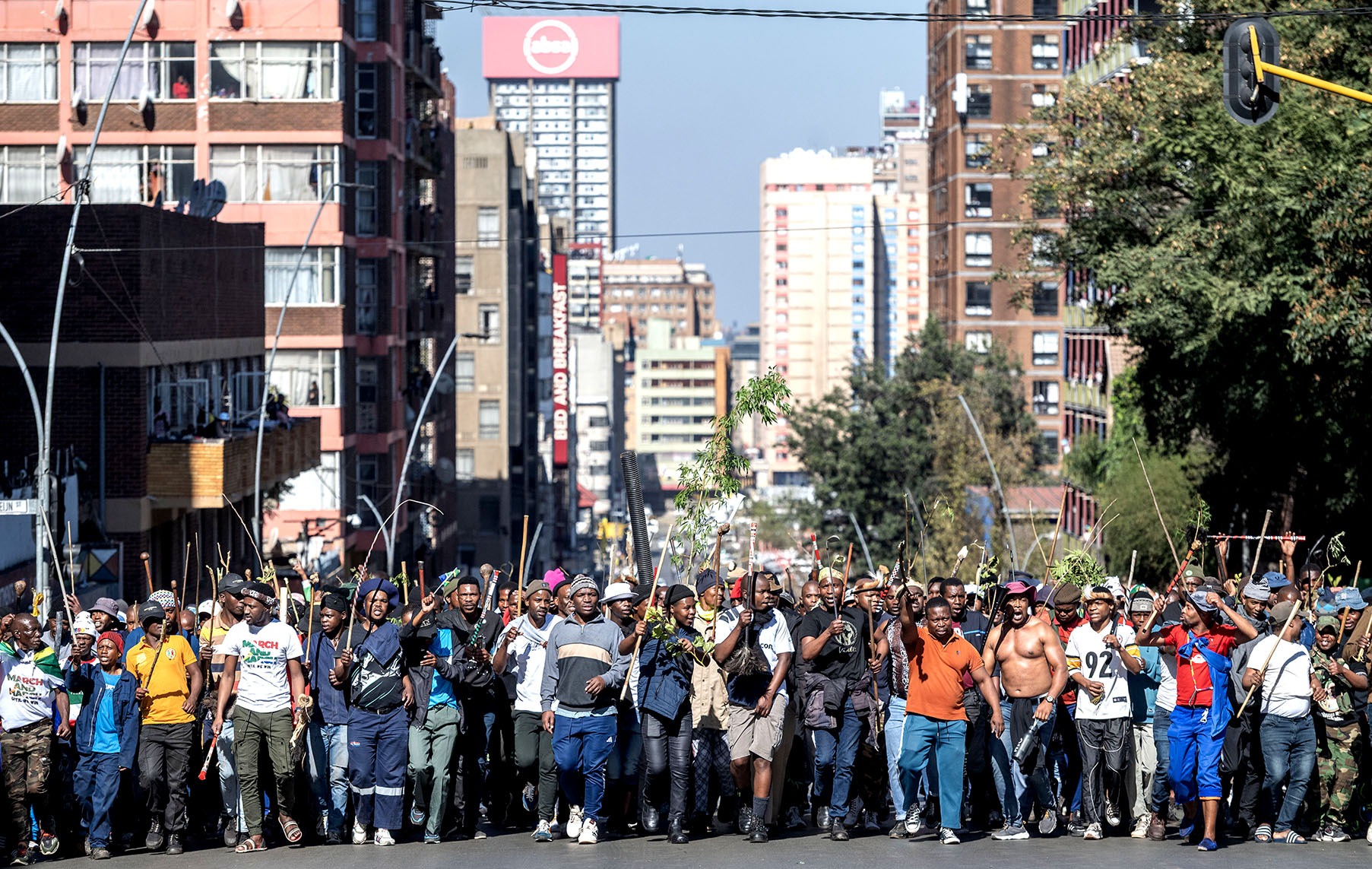
 Protesters march through the Johannesburg CBD on 30 June 2026. (Photo: Leon Sadiki)
In recent weeks South Africa has experienced some of its most significant anti-migrant mobilisation. Journalists and researchers have done important work exposing the political infrastructure behind groups like March and March, Operation Dudula and South Africans for Constitutional Reform – the organisational networks, the funding questions, the complicit political parties, the well-documented use of social media to amplify grievance before facts can be established. An understanding of the machinery is emerging.
Less examined is the economic terrain into which that machinery has been fixed. The economic context is mentioned – almost always – but typically as a backdrop rather than a subject of analysis in its own right. That needs to change. Understanding it requires grappling with several layers of economic reality. And some of those layers implicate actors who are not ordinarily part of this conversation: National Treasury, mainstream economists, the ratings agencies and the business elite.
The first layer is the one everyone acknowledges
It is not difficult to understand why many South Africans feel desperate and angry. The expanded unemployment rate stands at 44%. Youth unemployment approaches 70%. The social grants system, while vital, leaves millions below the food poverty line. Public healthcare and education have been systematically underfunded – not by accident but by policy – leaving more than 150,000 posts in the public service unfilled, many of them in frontline service delivery. People, particularly in poor and working-class communities, wait in queues at underresourced clinics. Their children grow up without meaningful economic prospects. This is widely accepted.
When basic needs go unmet, competition for scarce resources feels existential. And when political entrepreneurs with a megaphone tell you that migrants are the reason the clinic is overwhelmed, or that your child did not get a school place, or that jobs are not available, the logic is emotionally legible.
That this anger is being cynically manipulated is undoubtedly true. But revealing that is an insufficient response. Those sympathetic to anti-migrant rhetoric are not stupid or hateful per se. Most, I would assume, understood that jobs wouldn’t magically fall from the sky the day after 30 June 2026.
Rather they are responding to an economic narrative that holds even more power than anti-migrant sentiment: scarcity.
The second layer: who manufactured the scarcity?
Why has the idea of scarcity become so deeply embedded in South Africa’s public imagination? Why do so many people – across class, across education levels – believe, almost as a matter of common sense, that there simply is not enough to go around?
The answer, in significant part, is that they have been told so, repeatedly, by some of the most authoritative economic voices in the country.
For well over a decade, and with particular intensity for the past few years, the dominant economic narrative in South Africa has been one of fiscal crisis and unavoidable constraint. Treasury, mainstream economists, the ratings agencies and the business elite have generated a near-constant stream of argument insisting that the government cannot afford more – cannot afford a basic income, cannot afford to fill public service vacancies, cannot afford to properly fund health and education. The country is “living beyond its means”. We are on the edge of a “fiscal cliff”. The debt-to-GDP ratio is a source of existential alarm.
What we are dealing with is manufactured consent, the deliberate construction of a common sense that serves particular interests.
The Institute for Economic Justice has challenged this narrative systematically. We have shown that claims of an imminent fiscal crisis have been exaggerated – in some cases, dramatically so. We have shown that revenue shortfalls, when they occur, are within historical norms. We have shown that the fiscal space to fund ambitious public services exists, if the question of mobilising resources is approached seriously rather than dismissed as irresponsible. The billions we found sitting in the Gold and Foreign Exchange Contingency Reserve Account, the possibility of wealth taxes on a country that under-taxes capital, the revenue lost to tax breaks for high earners, the trillions sitting on South Africa’s balance sheets, the corporate income tax rate quietly cut – none of these features in the doom narrative. The question of distribution is systematically excluded from the dominant account of what is fiscally possible.
This is not an accident. What we are dealing with is manufactured consent, the deliberate construction of a common sense that serves particular interests. Austerity is never simply a technical policy prescription; it is a form of alchemy – transforming political choices about distribution into the appearance of economic necessity. Treasury has been, whatever its technical competence, a proponent of this magical thinking. So have many of the economists and business representatives who dominate our economic commentary.
The consequence is a public that has been successfully taught to think about resources as extremely limited and fixed – as a cake that cannot be made larger, only divided differently. In that mental world, solidarity becomes a luxury we cannot afford. Every rand spent on someone else is a rand taken from you. And if migrants are using public services – even as patients at a clinic, even as children at a school – then they are, in this logic, queue-jumpers in a line that cannot accommodate everyone.
This logic of scarcity is the fertile soil upon which the seeds of anti-migrant hate land. And economic elites bear real responsibility for it.
The third layer: what the scarcity narrative hides
The narrative of unavoidable constraint does not only shape public consciousness about what the government can afford. It also functions to deflect attention from the actual dynamics of resource distribution in this country.
South Africa is not poor in the sense of lacking wealth. It is extraordinarily unequal in the distribution of that wealth. The wealthiest individuals and corporations hold an astonishing concentration of assets. Capital has been, and continues to be, extracted from productive investment and from the tax base – through profit-shifting, through offshore financial flows, through a tax structure that privileges capital income over labour income. The deliberate under-investment in productive and social infrastructure over decades is not a story of scarcity but of choice.
When people are fighting over places in an overwhelmed clinic, the appropriate question is not whether there are enough resources to properly staff that clinic. There are. The question is why those resources are being hoarded at the top of the income distribution, why they are being spirited offshore, why they are being used to service a debt burden that reflects, in part, years of State Capture and corruption rather than investment in people’s lives.
The theft of public resources through corruption on a massive scale is itself a story about distribution, not absolute scarcity.
First, it speaks to an economy of exclusion. The failure to structurally transform the apartheid economy meant that most South Africans remain excluded, unable to generate wealth through legitimate means. In such an environment not only does joblessness flourish, so does corruption, as for many preying on the state becomes the only path available for accumulation. This is not to justify corruption, but to understand its political economy. To realise that the protection of the economic status quo post-apartheid, combined with a highly unequal economic policy regime that sought to tackle economic inclusion through “market forces”, made corruption all but inevitable.
What is absent, at every level, is the question of who actually controls the resources, and why the distribution is so fundamentally unequal.
Second, while ordinary South Africans have been robbed, through the squandering of public resources, and decimation of state-owned enterprises, the response to that robbery has been to impose austerity on those same people rather than to forge a new economic path, mobilise national resources (including through recovering what was taken) and invest them differently. These are political and distributional choices.
The anti-migrant formations do not raise these questions. They direct attention away from them. In this – even if not by design – they perform a useful ideological function for those at the top of South Africa’s economic hierarchy. The important analyses of the political dynamics beneath the surface have ignored the responsibility that economic elites bear for this crisis and the purpose it serves for them.
The political economy of the queue
Pull these layers together and a coherent picture emerges. Decades of economic failure – deindustrialisation, austerity, the looting of state resources, the systematic underfunding of public services – has created genuine desperation. Into that desperation, a sustained ideological campaign by mainstream economic actors has injected the idea that the only path to recovery is for us all to tighten our belts and shoulder more pain; that the state cannot resource what we want; that what exists must be rationed. And into this world of scarcity, political entrepreneurs have inserted the figure of the migrant as the illegitimate queue-jumper.
Each layer enables the next. The material conditions create the desperation. The scarcity narrative makes it seem permanent and zero-sum. The xenophobic mobilisation provides a target that doesn’t threaten economic power.
What is absent, at every level, is the question of who actually controls the resources, and why the distribution is so fundamentally unequal.
The solidarity we actually need
None of this is to minimise the political agency of the formations driving this crisis. March and March, Operation Dudula and the political parties that have opportunistically embraced them are responsible for incitement, for violence, for the terrorisation of families who have done nothing wrong. Migrants struggle alongside South Africans, not at our expense. Poverty will not be solved by driving Somalian shopkeepers from their stores. Hospitals will not be better resourced by turning away Malawian mothers from maternity wards.
But understanding the basis upon which this misdirection is built and who benefits from it is essential to building a response capable of countering it. The answer is not only particular political elites, but also economic elites. The latter benefit from the narrative that the status quo is unavoidable, that redistribution is impossible, that the only question is who gets the insufficient resources that exist rather than why those resources are distributed as they are.
The task for progressive forces is to offer a credible, concrete alternative: an economy that produces enough decent work, income and adequate public services for everyone who lives here, funded by genuinely mobilising the resources that exist rather than pretending they don’t. That means taxing wealth, reversing austerity, rebuilding public institutions, mobilising domestic resources and challenging those who continue to benefit from the current highly unequal distribution.
Hate thrives where hope has been exhausted. Restoring hope requires dismantling not only the political machinery of the anti-migrant wave, but the economic ideology and structures that created the fertile soil for it to take root, and to continue to produce its poisonous fruit. DM
Dr Gilad Isaacs is executive director of the Institute for Economic Justice, a progressive economic policy think-tank based in Johannesburg.
Comments
Scroll down to load comments...