




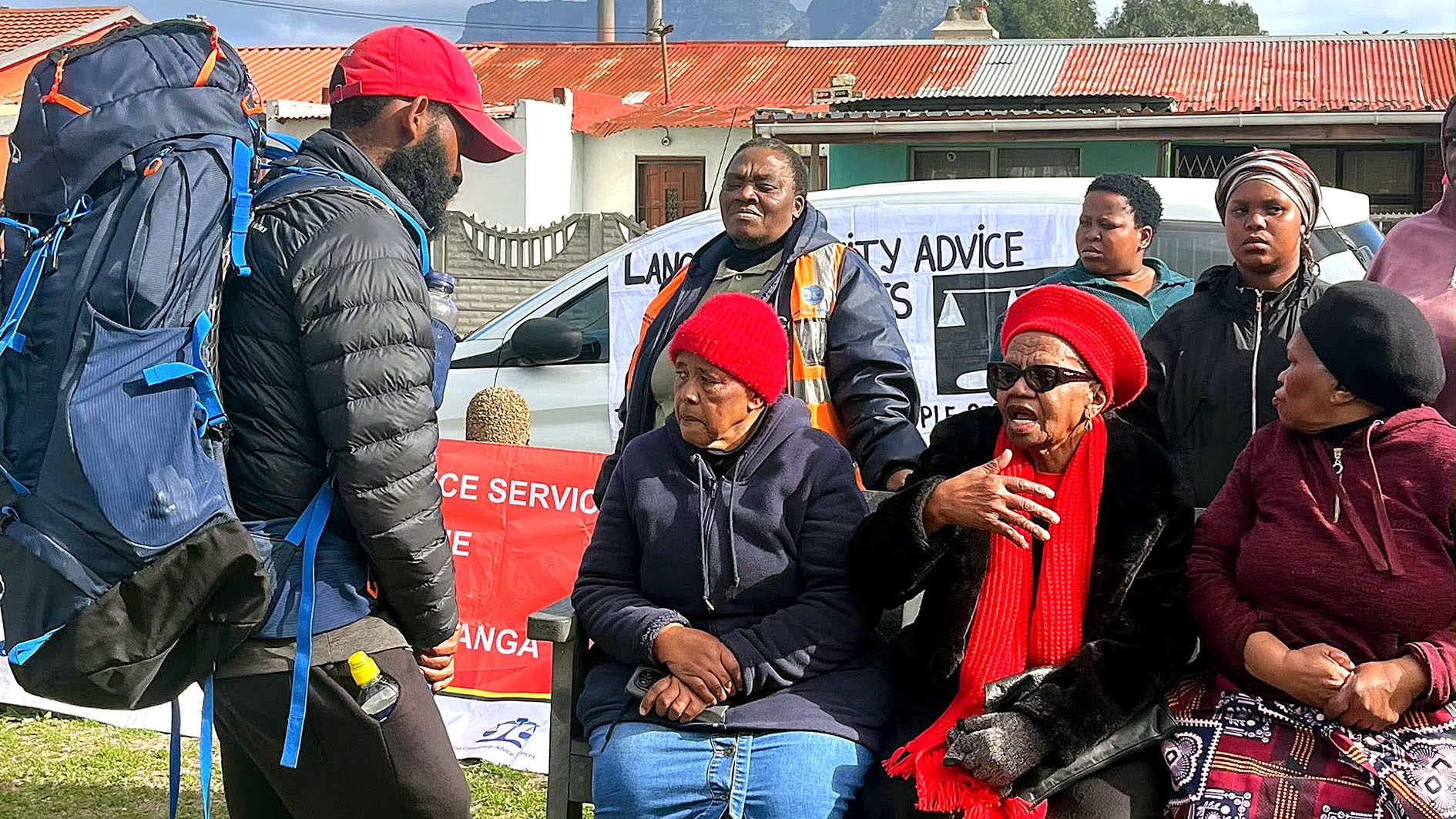
 Members of the Langa community who came out to tell Mthiyane about how they had waited more than 30 years to get government housing and basic services. (Photo: Walk for Home)
 Sixty days, 1,600km. Countless people who opened their homes and shared their meals with a stranger. This has been Wandile Mthiyane’s experience as he walked from Durban to Cape Town, raising awareness about South Africa’s housing crisis.
“Most people’s initial reaction was that I was crazy,” Mthiyane tells Daily Maverick. He admits that he also doubted whether this challenge was the best means of advocacy. “But as the journey unfolded,” he says, “people began to understand that it wasn’t really about walking. It was about listening.”
The idea for walking from Durban to Cape Town emerged from the desire to honour the legacy of his aunt, whose housing condition was one of the reasons he pursued a career in architecture – to contribute to building a world where people could live in “safe, dignified homes”.
“I remember government officials coming to her home and marking the door, promising that housing would come. Twenty-five years later, she was still waiting for an RDP house when she died.
“I was heartbroken and angry. Angry that she had waited so long. Angry that despite dedicating my career to housing, I hadn’t built something impactful enough, quickly enough, to change her reality while she was still alive.”
The walk became a way to raise funds for his Master’s studies in Design Engineering at Harvard University, as well as a means to listen to the lived experiences of communities across South Africa.
“I wanted to understand housing not as an architect or entrepreneur looking at data, but through the lived experiences of people across the country,” he explains. “I wanted to co-create solutions with communities rather than build solutions based only on my own perspective.”
/file/attachments/orphans/MthiyanesvisittoafrailcarecentreinBeaconValleyintheCapeFlatstobetterunderstandhowwehousethosewhoareill_WalkforHome_835032.jpeg "Mthiyane visited a frail care centre in Beacon Valley in the Cape Flats to better understand how we house those who are ill. (Photo: Walk for Home)")
/file/attachments/orphans/MthiyanewithhishostinLangaMamakopoMathebula_WalkforHome_356886.jpeg "Mthiyane with his host in Langa, Mamakopo Mathebula. (Photo: Walk for Home)")
Needless to say, walking across provinces is no easy feat, and according to Mthiyane, the practical logistics of the venture involved a lot less coordinated planning than most people probably imagined.
“I left Durban with roughly R2,000 in my account and no certainty about how I would pay rent while I was gone for two months,” he says.
The only accommodation he had secured ahead of the journey was the first night in eManzimtoti, about 30km from Durban. But what came next was a testament to the generosity and congeniality of SA’s people.
“My friends Simamukele and Desgo became the operational backbone of the journey. Every day they were calling churches, schools, community organisations, businesses and anyone who might be willing to help. Often our strategy was simply to ask each host if they knew someone in the next town. One connection would become another.”
One of Mthiyane’s close friends, Xabiso Dubase, led to a connection with an Eastern Cape educator, Rejoice Ngebe, who became “one of the most important people in the entire journey”.
“Mrs Ngebe mobilised an incredible network of teachers across the province. Through those relationships, accommodation was arranged throughout much of the Eastern Cape,” Mthiyane says.
And a similar network played out when Mthiyane reached the Western Cape, where “introductions spread throughout the Garden Route” thanks to Ian Perryman from Pelican Lodge in Sedgefield.
The reality of the journey was, as Mthiyane describes, “held together by hundreds of people carrying small pieces of it together”.
Perryman led Mthiyane to meet Denise Lloyd, a dedicated resident of Mossel Bay – the town that Mthiyane says left the strongest impression on him.
Lloyd arranged Mthiyane’s accommodation as well as a breakfast to meet business leaders, people from the tourism sector and community organisations.
“What stood out was how intentionally connected everyone seemed to be around solving local challenges,” Mthiyane says.
One of the organisations that was memorable was Surfer Kids – a non-profit that empowers young people through character-building activities.
“What fascinated me,” he explains, “was that they even pay participants in Bitcoin as a way of teaching financial literacy, long-term thinking and investment principles.”
/file/attachments/orphans/CommunitybuilderandactivistAneleGqasanawhotookMthiyanearoundLangashowinghimdysfunctionalplumbingandtakinghimtofamilieswhohadlosttheirhomestofireandstorms_WalkforHome_175347.jpeg "Community builder and activist Anele Gqasana, who took Mthiyane around Langa, showed him dysfunctional plumbing and took him to families who had lost their homes to fire and storms. (Photo: Walk for Home)")
Mthiyane also spent time with Bayethe Multisport Academy, which “introduces young people from underserved communities to sports like triathlon and cycling that have historically been inaccessible”.
“Their goal isn’t simply athletic performance. It’s character development, discipline, confidence and expanding what young people believe is possible for themselves,” Mthiyane explains. “Many graduates have gone on to become professionals, including lawyers and accountants, while others now compete internationally.”
An experience he recalls as being “incredibly powerful” was when some of the athletes from Bayethe cycled alongside him, teaching him about their neighbourhood’s housing conditions, the challenges they face as well as their local accomplishments, before escorting him from the area upon his departure.
Another town that became a highlight of his walk was Swellendam, where Mayor Francois du Rand dedicated an afternoon to discussing housing with Mthiyane.
“He openly shared what he believed the municipality was doing well and where gaps remained. He personally showed me housing developments, including approximately 950 units recently delivered in the community.”
His walk ended on 16 June 2026 – a day that was not coincidental.
“Too often we wait for politicians, governments, corporations, or wealthy philanthropists to solve problems. But history shows us that meaningful change usually begins when ordinary people decide to act.
“I often think about the youth of 1976. They didn’t wait for permission. They stepped forward because they believed change was necessary. The same applies today.”
It’s this message that inspires the advice he would give to young people who are passionate about social change: “Be the change you want to see.”
/file/attachments/orphans/MthiyanesleptattheDistrictSixHavenNightShelterwherehegave60ofhisunhousedneighboursK-Waybeaniesandspentthenighttobetterunderstandtheirexperiencesandchallenges_WalkforHome_265684.jpeg "Mthiyane slept at the District Six Haven Night Shelter, where he gave 60 of his unhoused neighbours K-Way beanies and spent the night to better understand their experiences and challenges. (Photo: Walk for Home)")
/file/attachments/orphans/MthiyaneinhishostsapartmentinSeaPointlaughingashewasservedsoupbyeveryfamilyintheWesternCape_WalkforHome_456911.jpeg "Mthiyane in his host's apartment in Sea Point, laughing as he was served soup by every family in the Western Cape. (Photo: Walk for Home)")
Mthiyane’s walk itself is a materialisation of another lesson that he shares with young people, and that is to take the first step even before the trajectory of the journey is certain.
“When I started this journey, very few people cared. There wasn’t much media attention. I didn’t have a massive social media following. There were no guarantees. But people began to believe because they saw action.
“The lesson is that you don’t need everyone to believe in you at the beginning. You simply need to start. Momentum attracts support.”
As for what’s next, Mthiyane will be further focusing on securing funding for his studies in Design Engineering at Harvard University to accelerate his mission to advance the AI-powered platform Ubuntu Home, which supports families to “design, plan, finance and ultimately build homes tailored to their needs and budgets”.
Walking 1,600km across the country left Mthiyane feeling “more hopeful than ever” about the direction of SA’s future. He notes that even though we face great challenges nationally – including unemployment, infrastructural failures and shortages in housing – what struck him over the course of his journey wasn’t necessarily the problems.
Rather, it was the people.
/file/attachments/orphans/WandileMthiyaneandAndrewTullockthedirectorofCampsBayIgnisiveInclusiveChangewhichupskillsunhousedpeopletoworkinfieldslikeconstructionsecurityandIT_WalkforHome_621551.jpeg "Wandile Mthiyane and Andrew Tulloch, the director of Camps Bay Ignisive Inclusive Change, which upskills unhoused people to work in fields like construction, security and IT. (Photo: Walk for Home)")
“Everywhere I went, I encountered individuals who were building solutions long before anyone gave them permission,” Mthiyane says.
“I met entrepreneurs creating jobs in townships. Young people building gyms to keep children away from crime. Teachers mentoring entire communities. Non-profits creating pathways into careers that once seemed impossible. Municipal leaders trying innovative approaches to housing. Families who had very little but still opened their homes to a stranger.”
It’s this that Mthiyane says revealed to him that the country “does not suffer from a shortage of talent, ideas, or compassion”. Instead, it’s a lack of “systems, coordination, and resources needed to unlock what already exists”.
Since his return to Durban, Mthiyane hosted a homecoming discussion on 27 June, during which he shared lessons from his journey and reflected on the communities and stories that shaped his walk.
The discussion, he says, naturally evolved into an action step, inspiring a Mandela Day Walk. The event, From Freedom to Home: Walking Together for Housing Justice, invites members of the public and people from across sectors, including governmental, business and civil society leaders, to connect and mobilise around a common cause.
“This journey made me believe that our greatest resource has never been our minerals or our infrastructure,” he says. “It has always been our people.” DM
From Freedom to Home: Walking Together for Housing Justice takes place on 18 July 2026 from 7.30am to 11am, starting at the OR Tambo statue on the Durban beachfront. Follow the latest details on Wandile Mthiyane’s social media.