



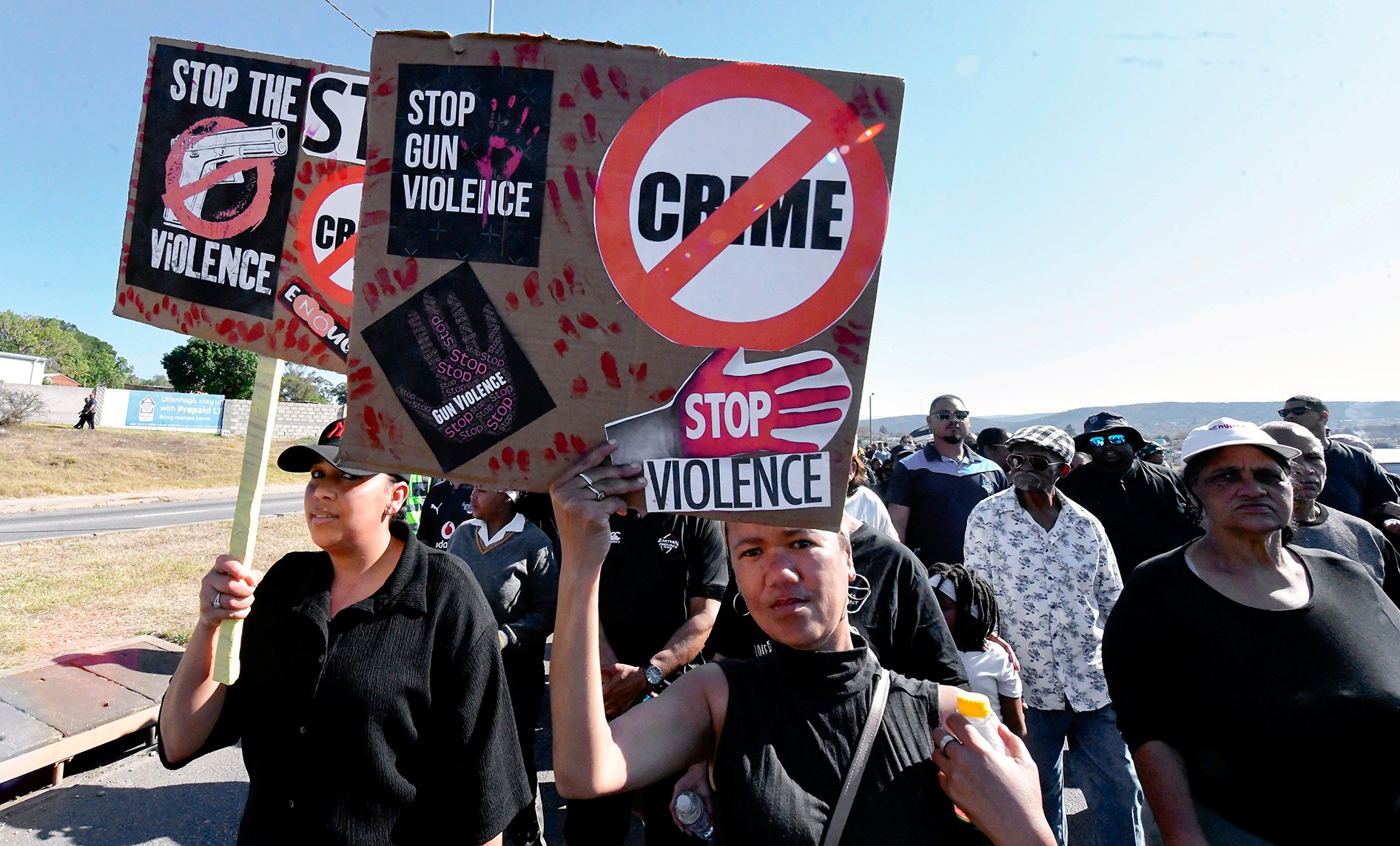
 Residents of Rosedale, Kamesh and Gerald Smith march against crime in Kariega, Eastern Cape, on 18 August 2025. The protesters demanded basic safety, better service delivery and more police visibility. (Photo: Gallo Images / Die Burger / Lulama Zenzile)
Gqeberha’s northern areas in the Eastern Cape is home to various ganglands and drug lords who claim turf within the community, which result in shoot-outs that terrorise community members trying to make an honest living.
Missionvale community leader Lynn Mostert, grandmother to a 13-year-old boy, says young boys growing up in the northern areas are not leading normal lives.
Parents, at least those cautious enough, have to implement strict rules, schedules, safety measures and even choose friends for their boys to give them a chance of a better future.
Mostert says the community of Missionvale is so dangerous that even going to the nearby shop to buy bread is a risky exercise.
‘Playing outside could be fatal’
“Playing outside in the streets like children used to back then is an extreme sport that can likely turn fatal because our streets are unpredictable; shootings erupt randomly without warning.”
In front of her house is a play park that families do not allow their children to go to, as it has been turned into a gangsters’ shooting ground.
“I worry so much about the outside influences from around the community. I’m scared that my grandson and other boys in the community will one day aspire to be part of the gangs because during shootings you would see the excitement from the young ones, hence we have to be very strict with them in cautioning that behaviour and [their] whereabouts,” Mostert said.
“We have to pay extra attention to our young boys especially, and as parents in this community we have to be actively involved in choosing their friends because they play at each others’ homes. So it’s important to know the kind of family the friends come from and if it’s safe for your child to be associated with them.”
/file/attachments/orphans/ED_562188_225440.jpg "Residents protest outside Kariega Magistrates’ Court on 23 June 2025 during the appearance of four men accused of the rape and murder of two high school students. It was reported that the charred bodies of Sinathando Malinga (19) and Ibanathi Peter (17) were found in bushes along Fourth Avenue in KwaNobuhle. (Photo: Gallo Images / Die Burger / Lulama Zenzile)")
Mostert says some of her biggest worries for her grandson are safety and, while at school, being influenced by other pupils involved with gangs to smoke and use drugs.
“He has been offered to try out drugs in the school toilets by another pupil; he reported this to us,” she said.
“Last year, when he was in Grade 6, he was bullied by an older boy who carried a knife to school. He started wanting to carry a knife to school to defend himself, saying we are treating him like a girl, so such things worry you as a parent because you can’t always be there to protect them.”
She said her eldest son, who went to the same school, was forced to drop out after he refused to join the gangs.
“The saddest part is that he was recruited by his friend who used to come play at our house before he joined the gangs. When my son refused, school life became difficult as the friend turned against him, wanting to stab him at school to a point where teachers had to lock him inside the classroom for safety, and we would have to go pick him up from school.”
Single mothers, vulnerable boys
Mostert said the Missionvale community consisted of many broken families, which has resulted in single, unemployed mothers living with their sons, which places the boys in vulnerable conditions.
“The drug lords lure these boys with money and new clothes. Not all of them will refuse or even report these offers because of the situation at home. This environment will shape the kind of men these boys will become, because as they grow up, they are challenged by the gangsters and make them feel unsafe with threats and provocations, until others eventually join to ensure their families, too, are protected.”
Mostert said one of her fears was not knowing if a stray bullet would strike one of her family members, either while in the street or inside the house.
“The fact that children [have] normalised seeing weapons on a regular basis affects their upbringing. We are already bringing up traumatised children.
“When we hear gunshots fired, I have taught the kids that if it happens while they are in the streets, to just lie on the ground, cover the head and ears and start praying. When a shoot-out happens while we’re inside the house, we all go to the toilet because it’s safer, or we go upstairs and keep low to avoid getting hit.”
Read more: Why is SAPS withholding vital crime statistics on women and children?
Read more: Community-led interventions crucial for healing children exposed to violence in SA
The murder capital of SA
In the Eastern Cape, the fourth-quarter crime statistics, which cover the period between January and March 2026, identify Nelson Mandela Bay as the province’s biggest contributor to reported contact crimes such as murder.
Nelson Mandela Bay remains the murder capital of the country, with the KwaZakhele Police Station in Gqeberha recording the most murders (59) in the country in the period under review.
Other police stations that recorded a high number of murders are New Brighton with 45 murders, Motherwell 44 and Walmer 36 – all in Gqeberha.
KwaNobuhle Police Station in Kariega, Nelson Mandela Bay, recorded 35 murders.
The data also shows that women and children in the province remain under threat due to the increase in the number of sexual offences, rapes and attempted murders recorded in parts of the OR Tambo district, such as Lusikisiki and Mthatha. Nelson Mandela Bay did not reach the top 30 districts for rapes and sexual offences.
/file/attachments/orphans/WhatsAppImage2026-06-25at1726221_318145.jpg "Child activist Thamsanqa Nkevu from Kwanobuhle, Nelson Mandela Bay. (Photo: Supplied / Thamsanqa Nkevu)")
KwaNobuhle-based child activist Thamsanqa Nkevu said the latest statistics were not a true reflection of what happened in households, especially in poor communities such as his.
Nkevu said the South African Police Service failed abused children by failing to ensure that officers at the stations were incorruptible and capable of dealing with matters relating to child abuse.
“Children in KwaNobuhle are exposed to a lot of trauma, which compromises their safety and well-being.” He said certain elements in society who harmed children were often found within the households.
Nkevu said his neighbour, a young drug addict mother of an eight-year-old boy, had been placing the life of the child at risk for years, judging by how he was treated.
“She would kick the boy out of the house around 2am, placing the child in danger of getting killed or abducted, an incident we have been exposed to in this community. The boy has even been raped, and no one knows who did it.”
‘Police indifference’
Nkevu said he had intervened by involving the police over the years, but no arrests were made until March 2026, when the mother was arrested.
“However, she was released on bail two weeks later, only for her to return back to the house to live with the boy. When we follow up with the police, you are sent from pillar to post until you give up, eventually.”
Nkevu said that as someone who had helped many children open cases, he had seen the trauma and difficulty they were subjected to at the hands of police.
“You would open a case, and after a while of no feedback, you go back to inquire, only to be told there are no records of such a case. In instances where you manage to get a case opened, dockets get lost, and the matter is struck off the roll in court – and justice is not served for the abused children.
“The police are failing the children, there is no way what is contained in the statistics is true, especially when it comes to sexual offences against children.” DM
Comments
Scroll down to load comments...