




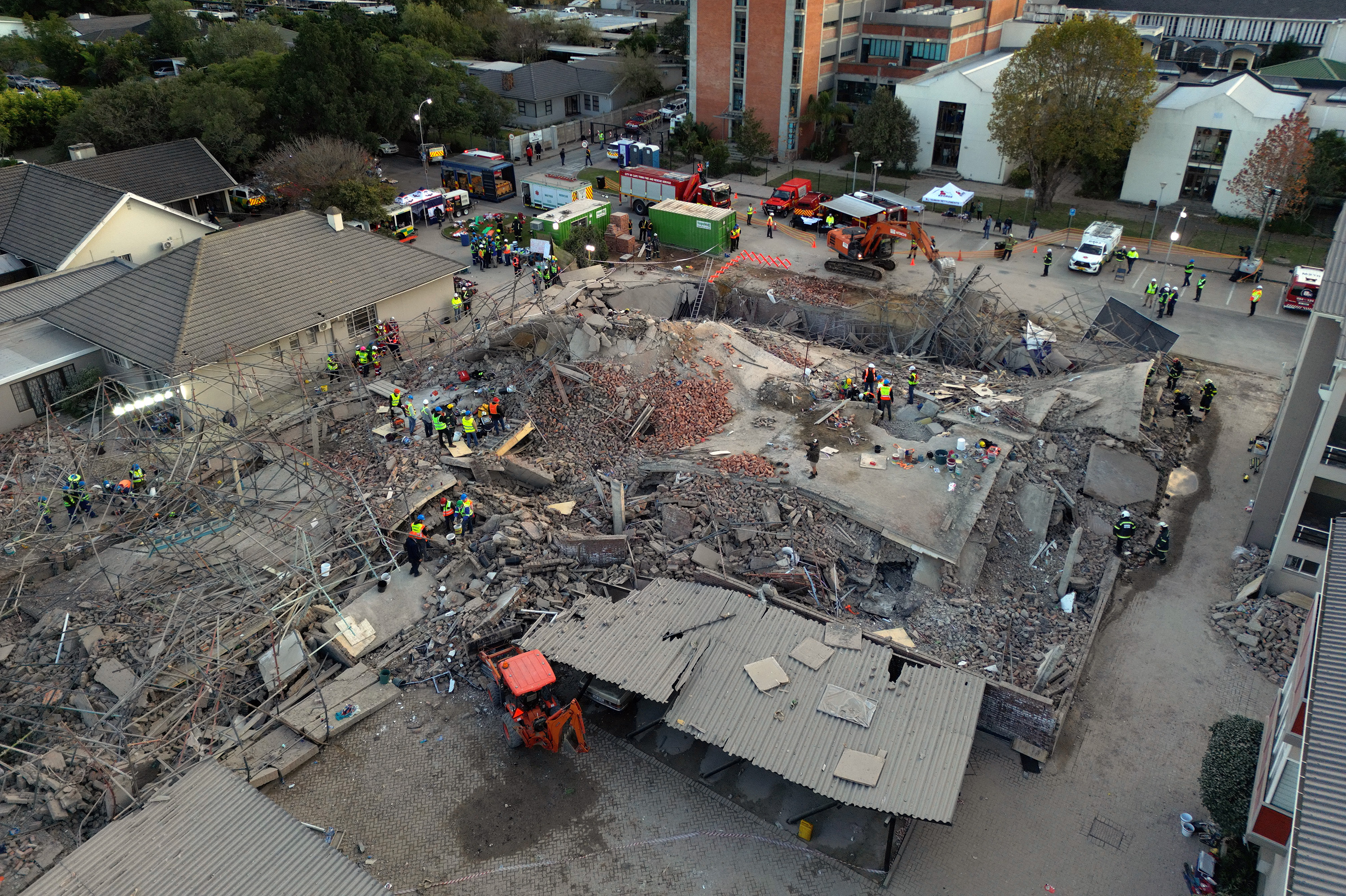
 A drone view of the scene of the building’s collapse in George. (Photo: Reuters / Shafiek Tassiem)
On 14 April this year, Sylvia Magxwalisa, 54, lodged an application for a declarator in the Western Cape Division of the High Court against the National Home Builder’s Registration Council (NHBRC) to hold it liable for the tragedy that occurred the day her husband died, and the suffering and loss that have followed the event.
While the widow has filed papers in her own capacity, her legal team, advocate Lucas van Tonder and attorney Andries van Greunen, have pointed out that she speaks for the broader group of victims and their dependents (many of whom were foreign nationals) who are seeking relief from the National Home Builder’s Registration Council.
The five-story luxury development in George was due for completion and occupation on 1 August 2024 before the tragedy occurred on 6 May 2024 at about 2.30pm. Seventy-five people were employed on the site, 34 of them died, and one of them was Andile Andrew Magxwalisa, 59.
A crack team of Directorate Of Priority Crime (DPCI) investigators have completed their investigation into the collapse, and which has been with the National Prosecuting Authority since February 2026.
Custodian of standards and a budget
The National Home Builder’s Registration Council is a regulatory body of the home building industry, established in 1998 with the mandate to protect the interests of housing consumers and, most importantly, ensuring buildings comply with industry standards.
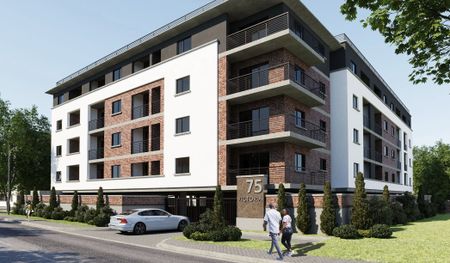
/file/dailymaverick/wp-content/uploads/2025/04/ED_502723.jpg "According to the National Home Builder’s Registration Council report, officials failed to undertake a proper technical assessment of the 75 Victoria development in George to ensure the contractor could manage the expanded scope of the project. (Photo: Jaco Marais / Die Burger / Gallo Images)")
/file/dailymaverick/wp-content/uploads/2024/06/Velani-Tamsin-George-3.jpg "Rescue personnel clear debris to rescue trapped workers at the collapsed building site on 7 May 2024. (Photo: Tamsin Metelerkamp)")
It manages a historically tracked substantial R10-billion in financial reserves, which are held within its warranty fund.
Two years after the biggest tragedy in South African building history and one year after the handing over of a redacted internal council forensic report to Minister of Human Settlements, Thembi Simelane, on 9 April 2025, the body has objected to Magxwalisa’s demand on various technical points and claiming no liability.
She noted that the suggestion by the the council that it needed to await outcomes from the SA Police Service (SAPS), the Department of Labour and the Western Cape Department of Public Works before it could act was “wholly inconsistent with its legislated mandate to proactively ensure safety, to promote ethical and technical standards, to improve structural quality, to ensure training and inspection, enforce compliance and provide redress where failures occur as stipulated for in Section 3.(a-j) of the Act”.
Magxwalisa challenged the council to disclose the full report to the court, which should then be read in support of her application.
Ultimate liability
She said it was “apparent from the response by the National Home Builder’s Registration Council that it intends to draw out a finding in relation to its ultimate liability, in a process of pointing fingers at various other players and/or participants in the process leading up to the collapse of the building”.
Far from disputing or being able to challenge the results of the council’s own forensic investigations – parts of which have been published and have remained uncontested – she claimed the council was playing a game of “wait and see” while families suffered.
The 285-page internal report that was handed to Simelane set out how statutory duties were ignored by the council, specifically by allowing an unqualified builder to construct a multi-storey complex and failing to conduct mandatory site inspections.
List of gross transgressions
Specific failures noted in the council’s report were that the homebuilder, Liatel Developments, was not registered to construct a building of that size.
While the George building consisted of a basement and five storeys, the builder was only registered for buildings up to two storeys. Furthermore, council staff members had executed incorrect grading certifications that allowed construction to proceed despite these limitations.
There were significant deficiencies in the assessment of the technical manager’s qualifications for the grade of building being constructed.
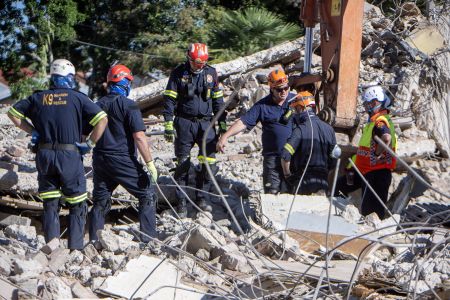
/file/dailymaverick/wp-content/uploads/2024/10/GroundUp-George-disaster-inset.jpg "Rescue teams battle in May 2024 to find construction workers trapped under the collapsed apartment block in George. (Archive photo: Daniel Steyn)")
/file/dailymaverick/wp-content/uploads/2025/01/ED_503941.jpg "Search and rescue operations at the collapsed building site on 16 May 2024 in George, South Africa. (Photo: Gallo Images / Die Burger / Lulama Zenzile)")
Her founding affidavit sets out that the size of the development was incorrectly captured and then irregularly upgraded without proper checks. Critically, the National Home Builder’s Registration Council had failed to refer the multi-storey project to its internal regional structural engineer for assessment – a safety control measure that would have identified design shortcomings.
Additionally, the Geotechnical report used for the project lacked the basic data required for a safe structural design, the report noted.
False claims
Council inspectors had also falsely claimed to have performed inspections on units that did not yet exist, while the first phase of the development was enrolled using the fraudulent use of an official’s login credentials.
Inspectors failed to report visible structural cracks and did not stop construction even after the site safety officer had resigned due to unsafe practices, such as the use of substandard props and improper scaffolding.
The council’s Standard Assessment Procedure (SAP) system lacked “safety stage gates” to prevent project approval until all conditions were met. Staff were also able to easily bypass compulsory compliance reviews. There were also, the investigation found, widespread shortcomings with regard to the qualifications and training of key personnel, particularly site inspectors.
The council’s report concluded that the collapse was a direct result of these systematic failures, mismanagement and non-compliance with regulatory standards. It also confirmed internal misconduct, including fraudulent data entry and bypassed safety protocols.
Immeasurable loss
Magxwalisa said her husband’s death had caused the loss of financial, physical, and mental support and argued that the council’s failures in oversight and regulation directly resulted in the collapse, and her subsequent prejudice and damage.
“I contend that the National Home Builder’s Registration Council had a duty of care to all individuals entering in or near a ‘home’ as defined in terms of the Act, more so in the process of the planning, approval, supervision and construction thereof. The council could and should have avoided the collapse of the George building, alternatively, that there is a direct causal link between the acts and omissions of the council and the ultimate prejudice, loss, and damage I have suffered. It was at all times foreseeable that if the council fails to comply with its obligations that the loss to the victims and to their lawful dependents, such as I, would follow.”
She noted that he victims and their dependants suffered delay and prejudice “on a daily basis, and it would add insult to injury if we were to pursue protracted litigation in order to obtain compensation from where the major obligation and deepest pockets lie”.
The court application added that “as custodian of the building industry, in so far as it is related to the collapsed George building, the National Home Builder’s Registration Council is liable not only for its own acts and omissions, but also for those in respect of which it acts as custodian and or ultimate guiding authority, namely all individuals or entities that participated in the process of designing and constructing the building”. DM
Comments
Scroll down to load comments...