



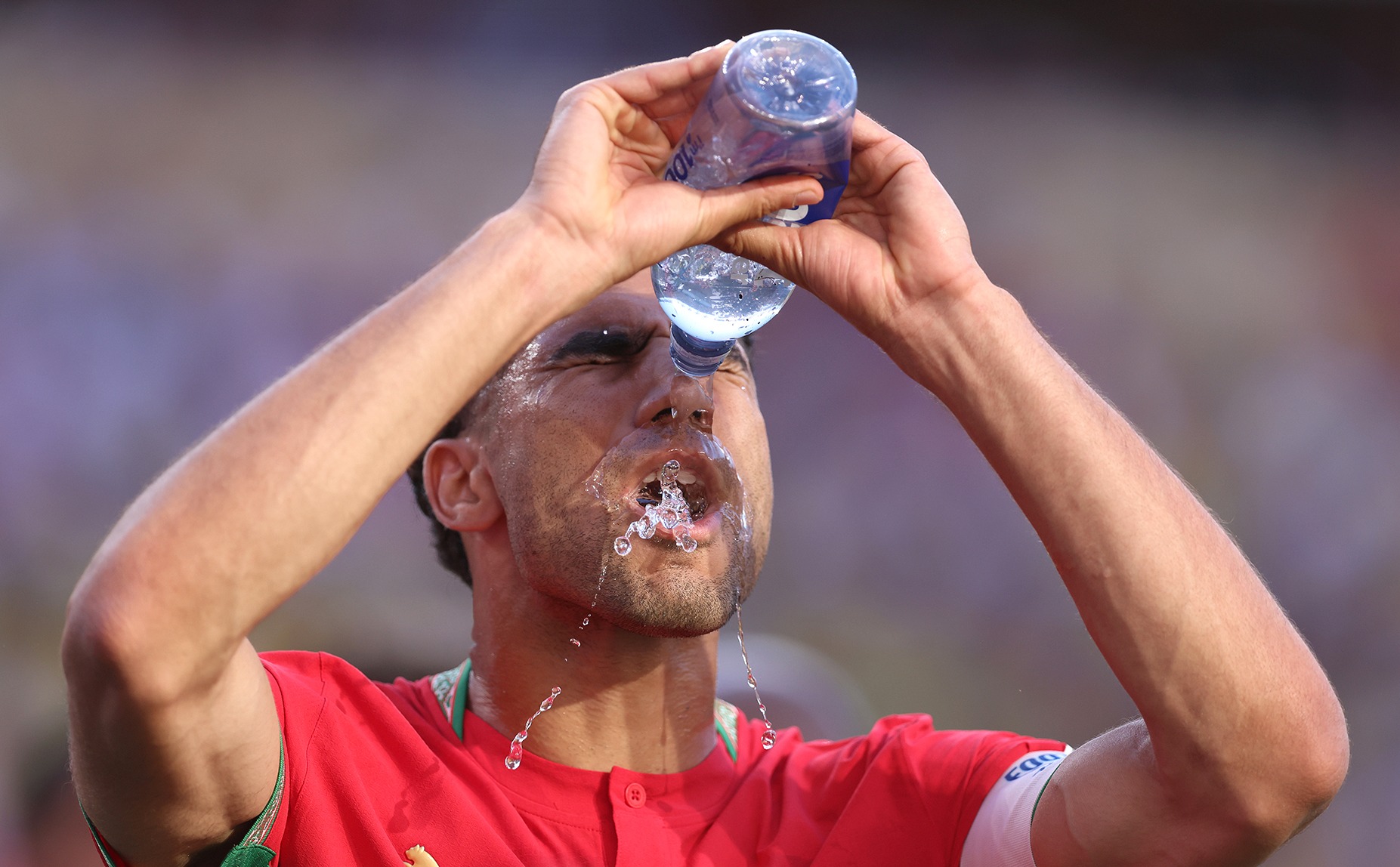
 Achraf Hakimi of Morocco cools down during a hydration break at the 2026 Fifa World Cup. (Photo: Catherine Ivill - AMA / Getty Images)
“Soccer is a game of two halves.” This is a famous idiom that speaks to the duality of the sport. One team can be absolutely dominant in the first stanza, but this does not mean the match is won. The opponents can play equally well in the second half and thus obtain a positive result.
However, if Fifa and some of the corporates involved in the sport have their way, soccer will soon be a game of four quarters. This pilot project for this has already taken off at the ongoing 2026 Fifa World Cup, in the form of “hydration breaks”. Essentially, these are ad breaks.
What is a hydration break?
During these intervals, at World Cup stadiums, players are provided with three minutes to replenish the liquids in the bodies – amid sometimes unbearable heat in the host countries the US, Canada and Mexico. But if you are watching on television, for large chunks of the break the broadcast moves away from the scenes on the pitch and you are bombarded with ad breaks from various World Cup sponsors.
This happens twice, halfway through each stanza of the current World Cup’s matches. People attending matches live in North America have let their feelings be known on these so-called hydration breaks.
/file/attachments/orphans/GettyImages-2282559617_792016.jpg "Hydration breaks have been met with disdain by fans at the 2026 Fifa World Cup. (Photo: Marvin Ibo Guengoer - GES Sportfoto / Getty Images)")
Whenever the referee blows his whistle to signal to players that they must step off the field to rehydrate, this is generally met with cacophonous boos and jeers ringing out throughout the various stadiums. The feelings of the masses on the matter are clear, based on that evidence.
Germany forward Kai Havertz shared his feelings on the breaks, telling The Guardian: “They’re usually annoying, especially when you’ve just had two or three good situations and feel your flow is now being interrupted. But others decide that.”
/file/attachments/orphans/GettyImages-2283911656_664139.jpg "Kai Havertz of Germany (right) has described the hydration breaks as ‘annoying’. (Photo: Megan Briggs / Getty Images)")
Despite the breaks also providing coaches with an opportunity to share important tactical information with players, not all coaches have embraced them. Veteran tactician Marcelo Bielsa, who was in charge of Uruguay during the World Cup, shared similar feelings to Havertz before his team was eliminated from the 2026 tournament.
“Playing four times instead of two alters the conception of what had been culturally built to interpret football,” Bielsa said.
“This change of culture does not add anything and takes away a lot. I will just say that before this decision, football had a characteristic, now it has another. People fall in love with the game because of its characteristics,” the 70-year-old coach added.
/file/attachments/orphans/GettyImages-2283575595_467739.jpg "Uruguay coach Marcelo Bielsa dishes out instructions at the 2026 Figa World Cup. (Photo: Juan Luis Diaz / Quality Sport Images / Getty Images)")
Fifa’s stance
However, Fifa has defended breaking up World Cup matches into quarters by citing the heat in various cities hosting the quadrennial soccer banquet. According to the custodian of global soccer, at the heart of the pauses is player welfare, which is important due to the heat.
The gripe that many people have with the breaks comes via the fact that these hydration breaks are enforced with a blanket approach. It does not matter whether some matches are played in cooler conditions, or if technologically advanced stadiums that have the ability to control what conditions players are subjected to on the day are being used.
/file/attachments/orphans/GettyImages-2282971105_109699.jpg "Frenchman Désiré Doué has a water break during the 2026 Fifa World Cup Group I match between Norway and France at Boston Stadium on 26 June 2026 in Foxborough, Massachusetts. (Photo: MB Media / Getty Images)")
“For every game, no matter where the games are played, no matter if there’s a roof, or temperature-wise, there will be a three-minute hydration break. It will be three minutes from whistle to whistle in both halves,” said Manolo Zubiria, the US’ chief tournament officer for the ongoing World Cup.
Despite the disdain from soccer purists around the world, as well as people such as Havertz and Bielsa, Fifa has stood firm. The federation’s president, Gianni Infantino, brushed aside criticism that the hydration breaks are just a capitalistic money-grab, saying the organisation he heads will not be making money from the innovation.
/file/attachments/orphans/GettyImages-2282934213_644382.jpg "Fifa president Gianni Infantino has defended the mandatory hydration breas at the 2026 Fifa World Cup. (Photo: Joe Prior / Visionhaus / Getty Images)")
“The main reason is the heat, but we also have to understand that in a competition like the World Cup, played over 39 days, with teams potentially playing eight matches in those 39 days, having a moment to rest is extremely important,” Infantino said.
“What matters even more to us is ensuring that all teams, in every match, are playing under the same conditions. And it’s very difficult to accept that a coach might have the opportunity to influence a match by making adjustments simply because it’s hotter, while in another match, where the temperature is slightly lower, the same coach doesn’t have the same opportunity. We want to ensure equal conditions for everyone, and that’s why these breaks are implemented in every match,” said Infantino.
“There is no additional revenue for Fifa, as all commercial agreements were signed well in advance. So, this is not a financial issue for us. For us, it is purely a sporting matter,” the Fifa boss said.
Player welfare or business interests?
The question that should be asked is why Fifa felt the need to deviate from the standard of the cooling breaks that were already part of the sport. It’s not uncommon in matches played in Africa, for example, to see referees haul off players for a brief drinks break in scorching heat.
What is not normal is for those breaks to then be used for advertising purposes. The broadcast remains fixed on what is happening on the field, even if it’s just players conversing among themselves.
Fifa’s argument has also been tainted by the fact that in the round of 32 match between co-host Mexico and Ecuador, the hydration breaks were abandoned. This is because kickoff in that match had to be delayed by an hour due to thunderstorms in Mexico City. That’s an example of Fifa’s pursuit of uniformity falling away.
/file/attachments/orphans/GettyImages-2284103482_988086.jpg "The round of 32 match between Mexico and Ecuador in Mexico City on 30 June 2026 did not have any hydration breaks. (Photo: Carl Recine / Getty Images)")
In addition to that, Infantino’s assertion that Fifa is not making money from the myriad ad breaks that come with the fixed cooling stoppages is true for now. But it may not be true by the time the next couple of World Cups come around. Especially as Fifa is pushing for the stoppages to become the norm, regardless of the conditions in the host country.
Fifa may not be making money now. However, if the hydration breaks do become a staple at World Cups, there will be an opportunity for the federation to leverage this when they negotiate with broadcasters for rights. DM
Comments
Scroll down to load comments...