




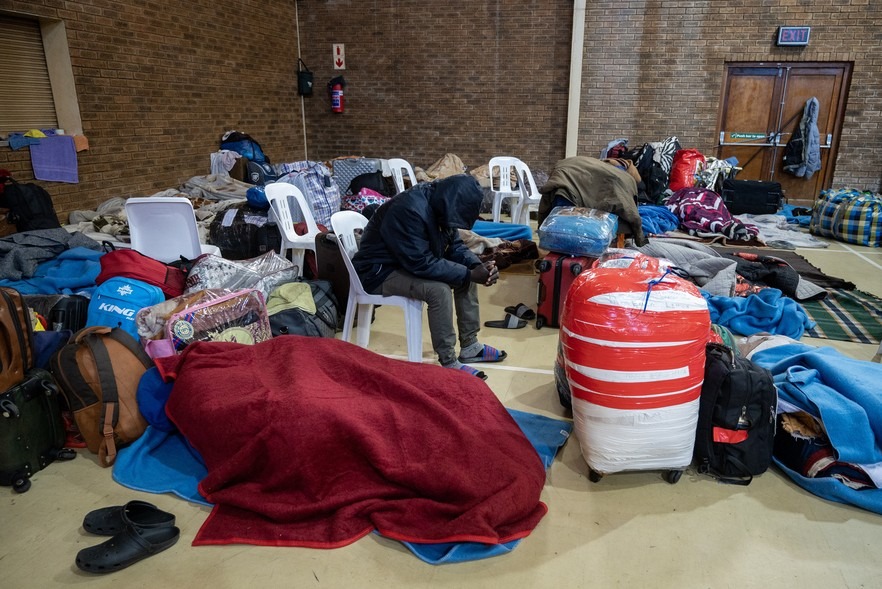
 A Malawian man waits in a hall at the Callie De Wet Sports Centre in Robertson. About 300 Malawians have been awaiting repatriation. (Photo: David Harrison)
Malawian immigrants, fearing xenophobic violence, have sought shelter at the Callie de Wet community hall in Robertson, Western Cape. Their numbers have swelled to more than 300 this past week.
When GroundUp visited the town on Tuesday, we found South African Police Service (SAPS) officers monitoring the area and dozens of people from Nkqubela informal settlement gathered on the mountain.
“We are not safe here at all,” a woman from Lesotho told us. She was born in Lesotho and grew up in De Doorns before moving to Robertson. She had been working on a fruit farm in McGregor for five years.
She said the police had come searching for undocumented immigrants that morning.
Asked about the alleged raids, SAPS provincial spokesperson Sergeant Wesley Twigg said Robertson police had no record of this.
/file/attachments/2994/gu2_890196.jpg "Immigrants from Malawi and Lesotho fled the Nkqubela settlement in Robertson and gathered on the mountains after early morning raids, allegedly by SAPS, looking for undocumented people. (Photo: David Harrison)")
Back at the community hall, a man who did not want to be identified said supporters of March and March had gone door to door, threatening people.
“The landlord told us to get out. We came here to look for a safe space.”
We met 10 Malawians who said they had come to the hall from Klapmuts in Stellenbosch, hoping to be repatriated. They had spent all their money on transport and had nothing left for food.
In the hall, people were lying on donated mattresses and blankets, with women and children in a separate area. In a kitchen at the back, volunteers were preparing food.
/file/attachments/2994/gu3_336295.jpg "Malawians from the Nkqubela settlement in Robertson are processed by home affairs officials at the Callie De Wet Sports Centre. (Photo: David Harrison)")
Two men in their twenties said they fled Ashton and had been living in the hall for a week. One of the men had been working on a farm in Ashton for two years. The other said his boss had “chased him away” because he didn’t have the right documentation.
“We are safe here, even though we have to go home. We accept the situation. We don’t know how long it’s going to take,” said one of the men.
They were grateful for the support they had received.
/file/attachments/2994/gu4_786641.jpg "Robertson town council Speaker Paula Hess (left) and Benita Ahamed prepare food for displaced immigrants at the Callie De Wet Sports Centre. (Photo: David Harrison)")
We met Wicks Mangombe standing outside the hall where blankets and clothes were hung up to dry. He said he had been living in the country for two years.
He added that while there had been food donations, there had not been enough to go around as the numbers swelled. He had no money left and had not had much to eat in the past week.
He was evicted by his landlord, who feared anti-immigrant violence.
“We are suffering now. We don’t know when the buses are coming. We are in pain; it’s not a nice situation,” said Mangombe.
/file/attachments/2994/gu5_443489.jpg "Malawian immigrants outside the Callie De Wet Sports Centre in Robertson. (Photo: David Harrison)")
Celeste Matthys, Langeberg Municipality Director of Economic, Social and Integrated Development Services, said she had spent the week at the hall trying to manage the situation.
On 21 June, Ashton police called her when about a dozen people came to them, saying their landlords had kicked them out of their homes.
On that Monday, the municipality identified the community hall as a temporary shelter. The numbers then grew, with people coming from various areas, including Swellendam.
/file/attachments/2994/gu6_136183.jpg "The Nkqubela settlement in Robertson. (Photo: David Harrison)")
About 225 Zimbabweans were transferred from the hall to a Home Affairs Refugee Reception Centre site in Epping, Cape Town, to be processed for repatriation.
Those left at the Robertson hall are all Malawians.
Matthys said: “Most of them have experienced their doors getting kicked in the middle of the night and their belongings being taken. Most of the people have been coming because of threats in the communities.”
She said they had struggled to keep up with the demand as more people came. They were grateful to the local community and organisations like Gift of the Givers for mattresses, blankets, food and baby products.
“These Malawian people only came to our country for a better life,” she said.
Inside the hall, there was an area where municipal and home affairs officials were processing immigrants.
On Wednesday morning, five buses arrived to take people to Musina.
/file/attachments/2994/gu7_198300.jpg "A street in Nkqubela. (Photo: David Harrison)")
/file/attachments/2994/gu8_159203.jpg "Zimbabwean women and children wait for a second night after their bus to Zimbabwe broke down along the N1. (Photo: David Harrison)")
/file/attachments/2994/gu9_938639.jpg "A group of Zimbabweans attempting to leave South Africa tries to fix the engine of their rented bus. (Photo: David Harrison)")
Returning from Robertson on the N1, we found a group of Zimbabweans with a broken-down bus at about 6pm. They were on their way to the Beitbridge border.
Elvis Mukucha said the group had organised their own transport and left Bellville on Monday. They spent the night on the bus. It had Zimbabwean number plates. Many had not eaten since the day before. Mukucha said he had been living in SA since 2006.
“It’s better for us to go back to our country because here in SA they don’t like us,” he said. DM
Originally published by GroundUp.
Comments
Scroll down to load comments...