




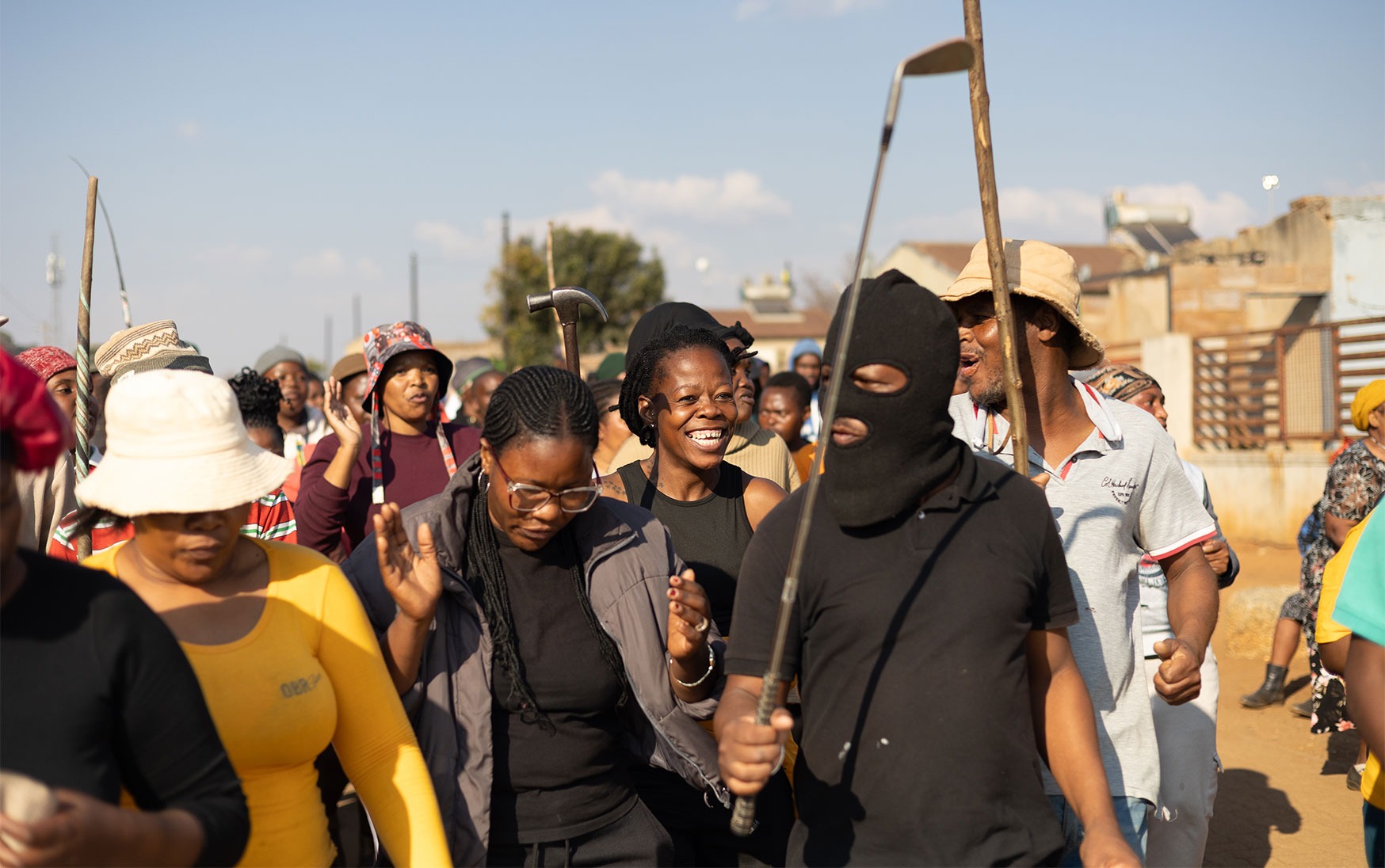
 Residents march through the streets in Greenfields, Katlehong, south of Johannesburg, on 1 July 2026 during community-led evictions of migrants and their businesses. (Photo: OUR CITY NEWS / Alaister Russell)
In the aftermath of the nationwide xenophobic 30 June protests, the South African Police Service proudly claimed that the country “remained relatively stable” and that the “overwhelming majority” of protests were peaceful.
/file/attachments/orphans/XAR_Evict-22_242046.jpg "Residents threaten a business in Greenfields, Katlehong, south of Johannesburg on 1 July 2026. (Photo: OUR CITY NEWS / Alaister Russell)")
/file/attachments/orphans/XAR_Evict-9_497570.jpg "A SAPS police officer arrives as residents gather to evict migrant-owned businesses in Greenfields, Katlehong, on 1 July 2026. (Photo: OUR CITY NEWS / Alaister Russell)")
But for South Africans and migrants alike who woke up on 1 July and had to reckon with the aftermath of their businesses being destroyed, their homes and privacy violated, their bodies assaulted, and in at least one case their loved one being taken away from them, these words ring hollow.
In Alexandra, north of Johannesburg and an area that has seen violent xenophobic violence over the years, 21-year-old Siphesihle Mncemeleni was shot and killed on Tuesday night after a Somali-owned spaza shop was looted.
His sister, Nompumelelo, 18, told Our City News on Wednesday morning that Siphesihle, or Sihle as he was known, brought his friend’s phone to charge it at their house. After noticing that it wasn’t charging, he wanted to take the phone back to his friend, who was only a block away on 9th Avenue.
/file/attachments/orphans/XAR_Evict-16_577914.jpg "A resident carrying an angle grinder arrives at a shop during community-led evictions in Greenfields, Katlehong, south of Johannesburg on 1 July 2026. (Photo: OUR CITY NEWS / Alaister Russell)")
Nompumelelo didn’t know that this would be the last time that she saw him alive.
“What is sad is that Sihle was in the house the whole day, and it’s like death called him because he left to give his friend his phone and never came back,” she said.
Gauteng police spokesperson Brigadier Brenda Muridili told Our City News that police had opened a murder case. She said that the circumstances surrounding the incident were under investigation.
/file/attachments/orphans/XAR_Evict-6_364626.jpg "Mozambican national Moses Sithole looks through his possessions after residents evicted him from his home in Greenfields, Katlehong, on 1 July 2026. (Photo: OUR CITY NEWS / Alaister Russell)")
Deputy National Police Commissioner Lieutenant General Tebello Mosikili told the media on Wednesday that police worked tirelessly throughout the night to “ensure that peace, safety and stability prevail”.
Despite these assurances, and confirmation that police arrested more than 900 people throughout the country, only 82 arrests were made in Gauteng, with many people and communities throughout Johannesburg experiencing a night of fear and panic. In Malvern and Jeppe, a large mob moved through the streets and at times had to be dispersed with rubber bullets.
/file/attachments/orphans/XAR_Evict-18_662291.jpg "Residents chant struggle songs near a shop where people are evicting people from migrant-owned businesses in Greenfields, Katlehong, on 1 July 2026. (Photo: OUR CITY NEWS / Alaister Russell)")
There were reports of mobs going from door to door in certain areas, and in Tedstone Ville, east of Johannesburg, one Mozambican man told Our City News how a mob from the nearby Ramaphosa informal settlement had come looking for undocumented migrants who were renting backyard shacks in the neighbourhood.
“In 2008, they burnt my car. I saw them kill and burn people. That is why I moved this side,” he said early on Wednesday morning.
“Last night, the people came from that side. They came here, they were outside the gate, but I did not come outside. I only heard they were looking for foreigners. They were shouting and shooting.”
/file/attachments/orphans/XAR_Evict-24_894812.jpg "A resident leans against a shop owned by migrants during community-led evictions of migrants and their businesses in Greenfields, Katlehong, on 1 July 2026. (Photo: OUR CITY NEWS / Alaister Russell)")
In Thembelihle and further south in Lenasia, there were similar incidents, with one woman telling Our City News reporters that a group of people forced their way into her house. They harassed and intimidated her, stole her TV and a cellphone and left.
Also in Thembelihle, a group of men forced their way into a Malawian man’s house, struck him on the head with the butt of a gun and left. Community activists visited the man in hospital on Wednesday and were later going to open a case at the police station.
SA traders lose goods, equipment
But it wasn’t just assaults and intimidation that occurred on Tuesday night. South African traders at the Natalspruit taxi rank in Thokoza in the east of Johannesburg arrived at work on Wednesday morning, only to find their goods, including fruit and vegetables, and other tools such as sewing and tailoring machines broken and lying on the ground at the rank.
There were charred trolleys, blackened merchandise and ash-covered parts of the trading area. Among those who had lost their goods the night before was South African informal trader Lizzy Elizabeth Khoza, who said she was devastated after seeing that her stock had been destroyed.
“I was shocked and heartbroken when I saw my stock. I don’t know what to do,” she said. “They burnt all the trollies and took some of my stock. I get business from the same people who burnt my stock.”
Taxi rank manager Moses Mtshali told Our City News that traders were told to remove their stock before the protest. “I told them to remove their stock, but they didn’t listen. Those who listened, their stock was not affected by this,” he said.
Risks of expulsion rhetoric exposed
A day after marches were held across the country, groups of people mobilised in parts of Johannesburg on Wednesday, targeting businesses and demanding that undocumented migrants leave and for South Africans to be hired in their place.
In Germiston, a group grew to at least 200 people at one point, as it moved among businesses in the area. The mobilisation showed how quickly the language of protest around “illegal immigration” can spill over into intimidation on the ground, particularly when groups feel emboldened by wider campaigns that frame migrants as a problem to be removed.
Although March and March leaders have repeatedly described their campaign as peaceful and lawful, Wednesday’s events again exposed the risks created by that rhetoric. Under the banner of demanding action against undocumented migration, groups on the ground have increasingly blurred the line between protest, vigilantism and xenophobic harassment.
In Greenfields, south of Johannesburg, a group marched to several shops owned by migrants and demanded that they pack up their shops and leave.
The mob had allegedly warned migrant-owned businesses on Tuesday that they needed to leave on Wednesday. Some had already left, and those who hadn’t yet left were on Wednesday forced to close their businesses. DM
This story is produced by Our City News, a non-profit newsroom that serves the people of Johannesburg.
/file/attachments/2985/WhatsAppImage2025-11-21at1946001_346702_1cea9e715c05dc0a538fc79753ac3401.jpeg)
Comments
Scroll down to load comments...