




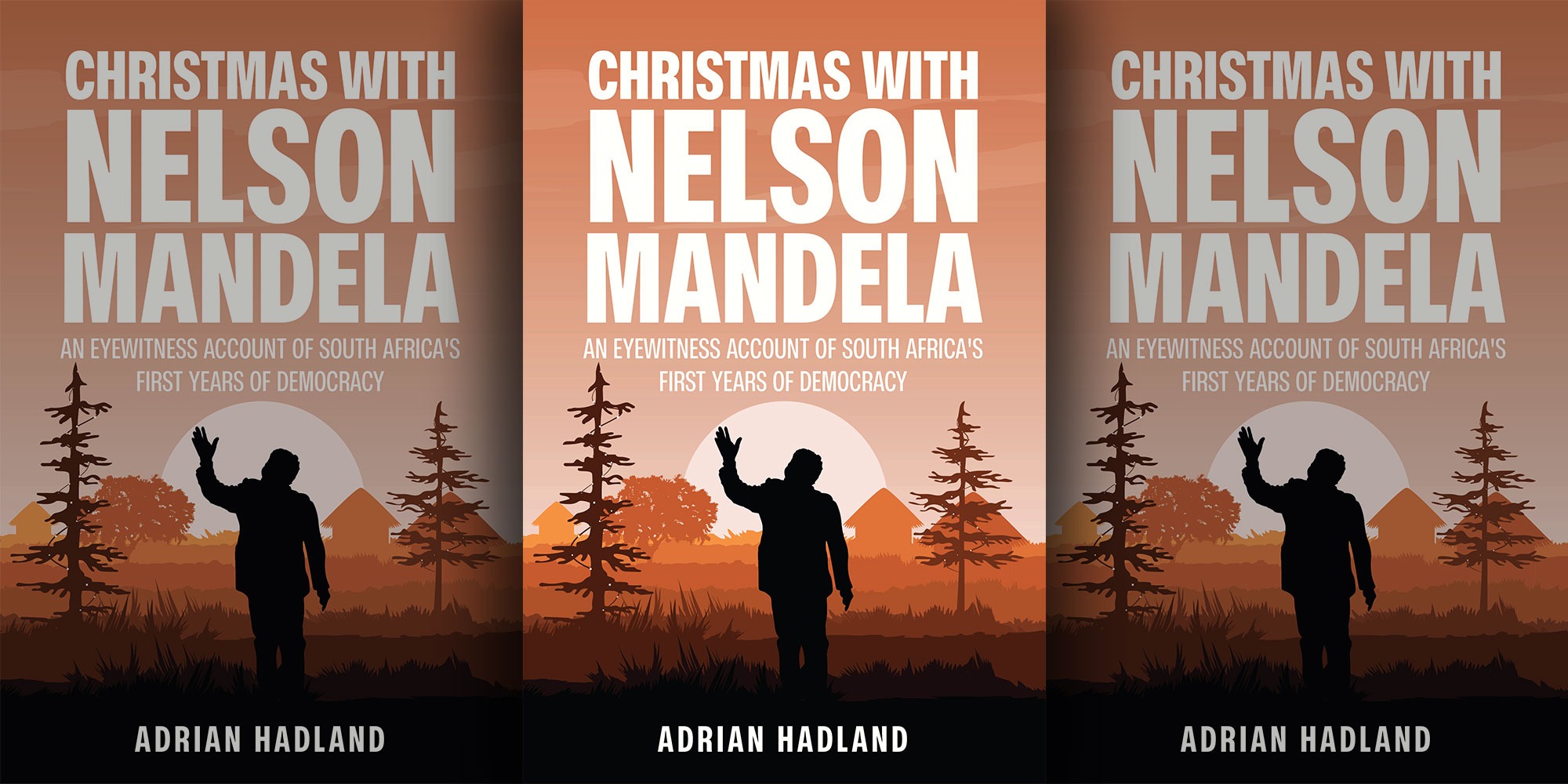
 Christmas with Nelson Mandela by Adrian Hadland. (Image: Low Battery Books)
 Journalist Adrian Hadland had a box of cuttings and papers sitting in his wardrobe for close to 20 years, full of writing, columns and words about an extraordinary period in South Africa’s history: the Government of National Unity presided over by Nelson Mandela from 1994 to 1999. In Christmas with Nelson Mandela, he transforms that personal archive into a book. Here is an excerpt.
***
December 25, 1995
It is a little before five in the morning and Nelson Mandela is dressed to walk the hills in the dark, moist weather.
The sun is scarcely an orange smudge above the misty Transkei valleys of his birthplace, but Mandela has a lot of ground to cover.
He chooses a different direction each day, sometimes south to the village of Mvezo on the banks of the Mbhashe River, where he was born; sometimes toward Mqhekezweni, the Great Place, formerly the residence of Chief Jongintaba Dalindyebo, where Mandela lived for the 10 years prior to his circumcision.
As he walks, the people in the scattered hamlets come hailing him with calls of “Madiba”, “Nkosi” or “Dada”. They take his hand in theirs, women and children looking away in the traditional sign of respect.
They chat for a few moments before he walks on through the mist or rain that quickly rolls across the shallow hills.
The children rush to greet him, pushing their small hands into his boxer’s paws, laughing. He asks each of them their name and, usually, about their schoolwork.
For a few precious weeks each year, the South African president returns to Qunu, the place of his childhood.
“It becomes important, the older you get, to return to places where you have wonderful recollections,” he says. “This is really home.”
It was in the fields surrounding the village of Qunu, just 35km southeast of Umtata in the Eastern Cape, that Mandela had some of his most formative experiences. Here, he has built an exact replica of the house in the grounds of the Victor Verster Prison in Paarl where he spent the last of his 27 years in prison.
‘Practically free’
It was this house, guarded by a few bored warders (they became bored when they realised he wouldn’t try to escape, he says) that he enjoyed his first moments in almost three decades of being “practically free”.
For this reason, the house has pleasant memories and so has been rebuilt in the place closest to his heart. When its rooms are filled with his grandchildren and people from the surrounding villages have gathered in his garden to feast, then he is truly a happy man.
As he walks, the fond memories come flooding back: the big boulder he used to slide down as a child, his first school, the trading store where he first saw white people, the hut he used to share with his childhood friend, Justice, son of Dalindyebo.
But it is not all sweet recollection and misty-eyed reminiscence. The abject poverty of many of these people, the brackish drinking water, the smoking cow dung they use to cook their meals and scarcely heat their homes – all this saddens him deeply and is a clear reminder of the awesome responsibilities he now holds towards them and many others.
“When you see the children, the way they are dressed, completely emaciated, you are really moved,” he says. “You feel the indescribable pain of poverty and responsibility.”
At one village, an impromptu meeting is held with children scattering off to round up still dozing or working adults. Thirty or 40 people are gathered by the time the chief begins his speech. “Madiba, we are very proud you grew up here,” he says, a second elder translating. “Whenever we see you putting your feet in our soil it gives us great hope.”
One of Mandela’s fondest memories is of the tales he used to hear while living at Dalindyebo’s kraal in Mqhekezweni. It is not surprising, then, that Mandela too likes to tell a good tale or two in the autumn of a remarkable life.
But the stories of the latest leader of the Madiba clan are far more international than ever they were at Dalindyebo’s kraal. He now speaks of US President Bill Clinton and of the American leader’s somewhat testy relationship with Cuba’s Fidel Castro and Palestinian leader Yasser Arafat; he chuckles over the repeated bearhugs dished out by Russian President Boris Yeltsin. He describes former British Prime Minister Margaret Thatcher’s gentleness and motherliness and her Labour Party opponent Neil Kinnock’s shock at the description. He tells of French premier Jacques Chirac’s support and frankness and, off the record, of the various idiosyncrasies of some of South Africa’s better-known leaders.
A welcoming prospect
As we round the crest of a hill, his homestead is nestled some 500m below in a verdant valley. The brick house, of jail staff quarters design, is faintly incongruous with the grass roofs and mud walls of his neighbours. But the Christmas lights on the young pine trees leading to his front door, the smoke from an outside fire curling up into the morning sky and the two yellow marquees in the back garden are a welcoming prospect.
On Christmas morning, anyone who lives within walking distance of the Mandela kraal is invited to a two-day feast. Sixteen sheep and an ox are slaughtered for an expected 600 guests. Mandela’s great-granddaughter, Rochelle, has been up all night wrapping presents. As usual, the children come first; the adults will only eat once the children have been fed. (“There is brandy for the old ones later if the food has run out,” he says).
As he walks down the hill homewards, alongside the main road from Umtata to East London, people wave and shout from their cars. Some stop and come over to introduce themselves.
It has been one of the disadvantages of his fame and renown – the lack of privacy, he says. In 1984, while serving time on Robben Island, he was placed in isolation. Though he could meet the other prisoners occasionally, he became used to living alone. It is partly for this reason that he no longer holidays at the game farms so strongly recommended by Deputy President Thabo Mbeki and Jakes Gerwel, the cabinet secretary.
On this day, there is time before the feast begins and the neighbours start to show up in their Sunday best, for a quick motorised tour of the outlying districts and villages he hasn’t had time to reach on foot.
But first a cup of tea, a game with the grandchildren, and a glance at the Sunday papers. Kicking off his muddy shoes in the doorway of his kitchen, with the hills of Qunu partly obscured by the early morning mist, he is home, truly home. DM
Christmas with Nelson Mandela is published by Low Battery Books. It is available at a retail price of around R510.