




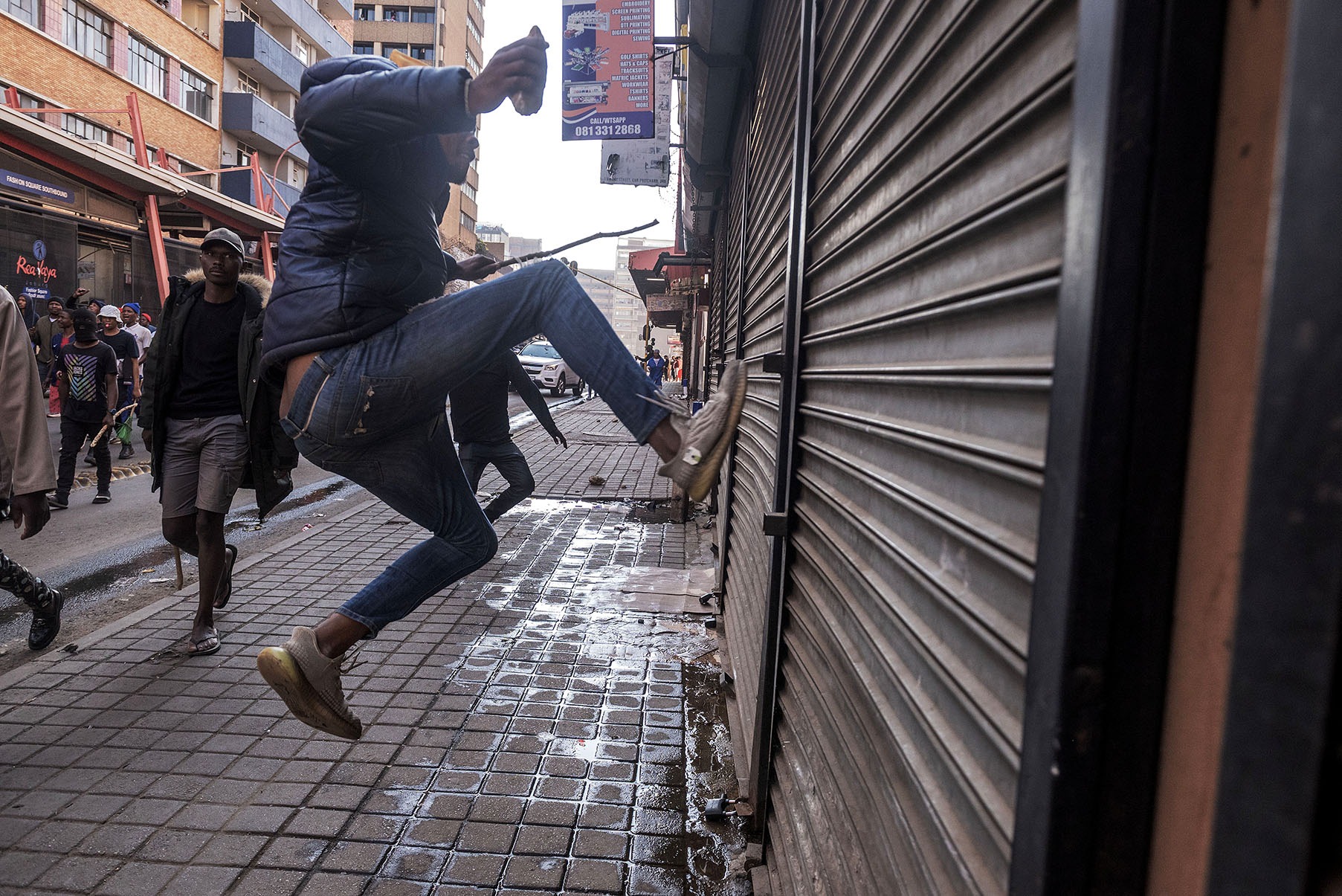
 Protesters marched through the Johannesburg CBD, South Africa, on Tuesday, June 30, 2026. As they passed several businesses, some protesters banged on doors and windows while chanting slogans during the demonstration. (Photo: Leon Sadiki)
A Rosettenville, Johannesburg, business owner, who spoke to Daily Maverick on condition of anonymity, said his business turnover was 30% down for June as a result of the xenophobic unrest.
“The first reason for that is that our customers have left, so there aren’t as many people in the area, because a lot of our customers are foreign nationals … not only the illegal people, but also the affluent legal people who are from other countries,” he said.
He noted that he had lost two of his “best staff members”, who had been forced to return to their countries.
“When I bought the store about five years ago, they were already employed. Although the one worker came to the country legally, his papers expired, and when we tried to renew them, there were huge bribes that we were asked to pay,” he told Daily Maverick.
“I don’t know what the future holds. I’ve lost my two best workers, so there’s a good chance I’m going to close the shop. I was trying to recover after Covid and started at zero, trying to get the shop profitable, but I think this is it,” he said sadly.
While no formal estimate has yet been published on the rand value of business lost to the 30 June protests, early reporting points to a direct commercial impact, with shops closing pre-emptively, informal traders staying away, foreign workers remaining at home and security costs rising as police and military resources were deployed.
/file/attachments/orphans/ED_614179_882278.jpg "Protesters march against illegal immigrants on 30 June in Pretoria. (Photo: Frennie Shivambu / Gallo Images)")
Cross-border transport
Rebecca Phala, national spokesperson for the South African National Taxi Council (Santaco), confirmed that the taxi association had received reports of growing uncertainty among travellers, particularly on routes operating between Gauteng and neighbouring SADC countries, especially Mozambique and Zimbabwe.
“At this stage, we are still engaging our provincial and association structures to consolidate information and would therefore not want to speculate or provide figures that have not been fully verified. Our immediate concern is ensuring that people who travel lawfully across our borders continue to do so safely and without unnecessary fear or disruption,” she told Daily Maverick.
Phala noted that any disruption to lawful cross-border transport has wider implications beyond taxi operators alone. It affects commuters, families, small businesses, tourism, regional trade and the many communities whose daily livelihoods depend on reliable transport connectivity.
“We continue to monitor developments while engaging affected structures,” she said.
Santaco says it is aware of heightened tensions surrounding the planned protest action and continues to receive updates from its structures.
“We encourage continued coordination between law enforcement agencies, border management authorities and transport stakeholders to ensure that legitimate cross-border travel, regional trade and public safety are protected. Our position remains that immigration management must be conducted through lawful state processes and not through actions that may place innocent travellers, transport operators or communities at risk,” she cautioned.
/file/attachments/orphans/WhatsAppImage2026-06-30at1051061_836360.jpeg "Protesters in Johannesburg march against illegal immigrants on 30 June. (Photo: Leon Sadiki)")
A White Paper on National Labour Migration Policy, presented in Parliament on Friday, 26 June, shows that there is no evidence that international migrants are a major cause of unemployment in South Africa. In fact, it cites a 2018 World Bank analysis which found that for every employed migrant in South Africa, two jobs were created for South Africans.
The Conversation reports that research by Justin Visagie, associate professor at Wits University’s Southern Centre for Inequality Studies, and Ruth Castel-Branco, a senior lecturer at Wits, suggests that the unemployment rate would fall by only six percentage points — from 43.6% to 37.6% — if all foreigners’ jobs were somehow handed to unemployed South Africans.
“This is a relatively modest reduction given the scale of South Africa’s unemployment crisis. It highlights that foreigners do not dominate the labour market overall, even if some sectors and locations have higher concentrations of immigrant workers,” said Visagie.
As a 2018 World Bank report points out, self-employment accounted for 25% of total jobs for immigrants, compared to 16% for locals.
“Migrants are more likely to appear in entrepreneurial roles than locals, suggesting that their actions are likely to promote economic growth by enhancing, for instance, the supply of small retail establishments,” the report states.
A report by the Organisation for Economic Cooperation and Development, titled How Immigrants Contribute to South Africa’s Economy, concluded that:
- Immigrants are well-integrated into the labour market in terms of employment and unemployment rates and, in general, do not seem to displace native-born workers.
- Immigrant workers are more likely to be employed than native-born South Africans, which is consistent with the country’s very low employment rate.
- Immigration seems to be, at least in part, demand-driven, and immigrant workers are frequently found in occupations with high growth rates.
- The impact of immigration on gross domestic product (GDP) per capita is positive.
- Estimates from an econometric model show that immigrant workers may raise the South African income per capita by up to 5%.
- Immigrants also have a positive net impact on the government’s fiscal balance as they tend to pay more in taxes, especially in income and value-added taxes. DM
Comments
Scroll down to load comments...