




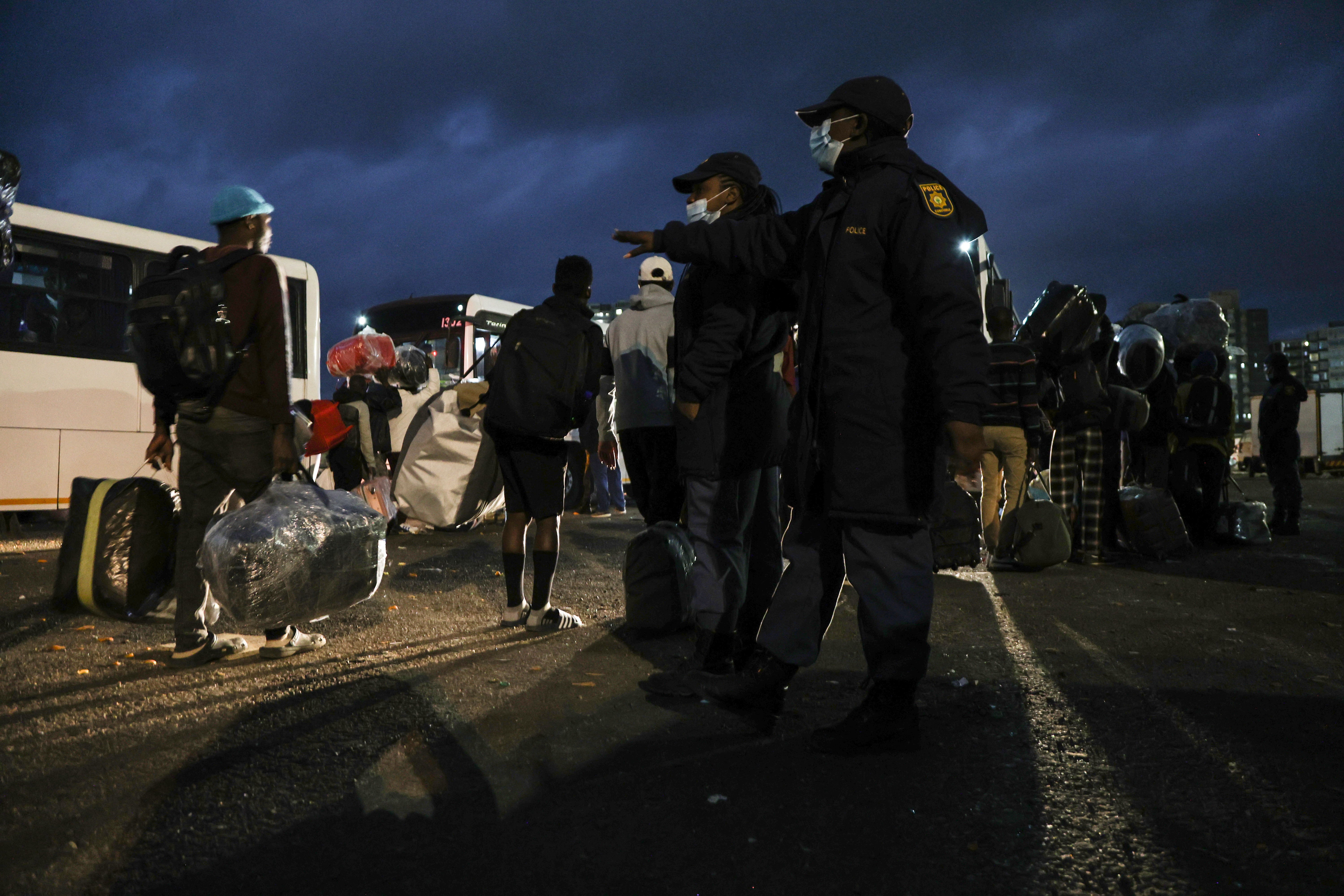
 Foreign migrants board buses at the drive-in site in Durban as they begin their voluntary repatriation journey to Malawi on 29 June 2026. (Photo: Felix Dlangamandla)
Every wave of anti-immigrant sentiment or discontent around the globe carries an implicit economic claim that foreigners are taking away jobs, committing crimes, draining public services and hollowing out local livelihoods.
In South Africa, those claims were sharpened with a cruel and concrete threat of eviction by 30 June. It might be worth pausing on that claim because the data tells a much more nuanced story. A story where the people most often blamed are, in aggregate, quietly holding up parts of the economy without much acknowledgement.
/file/attachments/orphans/JABULANIMARCH19_161513.jpg "Residents of Soweto marched from the Jabulani Amphitheatre to the Protea North Police Station in Soweto, Johannesburg, South Africa, on Monday, 29 June 2026, before a planned demonstration against undocumented migrants scheduled for the following day. (Photo: Leon Sadiki)")
Take Mpho, a friend of a friend who arrived from Malawi in 2011 with nothing and no papers. He crossed the border illegally due to economic desperation and then did everything that those who fear illegal migrants, and much of the public sentiment in South Africa today, would have expected him not to do.
He built a life for himself with little to no resources at hand. Today, he runs a small business in Cape Town and employs other people. And by every measure, the South African state cannot quite bring itself to record that he is a contributor to the informal economy, to the livelihood of his workers, to the tax he pays every time he restocks.
By the logic of the mob and complacent bystanders, he’s exactly the problem.
The gap between the portrayal of the story of Mpho (along with countless like him) and what aggregate data from official national statistics actually show today reflects a broader divide driven by disinformation, economic desperation and meaning-making. That gap is worth investigating in its own right rather than accepting it as a “legitimate concern”, as President Cyril Ramaphosa has done under immense political pressure.
Let’s start with who migrants actually are, both documented and undocumented. According to South Africa’s two most recent censuses, the foreign-born population increased from roughly 2.18 million in 2011 to about 2.41 million in 2022. That was a modest increase in absolute numbers, but a decline as a share of the population, from 4.2% to 3.9%. Most come from the region next door: Zimbabwe, Mozambique and Lesotho.
Economic contribution
So what do they contribute to the economy? Actually, more than they take, on every serious estimate. The 2018 joint OECD-ILO study remains the most thorough accounting (although dated) of the issue and found that immigrants generated 8.9% and 9.1% of national GDP, a share larger than their slice of employment, meaning the average foreign worker is more productive than the headcount suggests.
A World Bank analysis of 1996 to 2011 reached a similar conclusion: each immigrant worker generated roughly two jobs for citizens.
/file/attachments/orphans/JABULANIMARCH20_253849.jpg "Soweto residents march against undocumented migrants on Monday, 29 June 2026. (Photo: Leon Sadiki)")
This is because immigrant and local labour tend to complement rather than compete in aggregate, and migrants are more likely to start businesses and hire locals. In economics, we call this “complementarity” or “multiplier effects”, which in simple terms means that migrants and locals are not perfect substitutes.
They specialise in different tasks, which raises overall productivity and demand for local labour and goods. This results in an increase in local consumption and further demand, thus creating additional jobs for South Africans.
Non-existent data
Pivoting to the most damning part of the story, the rise in the xenophobic movement rests on two central claims: first, that countless people, mostly illegal, are entering the country and second, that they are driving up crime.
Both claims collapse under scrutiny, not because the data definitively disproves them, but because the necessary data simply does not exist.
Official South African statistical data on migration identify people as foreign-born or foreign citizens, but they do not distinguish between documented and undocumented residents.
The state’s inability to produce reliable figures, as argued by leading academic demographers such as Professor Tom Moultrie at UCT, is itself a profound failure of state capacity, one that has left space for speculation, misinformation and baseless hate to flourish.
This means that there’s a counting problem, not a population with an invasion problem.
‘Collapsing state capacity’
Harvard University’s Growth Lab project spent two years on this question and concluded that South Africa’s economic plague is driven by “collapsing state capacity and the persistence of spatial exclusion”, not by immigration.
The project documents that over a decade, per capita income has been falling. Unemployment has climbed from 20% at the end of apartheid to 33.5% in 2022, the highest in the middle-income world, with youth unemployment above 60%.
Between 2009 and 2019, exports and investment contributed virtually nothing to growth. The country lost global market share across manufacturing, agriculture and tourism. The findings indicate that the trajectory of South Africa is not one towards growth or inclusion, but rather towards stagnation and exclusion.
Spaza shops
The one domain where immigrant “displacement” rhetoric is empirically sound is the spaza shop economy in townships. Although there are no comprehensive, nationally representative statistics on ownership of township spaza shops, partly due to their informal nature, the available case‑study literature since around 2013 points to a clear upward trend.
Early work in the mid-2010s suggested that foreign-born micro-entrepreneurs controlled around 50% of spaza outlets in some townships. More recent surveys, however, indicate that in certain localities. foreign-born ownership has risen to more than 80% of shops.
The economic pain behind those figures is real, and it should not be waved away. A local-born owner who watched their shop close is not imagining the loss, and the resentment is rooted in a lived experience, not a manufactured one.
That said, this narrow displacement is politically inflated to explain far broader macroeconomic problems that are in fact driven by state failure and structural stagnation, not by a handful of Somali shopkeepers selling bread and cooking oil.
‘Every metric points to the state’
The serious question beneath all of this is one that statistics cannot reach. Why does the anger keep rising for the immigrants when every metric points to the state?
This brings us to the social and political theory of the nation-state conception itself. By its nature, it is a machine for sorting people into insiders and outsiders. And when the inside is failing, along with its insiders, the only explanation it can offer is finger-pointing at the outsiders.
A government that cannot count its residents, keep its lights on or place the poor within the reach of work, can still do one thing cheaply and instantly. It can name who does not belong, and accept it as a “legitimate concern” for its own failures.
What makes this especially bitter in South Africa is that its founding document had the opposite instinct. The post-apartheid settlement was built on the most expansive idea of belonging and the nation-state, along with India.
The constitutional promise, more specifically Section 10, grants that dignity was not a reward for nativity or nativeness.
The turning against immigrants is not the recovery of some authentic national self. It is an old trick of nation-state formulation that has forgotten how to reason better.
Mpho crossed a line on a map, but the deeper crossing, one that is more concerning, is the one South Africa is making right now. From a nation defined by who it could include to one defined by who it can expel. DM
Saurav Roy is a PhD student in the Department of Land Economy at the University of Cambridge, working at the intersection of financial economics, energy transition and economic geography.
Georgina Campbell is a researcher and practitioner at the Wild Law Institute based in South Africa, working at the intersection of systems transformation, education, governance and strategic communications.
Comments
Scroll down to load comments...