



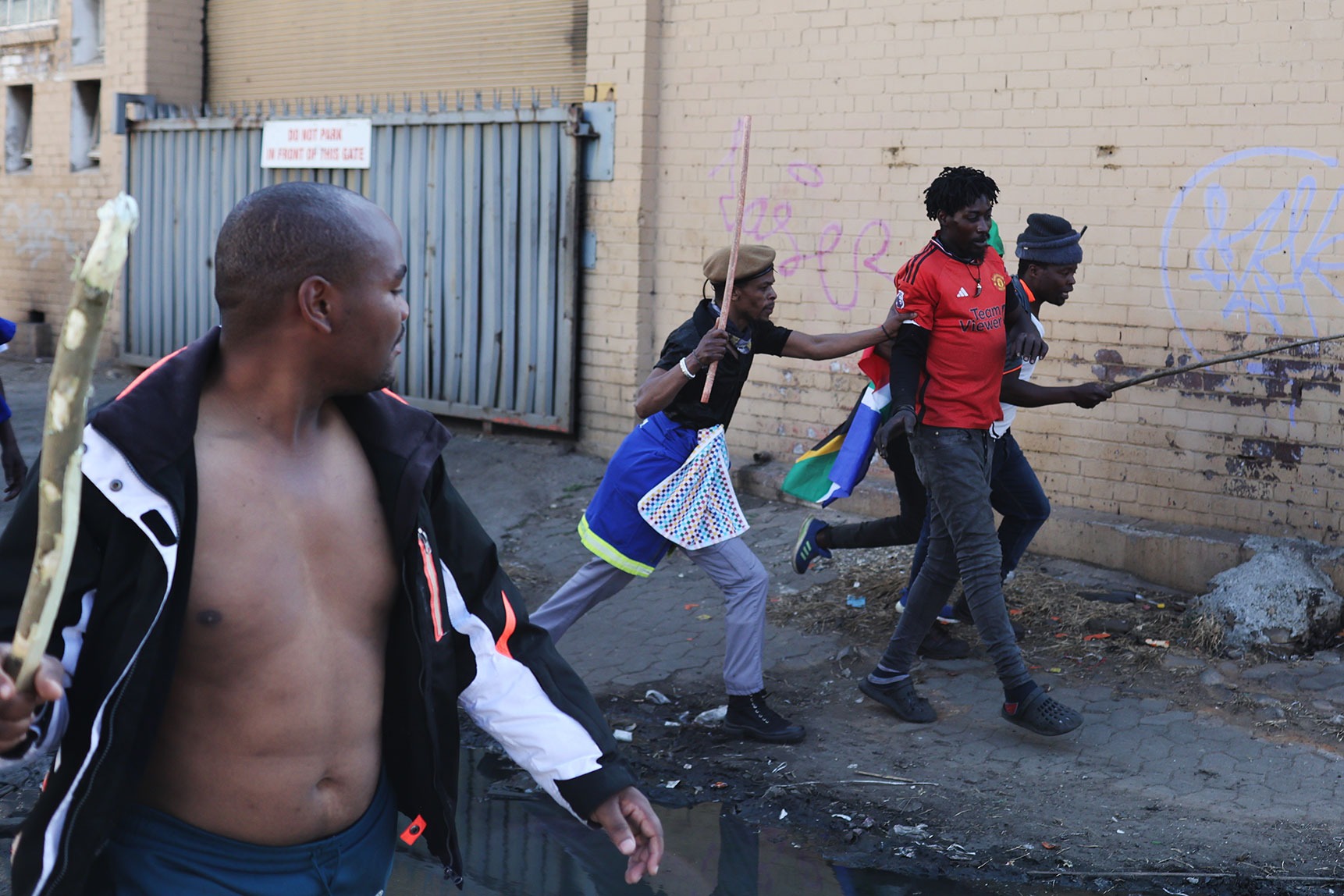
 Anti-migrant marchers intimidate a bystander during demonstrations in the Johannesburg CBD on 30 June. (Photo: Alaister Russell / Our City News)
 For years and decades to come, the date of 30 June will remain etched into the collective memory of South Africans. This might be a stretch, but it might even carry the significance of 8 January, 2 February, 21 March, 27 April, 16 June or 9 August.
Those days — which respectively mark the formation of the ANC in 1912, the unbanning of liberation movements in 1990, the 1960 Sharpeville massacre, the birth of democratic South Africa, the beginning of the 1976 uprisings and the 1956 Women’s March to the Union Buildings — were epochal. They marked seismic turning points. You know, the moments when it is clear to everyone that things will never be the same again.
The date of 30 June 2026 — and the months that preceded it and the days that will follow it — was a turning point in its own right. It was when the South African state effectively ceded power to a coterie of rabble-rousers with questionable motives.
Like the other moments, this one will have images that we will remember it by. For instance, the image of bodies strewn on the streets of Sharpeville, the picture of dying Hector Pieterson and snaking queues of election day 1994 are instantly recognisable.
Over the past few weeks, the sights of marching impis led by the likes of Jacinta Ngobese-Zuma, Ngizwe Mchunu and Nkosikhona “Phakel’umthakathi” Ndabandaba have been daily features on our media platforms. There have been heartrending images of desperate and suffering mothers and children at ramshackle camps, buses transporting terrified foreign nationals home and the long queues at border gates. And there have been those scenes of flare-ups in parts of the country where citizens took the law into their own hands, shutting down foreign-owned businesses and inflicting violence on those whom they believed should not be here.
/file/attachments/orphans/XAR_June30-13_986017.jpg "Anti-migrant marchers intimidate residents during demonstrations in the Johannesburg CBD on 30 June. (Photo: Alaister Russell / Our City News)")
The defining image
But the image that captured this moment was not an iconic picture at all. It was a picture taken and shared by President Cyril Ramaphosa’s communications team. In the image, the President grins widely as he shakes hands with Mchunu and Ndabandaba following a meeting at the Union Buildings on the eve of the 30 June protests. It was an extraordinary development where these microwaved leaders gained access to the nation’s seat of power and were given legitimacy by the highest office in the land.
/file/attachments/2994/CR1_151575.jpg "Cyril Ramaphosa meets with Ngizwe Mchunu ahead of the planned 30 June marches. (Photo: Facebook / @Times News 24hrs)")
/file/attachments/2994/CR2_188950.jpg "Cyril Ramaphosa meets with Nkosikhona “Phakel’umthakathi” Ndabandaba ahead of the planned 30 June marches. (Photo: Facebook / @Times News 24hrs)")
Dare we forget that it was less than a month ago that Ramaphosa told the nation that “as communities and as a society, we must not be tempted to join those who want us to turn against people who were not born in South Africa and who are in our midst”, that “we will and must not allow groups to use the legitimate concerns of South Africans to destabilise our country through inciting lawlessness and violence”, and that “we will act against forces who are exploiting the concerns of our people about illegal immigration to further their own political, personal or criminal agendas”.
That same Ramaphosa had warned South Africans should not “be fooled or influenced by social media campaigns that spread misinformation, fake news and lies about foreign nationals” and that “we must be concerned that anti-foreigner sentiment is at times accompanied by tribal and ethnic slurs, insults or attacks aimed at other South Africans”.
Those descriptions fitted neatly to the men that Ramaphosa met on Sunday night to seek assurance that the protests would be peaceful. They themselves have carefully trod a path in which they do not incite wrongdoing, but those who follow them have had no qualms about saying what should happen to foreign nationals, and at times fulfilling their promises. While ministers and premiers had engaged with the leaders of this movement, the President had avoided legitimising them with a direct audience, despite their wishes to communicate their message directly to him.
On Monday, perhaps aware that a united front would contribute to de-escalating tensions, the President buckled. Many in our society and in his own environment were uncomfortable with this; he really had no choice. It was a case of damned if you don’t, damned if you do.
/file/attachments/orphans/PJHB2_402790.jpg "A man who was suspected by protesters of being a foreign national squeezed through the crowd to safety after being confronted during the march. A small group of people was shielded from assault by individuals who intervened and escorted them to safety as protesters marched through the streets of the Johannesburg CBD, South Africa, on Tuesday, June 30, 2026. (Photo: Leon Sadiki)")
Had he chosen to maintain the stance of not engaging with the ragtag army and then see the country blow up, there would have been a lot of blowback against his arrogance and detachment. But in buckling and letting the vandals into the inner sanctum, Ramaphosa inadvertently conceded that the government was dealing with a powerful force that was usurping its own role. This was a hugely symbolic moment. That was a major victory for them and by the time 30 June dawned they had a bounce in their step.
Outsourcing immigration control
The state’s mishandling of immigration over the past three decades is what landed the government in a situation where it has to share power with a non-state actor that has no tangible structure. Having outsourced healthcare, security, education and — to a certain extent — power generation for those who can afford it, the state had now outsourced immigration control to groupings who have successfully claimed the mandate to speak on behalf of ordinary South Africans.
When these groupings set the six-month deadline for undocumented immigrants to leave the country by 30 June, they threw down the gauntlet to a state that they knew had diminishing authority and legitimacy. By taking on this issue, they were claiming that authority and legitimacy for themselves. And how bizarre: an elected government effectively being muscled out of its job not by political formations, trade unions or organised civil society but by an ill-defined force. In those six months the government of our republic has been dancing to this movement’s tune.
Mind you, there is nothing wrong with spontaneous movements that spring up to take on a state’s non-responsiveness. Both democracies and authoritarian polities often require that. For our constitutional democracy, however, this represents an unnecessarily dangerous development. The people who have seized on this immigration matter are a dangerous lot. They do not seek to better the republic but to take it backwards. Among them are ethno-nationalists, anti-constitutionalists, feudalists and easy-solutions populists.
However, one cannot blame them for seizing this moment and seeking to co-govern with the state when it comes to this matter. And one cannot be miserly when giving credit to their organising capacity. Not since the heyday of the Mass Democratic Movement — whose main components were a powerful trade union movement and popular anti-apartheid formations — has there been a broad-based protest that spread to remote corners of our republic. We should also not reproach them or their supposed handlers for seeing weakness in the state and exploiting that. They were gifted this moment.
/file/attachments/orphans/P2_969348.jpg "Protesters marched through the streets of the Johannesburg CBD, South Africa, on Tuesday, June 30, 2026. During the march, several people who were suspected by protesters of being foreign nationals were confronted by the crowd. A small gruop was shielded from assault by others who intervened and escorted them to safety. (Photo: Leon Sadiki)")
Can the government claw back the power it ceded? Yes, it can, but not in the short term. The government will try to do this by doing what it should have been doing all along. But that ship has sailed. The South African state, still seen by most South Africans as the 40% ANC, is incapable of reclaiming that power. The migration issue was the final nail in the legitimacy of this state. It crystallised government failures on basic service delivery at municipalities, high levels of crime, education deficiencies and a crumbling health system into one issue. It found a scapegoat and a mobilising tool. Migrants are responsible for our problems and the government cannot solve them, so let us rally behind someone who can, has become the rallying cry.
It is likely that it is only a government that is not dominated by the ANC that will begin to restore legitimate, constitutional power to the state. In the meantime, it will have to contend with forces that have tasted blood and others who will be encouraged by the successes of this moment. On the positive side, it could also be a moment for progressive forces to see the vulnerabilities of the weakened state and use those to effect good.
Whichever way, 30 June will be a huge milestone in our history. DM
Comments
Scroll down to load comments...