




 Illustrative image: Generated with Google Gemini Flash Image 2.5
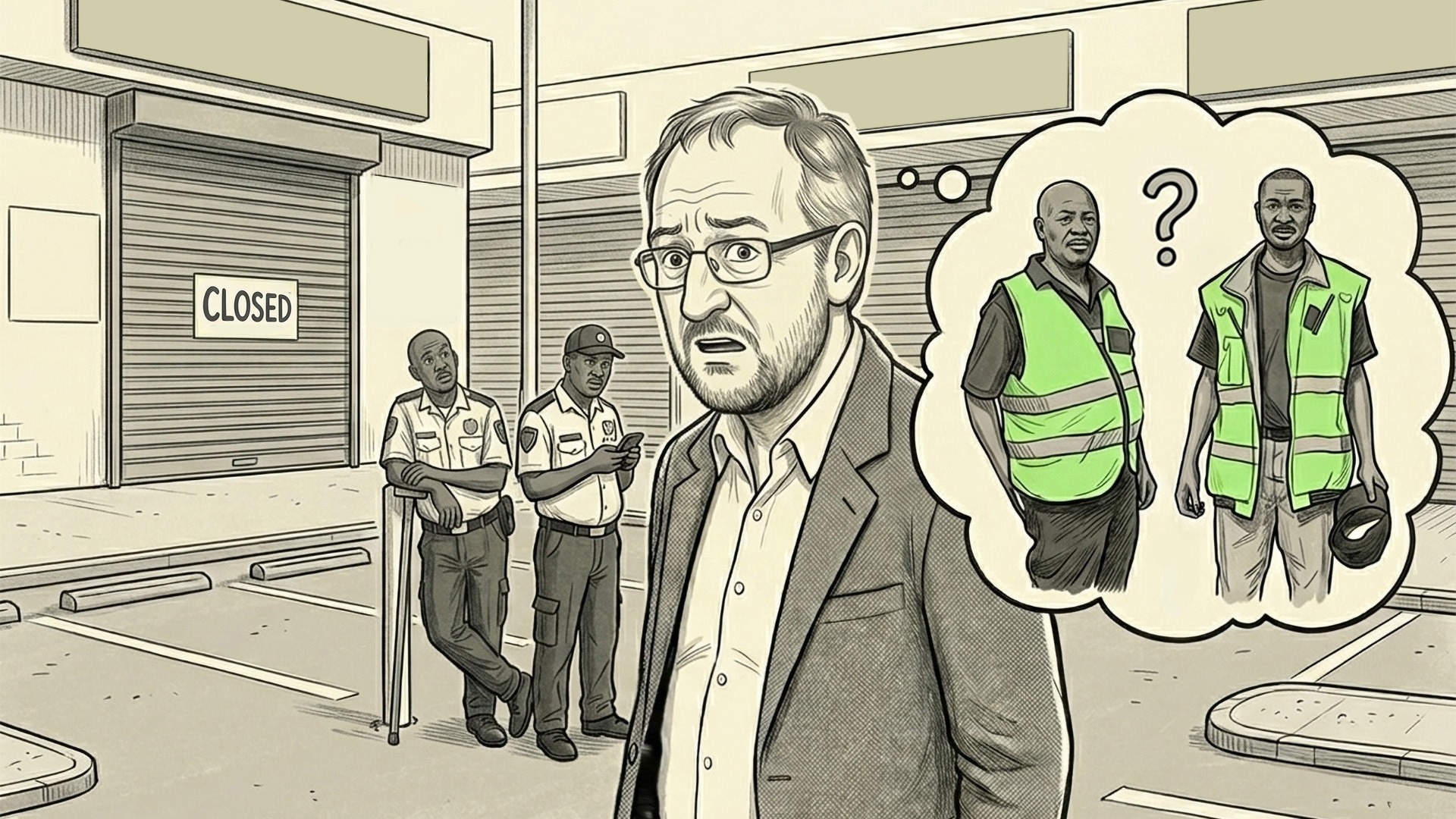
It can be quite a shock to go to your normal strip mall and wander in half-asleep, as I normally do, to find one or two of the shops with their steel shutters down.
More disturbingly, the normal car guards, the people I greet four days a week, at least one of whom walked here from the DRC and does French lessons on the side, are absent.
In their place are two incredibly bored security guards.
It was a slightly rude reminder of the stakes at play for the protests today. Some of the big chains were open, the supermarkets were going strong, but the local bottle store and one or two of the smaller outlets were closed.
I noticed that a store that sells a huge amount of plastic, West Pack (which has thankfully now come out of business rescue) was open but had a sign on the till saying they had been “requested by the SAPS to close at 15:00”.
As I wandered off, plastic in hand, I wondered how much money they might lose today.
Friends who run their own small businesses, a plumber and an electrician, have been slightly wary of today, worried some of their workers might be quite vulnerable.
I’ve often thought that one of the real tests of running a business in our society is how resilient you have to be. I am always slightly irritated by corporate types who use the “R-word”. It normally means they want us to do more with less.
But if you think about a small business, which employs just two or three people, you can imagine how losing one day’s income can really hurt them.
I know some people might just lock themselves in their shops and do admin, the kind of thing that never gets done otherwise. Others might take the opportunity to do something with their kids (this week being school holidays).
But give them the choice and they’d rather be working, getting income.
The other thing is how so many workers just won’t want to come to work. And who can blame them. Who’d want to put themselves in some kind of danger, or just the prospect of a huge amount of disruption?
I think informal businesses, people selling vetkoek (don’t translate that phrase into English, you’ll never have one again), the people on the side of the road who cut hair or fix tyres, I think they’re the ones who will really suffer.
Domestic workers and gardeners might stay at home too. And not all of their employers will be generous enough to pay them for a day they didn’t work.
I suspect construction firms will battle too. For them a day of lost production comes at a huge cost.
And none of these firms or operations or workers or people has the kind of financial cushion needed to get them through this. All of the research shows how so many people, even in the formal sector, have to rely on pay-day loans or dip into their pension savings pot just to get by.
I think what happens is that some people just spend less, they eat less and drink less and just try to stretch everything they can as far as they can. And there is a massive, longer-term cost to that.
But I think that, while there is all of this disruption today, to try to really stop the use of undocumented migrants in our economy is impossible.
It is a funny thing about economies, but firms and people adapt to certain circumstances. The longer that circumstance exists, the more entrenched it becomes. And the greater the disruption and the cost if you remove it.
Think of the fuel price formula.
Because it basically guarantees a tightly regulated income for owners and fuel pump attendants and all the rest, so an economy has grown around them. As a result, you know exactly what you are going to pay where, and where to go.
Try to change that formula now and the disruption would be huge. Some stations would close, people would lose their jobs, an entire industry would be changed.
Which is why, while we’re cheering the drop in fuel prices tonight, at some point we will be crying into our vetkoek when they go up again.
The same thing has happened around illegal immigrants.
They have become a major part of certain sectors of our economy, whether on construction sites or in homes or on the street, providing a whole range of services for money.
If they were to be removed suddenly, or even over the course of a year, all of the economies around them would suffer dramatically. The economic cost would be huge.
Sadly, there is a very recent example of this.
In the US, Donald Trump’s ICE agents have been targeting illegal immigrants in certain areas but not others. That has helped researchers determine what the impact on American citizens has been.
While it’s early days, the first research suggests that the number of American men with jobs declined in the areas where ICE deportations were the most intense.
Considering how deeply entrenched immigrants have become in our economy it would make sense that removing them, changing the long-held circumstance, would have a steep cost for our economy.
Unfortunately, that is not going to stop some people from trying. DM
Comments
Scroll down to load comments...