




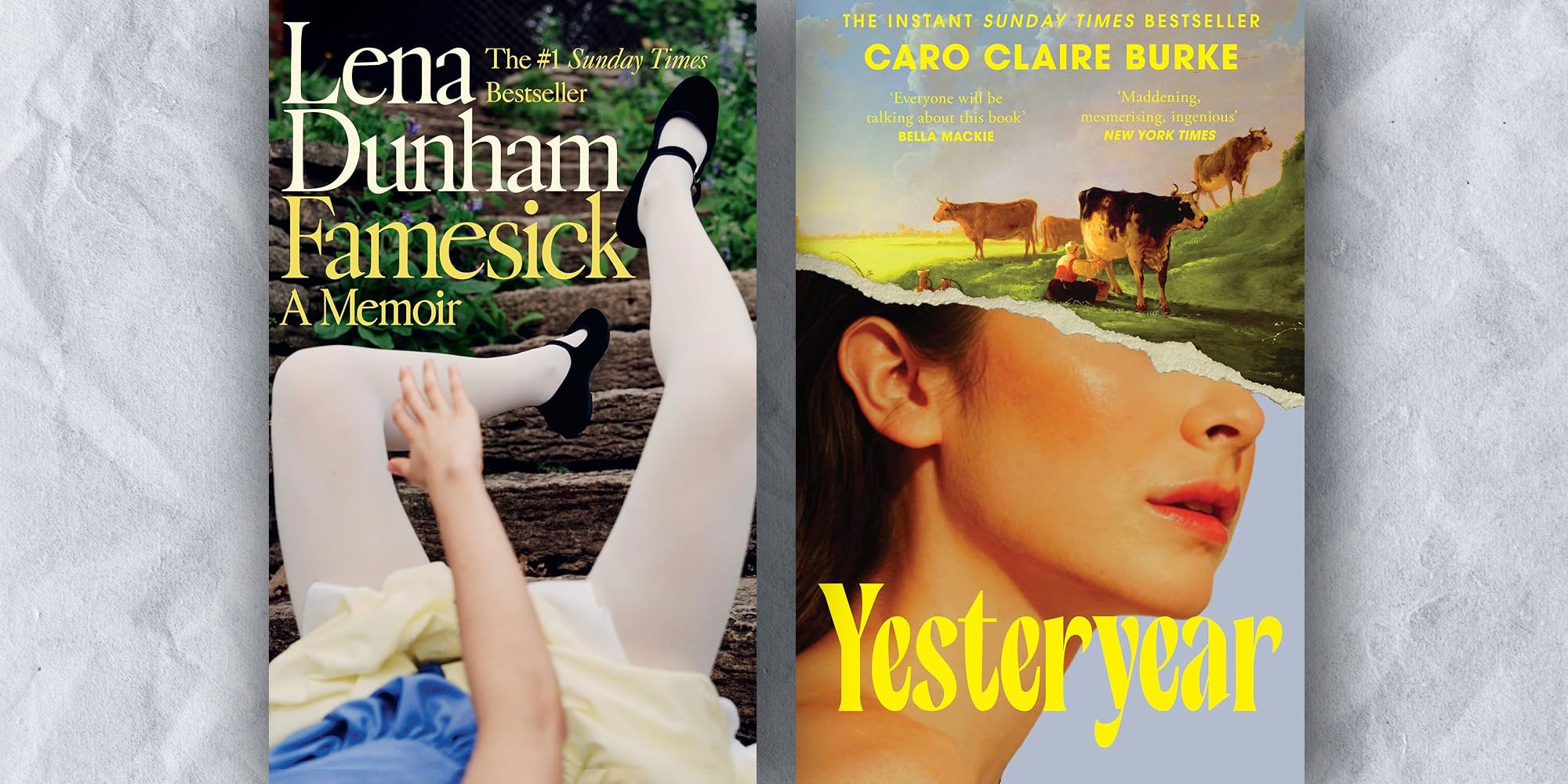
 Yesteryear by Caro Claire Burke and Famesick by Lena Dunham. (Credit: HarperCollins Publishers)
 Yesteryear by Caro Claire Burke
There is something deeply amusing about the trad-wife influencers who spend their days telling women to abandon ambition, return to the home, bake sourdough from scratch, raise chickens and find fulfilment in serving husband and family.
Not because the lifestyle itself is inherently objectionable. Plenty of people genuinely enjoy slower, more domestic lives. The irony is that many of the loudest advocates for this vision are themselves pursuing exactly the things they insist other women should relinquish: visibility, influence, status, money, audiences, personal brands.
The perfectly curated homemaker aesthetic often turns out to be less a rejection of modern capitalism than an exceptionally successful participation in it. That contradiction sits at the heart of Caro Claire Burke’s gripping novel Yesteryear.
Natalie appears to have everything the trad-wife movement promises. She lives on a picturesque cattle farm with her handsome cowboy husband, Caleb. She is a devoted wife and mother. More than 300,000 followers tune in to watch her bake, preserve, decorate and document her idyllic rural life.
On Instagram, Natalie is perfection personified. The problem is that perfection only exists while the camera is rolling. Behind the carefully filtered images lies a life that is considerably messier, lonelier and more complicated than the one presented to her audience.
Then, one morning, Natalie wakes up to discover that everything familiar has vanished. The appliances are gone. The hired help has disappeared. The comforts of modern life have evaporated. Even the man beside her, though eerily familiar, is not quite her husband. Has she been kidnapped? Is she dreaming? Has she lost her mind?
Burke cleverly alternates between Natalie’s influencer life and the strange historical reality in which she suddenly finds herself trapped. As the mystery deepens, so too does the novel’s exploration of what domestic labour actually looks like when stripped of filters, ring lights and sponsorship deals.
I raced through this book in a frenzy to discover what was really happening. Burke understands exactly how to keep readers turning pages, and she populates the story with characters so frustrating that at times you want to reach through the pages and shake them.
But Yesteryear offers more than a compelling mystery. It is also a sharp commentary on gender, performance, social media and the impossible expectations placed on women.
Beneath the twists and suspense lies a thoughtful interrogation of the fantasy being sold by influencer culture: the idea that fulfilment can be found by returning to some imagined simpler past. Burke’s answer is far more complicated than that.
Part psychological thriller, part social satire and part feminist thought experiment, Yesteryear is both entertaining and unsettling. It will keep you guessing until the final pages. And if, like me, you finished the book already imagining it on screen, there is good news: a film adaptation starring Anne Hathaway is already in the works.
Yesteryear by Caro Claire Burke was published in April 2026. Retail price: About R410.
Famesick by Lena Dunham
Many of us first met Lena Dunham through Hannah Horvath, the chaotic, self-absorbed and endearing protagonist of Girls. What is easy to forget is just how young Dunham herself was when the show exploded into the cultural zeitgeist. She was only 23 when she wrote the pilot. Not only was she the creator of the series, but also its writer, director and executive producer.
In Famesick, Dunham reveals that she initially assumed HBO would cast four actresses to play the four central characters. It was only relatively late in the process that she realised she would be playing Hannah herself. What followed was a level of visibility few people are equipped to handle.
Famesick is, on one level, a memoir about celebrity. But it is perhaps more accurately a memoir about what happens when extraordinary success arrives before a person has fully developed the tools to navigate it.
Dunham writes candidly about fame, scrutiny, creative pressure and the relentless demands of an industry that is always hungry for more. One of the most striking aspects of the memoir is the extent to which Dunham traces the relationship between fame and the body.
Celebrity memoirs often focus on public scrutiny, but Dunham is equally interested in what relentless visibility does physically. Throughout the book, she chronicles a series of health challenges while simultaneously navigating the demands of producing, promoting and sustaining a successful career. What emerges is a portrait of a body that repeatedly signals distress while an industry built on momentum insists that the show must go on.
The result is a powerful exploration of burnout, chronic illness, anxiety and the ways in which ambition can become untethered from our physical limits. Dunham describes exhaustion so profound that even removing her shoes or changing out of her clothes at the end of the day felt like a Herculean task.
She writes about dissociation as a response to anxiety, about the strange distance that can emerge between a person and their own life when the pressures become too great.
At times, the memoir elicited profound empathy. At other times, it felt almost overwhelming. There were sections that I found genuinely difficult to read, not because they were poorly written, but because of the cumulative weight of pain, self-analysis and suffering they contain. Yet perhaps that discomfort is part of the point.
We often demand honesty from memoirists, particularly women memoirists, and then recoil when they offer it without softening the edges. Famesick asks readers to sit with experiences that are messy, repetitive and unresolved. While I occasionally found myself wishing for more distance, I also found myself questioning why I expected that distance in the first place.
The book is perhaps at its most courageous when it turns to one of the most controversial periods in Dunham’s public life: her defence of a man accused of rape. I approached these chapters with a degree of apprehension, wondering how she would navigate an episode that remains deeply troubling.
What follows is not an attempt at exoneration. Instead, Dunham places her own actions under sustained scrutiny, examining the loyalties, blind spots and failures that shaped her response.
I found myself respecting her willingness to engage so directly with a chapter of her life that continues to shape how many people view her. The sections are uncomfortable, demonstrating a genuine effort to understand how someone whose work has often centred women could nevertheless contribute to harm.
The memoir also raises a broader question about the ethics of writing itself. Dunham writes extensively about the people who populate her life: friends, family members, lovers, colleagues and those with whom she has fallen out. She does so with varying degrees of tenderness, frustration, affection and regret.
While there is a clear attempt to be reflexive about the power she holds as a writer, the book repeatedly prompted me to consider where the boundaries of memoir ought to lie. What obligations do writers have to the people whose lives intersect with their own? How much of another person’s story can we claim in the service of telling our own?
Memoir necessarily involves writing about others, but Famesick serves as a reminder that this is never a neutral act. Every story told illuminates one life while exposing another.
Famesick charts the collision between public perception and private experience, between a confident public figure people believed they knew and the far more vulnerable person behind the headlines. What emerges is a story of survival.
More than anything, Famesick explores what happens when personal development and public scrutiny unfold simultaneously, leaving little room for mistakes, uncertainty or reinvention.
The questions Dunham raises about accountability, illness, ambition and storytelling linger long after the final page. In that sense, Famesick succeeds not only as a memoir of fame, but as an exploration of what it costs to be seen.
Famesick by Lena Dunham was published in April 2026. Retail price: About R465. DM
Joy Watson is Book Editor-at-Large at Daily Maverick.
Comments
Scroll down to load comments...