




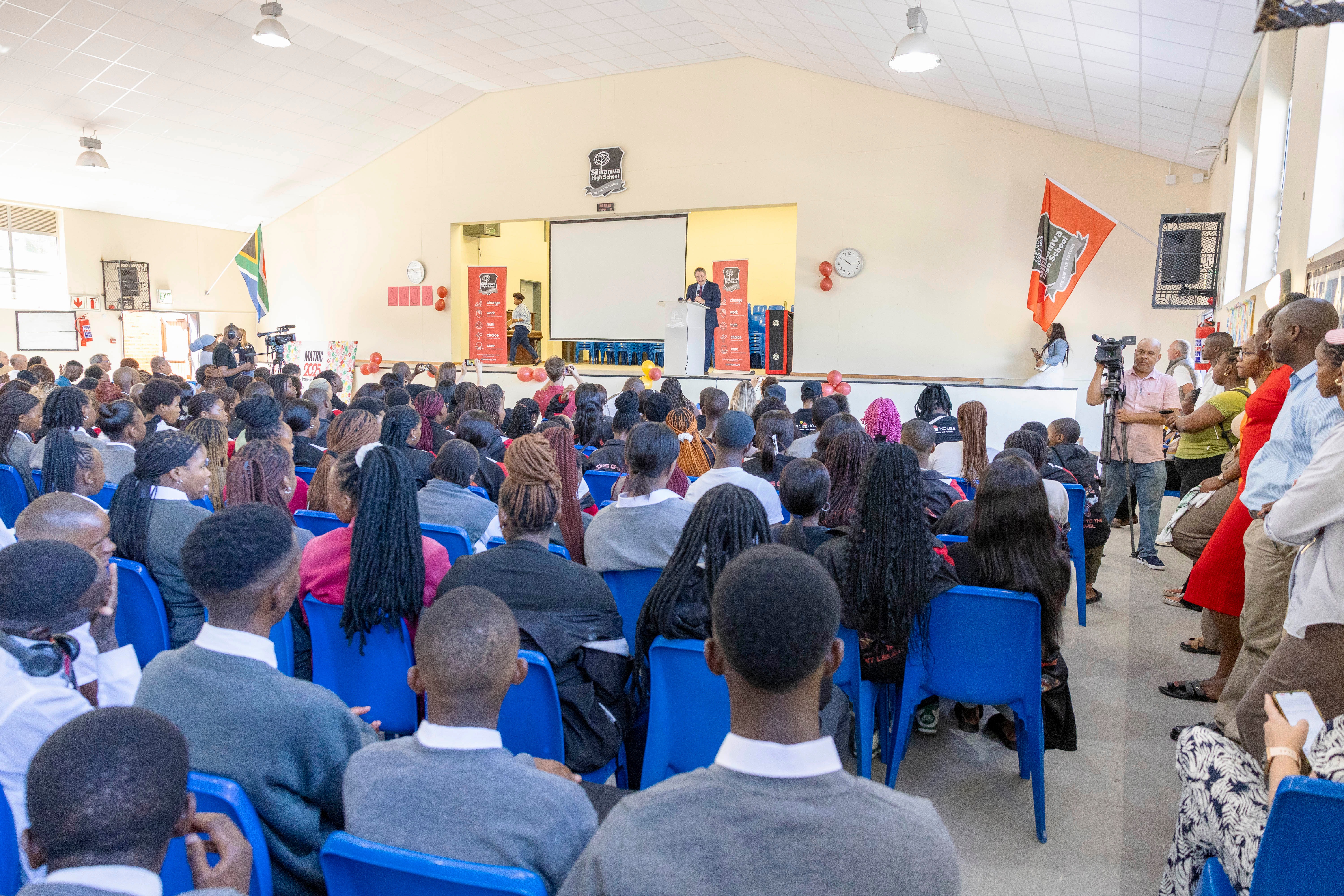
 Matric learners at Silikamva High School in Hout Bay, Cape Town, after the release of their results on 13 January 2026. The class of 2025 achieved a 100% pass rate. (Photo: ER Lombard / Gallo Images)
Top South African researchers Ursula Hoadley, Gabrielle Wills, Carol Bertram and Servaas van der Berg investigated how more than 60% of South African students complete high school even though only 20% of Grade 4 students can read for understanding.
The authors scrutinised how this is possible by examining the policies, practices and pressures that shape student progression through the system. Their research is based on extensive data that is difficult to refute.
The paper* identifies two fundamental tensions that drive South African education. First, the country has very high school participation rates (nearly 100% up to age 15), but extremely low learning quality in the early grades. Second, the system must balance social promotion (advancing students regardless of performance) and grade retention (holding students back until they meet standards).
The authors argue that social promotion is “…common across developed countries, like Denmark, Japan and parts of the US, for example, and across developing countries such as Ghana, Uganda and Namibia, more common at the primary than high school levels. Advocates claim social promotion avoids harming students’ self-esteem, supports their social and emotional development, and prevents increased dropout rates associated with retention. Proponents also focus on relative costs of grade retention and automatic promotion.”
Honestly speaking, there just isn’t space to keep children in the same grade year after year, and there is no effective remediation for those who need it, with the burden largely falling on teachers.
The research approach
The study draws on three data sources: qualitative interviews with 50 teachers from eight high schools in the Western Cape and Eastern Cape (covering English, mathematics, mathematical literacy and history in Grades 8 and 10); quantitative student mark data from the Data Driven Districts initiative and analysing 2023 Grade 8-11 mark distributions to detect possible mark manipulation; and official policy documents on promotion, progression and examinations.
Schools in the qualitative sample were selected to reflect a range of typical South African public school contexts. National Senior Certificate (NSC) enrolments were above 40, predominantly among African students, with an even split between fee-paying and no-fee schools. They included a mix of high and low performers based on three years of prior NSC results. The 50 teachers interviewed were diverse in both experience and training background.
/file/attachments/2994/07ED_583445_916862.jpg "Matriculants during an examination monitoring visit at Forte Secondary School in Dobsonville, Soweto, on 23 October 2025. (Photo: Fani Mahuntsi / Gallo Images)")
Nine mechanisms that help students pass in schools
The paper describes nine mechanisms that enable students to progress through high school despite their lacking certain foundational skills.
- Promotion and progression policies allow students who have repeated once in a phase to be automatically progressed regardless of results.
- School-based assessments (SBAs) have been given increased weighting (60% in Grades 8-9, 40% in Grades 10-11 since 2022), and teachers heavily scaffold these tasks, providing multiple opportunities and allowing collaborative completion so that students seldom fail SBAs. In some schools, students’ SBA marks closely correspond to their examination outcomes, indicating well-
calibrated and effectively moderated assessments. In others, however, SBA marks are substantially higher than exam results, pointing to inconsistencies in assessment standards. - Quantitative data reveals widespread mark manipulation, with student marks artificially bunched at the 40% pass threshold, particularly in term 4 and especially in the Eastern Cape, KwaZulu-Natal and Mpumalanga.
- English assessment uses extremely lenient rubrics where marks are awarded simply for writing something down, and teachers focus on the creative writing paper (paper 3), which they describe as “almost impossible to fail”.
- Examination papers have become highly predictable through constant recycling of past papers, enabling rote learning and “parrot fashion” preparation, where students memorise essays rather than developing understanding.
- Passing requirements are set at very low levels. At the further education and training level, students need only 30% in three subjects and may fail one subject entirely. In 2024, English first additional language had a 99.7% pass rate, but only 17.8% of mathematics candidates reached the 60% threshold required for university science, technology, engineering and mathematics admission.
- Teachers operate under intense political and bureaucratic pressure to pass students, with districts monitoring pass rates and schools facing public rankings. One school progressed 65% of its Grade 8 cohort. Teachers reported feeling professionally undermined, and progressed students are derogatorily called abaphiwange (meaning low IQ).
- Intensive remediation is provided only at Grade 12 level through matric camps, extra classes and tutoring, whereas Grades 8 and 9 don’t get the same attention and are often neglected and sometimes taught by student teachers.
- The cohort naturally winnows down by Grade 12, with only 37% of Grade 8 students reaching matric without repeating.
What does this all mean?
The authors identify two critical problems with this hybrid system. First, there is widespread misunderstanding of promotion and progression policies among teachers. In their interviews, 32 of 50 teachers did not know how many students had progressed in their classrooms. Teachers felt undermined by being forced to progress students they believe should repeat, which leads to demoralisation.
Second, despite policy requirements for remediation, there is virtually no systematic support for students in the primary or early secondary grades. The system, in effect, operates as “social promotion without remediation”, pushing students through until they receive just-in-time cramming in Grade 12.
The authors argue that although the hybrid system may be appropriate for balancing participation and quality concerns, it requires clearer understanding across all levels and, most critically, prioritised remediation in Grades 8 and 9.
The authors recommend introducing higher-stakes assessments earlier, such as the General Education Certificate at Grade 9, to create accountability for learning before the final matric year.
They also call for assessment reform to reduce predictability and rote learning, and for a shift in focus from mere progression to genuine promotion that maintains the legitimacy and value of schooling qualifications.
Everyone agrees that we have made significant progress in participation in the South African education system, but we must focus on the quality of learning. DM
* Reference: Ursula Hoadley, Gabrielle Wills, Carol Bertram, Servaas van der Berg (2025). Schooling and learning? How South African students get through high school despite low academic outcomes in the early grades. Working Paper November 2025, Department of Economics, Stellenbosch University.
Dr Mark Potterton is the newly appointed principal of Immaculata Secondary School in Soweto, and director of the Three2Six Refugee Children’s Education Project.
This story first appeared in our weekly DM168 newspaper, available countrywide for R35.
/file/attachments/2994/DM-260626_643039.jpg)
Comments
Scroll down to load comments...