




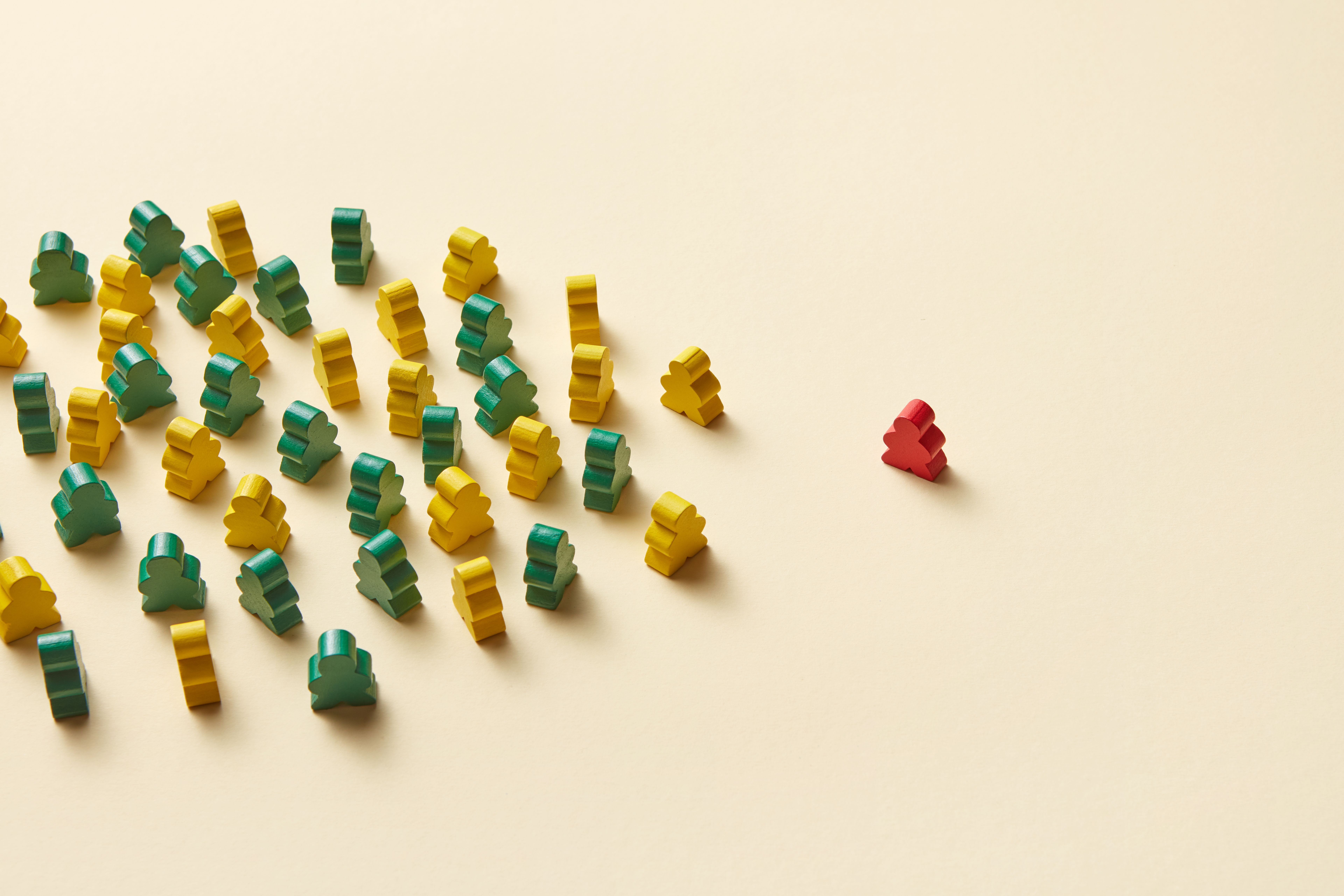
 We are inherently social beings whose identities are shaped by the groups we belong to, from families to political parties. (Illustration: Pexels)
 Psychologists say we are profoundly social beings. We learn who we are, what is true and appropriate through our relationships with others.
Groups give us affirmation, connection, safety, recognition and a way of making sense of the world. They help us form values, test opinions and locate ourselves in relation to others.
Professor Kevin Durrheim, a social psychologist and distinguished professor at the University of Johannesburg, says Social Identity Theory suggests that people derive part of their sense of self from the groups to which they belong.
When a group affirms us, we feel recognised. We feel less alone. They mirror back to us what matters, what is acceptable, what is painful and what should be resisted.
Much of who we become is formed through our relationships with others.
Melissa Steyn, Professor Emerita at the Wits Centre for Diversity Studies, says the key question is not simply whether we belong to groups, but how we belong.
Some groups shape us more deeply than others. Although we are born into a community, we could choose to either belong to that group or disassociate from it. Together the groups we belong to help make us the complex people we are. It becomes problematic when belonging to a group depends on conformity.
Clinical psychologist,Sasekile Ndhlovu says group belonging becomes unhealthy when the need to belong is so strong that the risk of being alienated by the group prevents us from disagreeing with it.
The person becomes so enmeshed that they are eventually unable to differentiate from the group. The boundary between the self and the group disappears. They echo the views of the group, avoid disagreement at all costs and lose the ability to think independently. Psychologically speaking we say the person becomes undifferentiated.
Steyn adds another layer: group belonging also depends on where people are positioned in society. For oppressed groups, membership can be a way to endure and resist. For those with power, a group could provide opportunities to extend power, privilege and further a particular agenda.
It can happen in families, relationships, social media, churches, political movements, cultural groups, friendship circles or any space where acceptance depends on adopting the group’s values and norms.
How group thinking plays out in SA
In SA, this matters deeply.
Durrheim explains that many of SA’s public debates are still organised around familiar group categories: race, political affiliation, class, language, culture and ideology.
These discussions are often shaped by shared interests and can provide important opportunities to understand inequality, injustice and collective experience. However, they can also encourage people to agree with what is being said because of who is saying it, rather than because the argument is supported by evidence.
Social media platforms are often used by groups to gain support and solidarity. Rather than engaging with the complexity of a matter, algorithms often reward repetition of a story line again and again without debating alternative perspectives.
Before long, the story begins to feel indisputable, not because it has been tested, but because everyone appears to agree. Complex issues are flattened into group slogans; followers begin to judge an argument by how many people share it, not by the evidence behind it.
The question shifts from “Is this true?” to “Can so many of us be wrong?”
When migrants become the convenient scapegoat
The current debate around undocumented migrants offers one example of how quickly this can happen.
SA’s anger about unemployment, poverty and crime is real. But when that anger is channelled towards a single group, a complex national failure becomes a simple story: foreigners are taking jobs, foreigners are driving crime, foreigners are the reason life feels harder.
That story is emotionally powerful because it gives people a target. It turns anxiety into certainty. It creates an “us” who have been wronged and a “them” who must be blamed.
In the run-up to local government elections, some political parties and movements can use this anger as a ready-made source of support. The more often the story is repeated, the more it begins to sound like common sense.
But this is where group thinking becomes toxic. The question is no longer whether the claim is supported by evidence, it becomes whether you are loyal enough to repeat it. To challenge the story can feel like betraying the group.
Professor Justin Visagie, Associate Professor at the Southern Centre for Inequality Studies at Wits University, argues that the belief that undocumented migrants are the main cause of unemployment is not supported by evidence.
SA’s jobs crisis is real, he says, but it is rooted in much deeper structural problems such as structural unemployment, skills and the weak vibrance of the economy.
“We don’t think in statistical ways.”
In addition, social media feeds often give people the stories they want to hear, and when people keep receiving similar information, it encourages polarisation.
Analysing Stats SA’s QLFS migration module and the Sead-SA Spatial Tax Panel, Visagie came to the conclusion that the numbers do not support the claim that foreign nationals are taking jobs from South Africans on a scale that could explain the country’s unemployment crisis.
His point is not that immigration policy does not matter. It is that blaming migrants offers a neat answer to a problem that is anything but neat. And neat answers are exactly what group narratives often provide: they reduce uncertainty, they offer belonging, they tell people who to trust, who to fear and who to blame.
This is why the way we belong matters.
A group can give people courage, dignity and language for their pain, but it can also become a closed room, where only certain truths are allowed to breathe. The challenge is not to live without belonging. It is to belong without becoming captured.
Choosing humanity over tribe
For Professor Jonathan Jansen, distinguished Professor of Education at Stellenbosch University, the answer to toxic groupthink is not to pretend that groups do not matter. It is to become more alert to the hold they have on us.
We are born into categories of colour, language, religion and nationality long before we can test them. Over time, they begin to feel like truth. They tell us who “our people” are, who to distrust, and which opinions we are expected to defend.
Jansen believes maturity requires a conscious loosening of these inherited boundaries.
Belonging becomes dangerous when loyalty to the group matters more than truth, compassion or independent thought, and he knows this from experience.
When he deliberately broke away from a church group that could not tolerate different views, the response was harsh. Some accused him of betrayal, others treated his independence as disloyalty. But for Jansen, that moment confirmed why one sometimes has to step outside the comfort of the group to remain honest and open to friendships and commitments that fall outside of the assigned groups.
His alternative is a wider understanding of “my people”. Not only those who look, pray, speak or vote like us, but the child from Congo, the struggling white student, the Muslim father in grief, the Jewish mother who has lost a child.
Our first response, he suggests, should be human before it is tribal. Jansen believes SA needs more spaces, in schools, universities, the media and public life, where people are encouraged to speak across inherited divides.
Without a stronger counter-narrative of shared humanity, group identity can harden into suspicion, exclusion and what he calls “extinction politics”. The work, then, is to stay alive to the stories our groups give us, and to ask whether they still make us more humane.
From wounded identities to shared humanity
For Michael Lapsley, the founder and global president of the Institute for Healing of Memories, comes to a similar conclusion, but through the language of wounded memory.
For him, people cannot simply be asked to move beyond the past or abandon the identities that shaped them. Healing begins when pain is heard, acknowledged and given moral weight. He says this becomes possible when people from different worlds listen to one another’s stories and share their feelings.
“The commonality of their pain becomes transcendent,” he says. “Then there is no longer ‘us’ and ‘them’, there is just ‘us’.”
Only then can people recover a sense of agency and stop being trapped in victimhood, guilt or shame. Lapsley argues that each person carries many identities, whether of race, faith, language, gender, history or nation. The task is not to deny these identities, but to bring “the riches” of all of them into a broader human identity rooted in compassion, justice, generosity and kindness.
Although South Africans may still live worlds apart, he believes shared experiences such as music, sport and even common threats like climate change can give us a glimpse of what becomes possible when narrow group loyalty is stretched into a more generous sense of belonging to one another. DM