




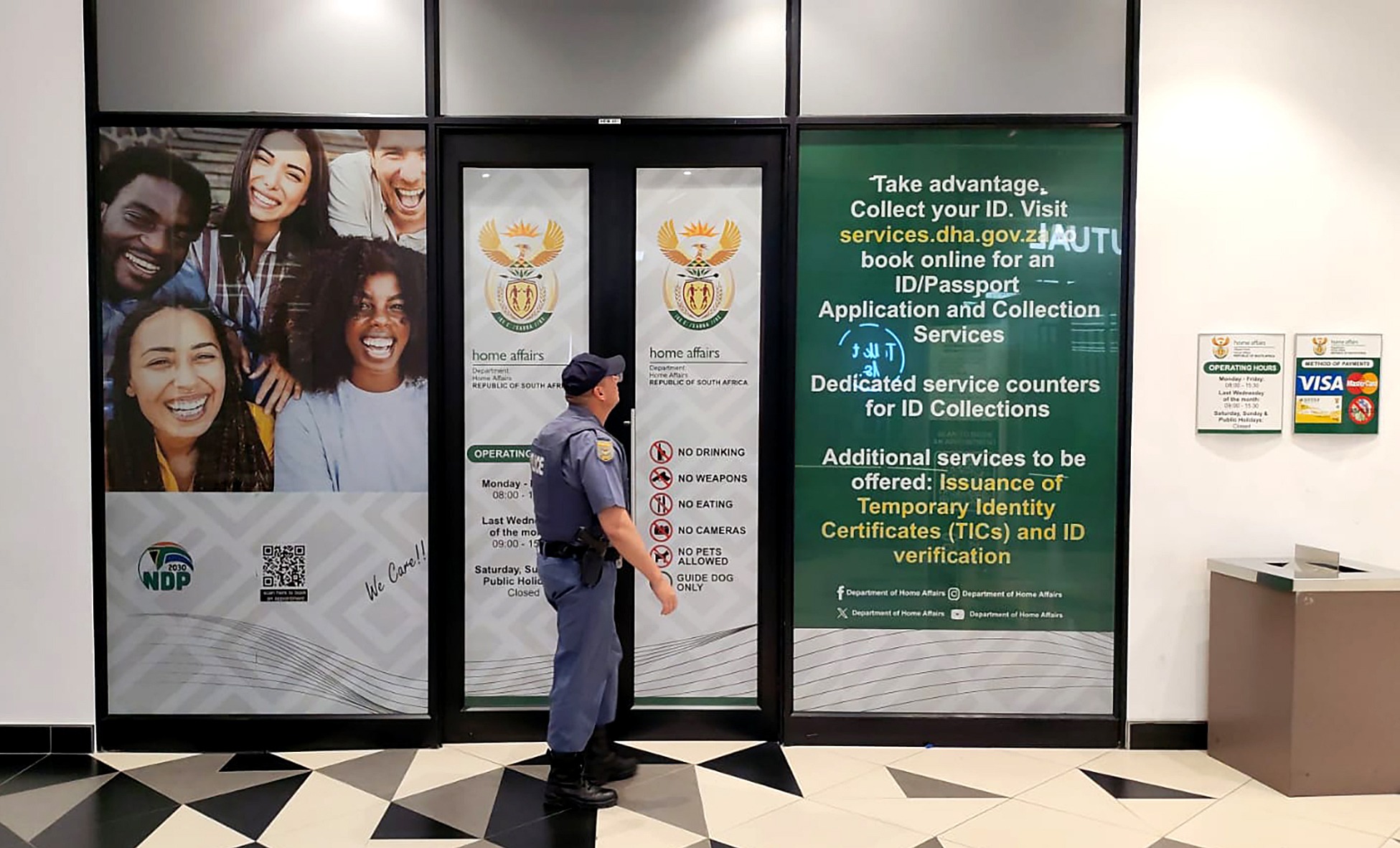
 A police officer in KuGompo City (East London) patrols a shopping mall and offices of the Department of Home Affairs over the weekend, after several undocumented foreigners were arrested during compliance and anti-crime operations. (Photo: Supplied / SAPS)
There is no new law coming into operation on 30 June 2026 that will introduce fines of R100,000 and imprisonment for employing an undocumented foreigner. Still, it remains illegal and puts both the employer and the employee at high risk.
What are the risks to the employers?
While no new law is coming into operation on 30 June, there is pending legislation, the Employment Services Amendment Bill, that proposes a R100,000 fine for employing an undocumented foreign national. This is a significant increase from the previous maximum fines of R20,000.
Social activist Hassen Lorgat points out that the new legislation, which is still in Bill form before Parliament, can also carry a penalty of imprisonment. It proposes a tiered fines system administered by the Labour Court for employers who illegally employ foreign nationals. According to reports, the proposed fine schedule is as follows:
- Up to R100,000 for a first offence per undocumented worker.
- Up to R1-million or 10% of annual turnover for repeat or multiple contraventions.
Speaking in Parliament last week, Sam Morotoba, Deputy Director-General in the Department of Labour and Employment, said in his presentation that there was an obligation on employers to employ only foreign nationals entitled to work in South Africa, and to retain records of the employee’s work permits.
He said that once enacted, the law would empower the Minister to set sectoral quotas where appropriate, strengthen skills-transfer requirements, regulate recruitment and placement services, and enhance monitoring and enforcement mechanisms.
Can a foreign worker obtain a work permit for domestic work or gardening?
This is highly unlikely. The Department of Home Affairs said in a statement on the issue that to do so, a South African employer needs to prove beyond a reasonable doubt that there is no local person who can do the job. Domestic work and gardening are also not listed as scarce skills.
Refugees holding the correct permits and holders of exemption permits, like the Zimbabwe Exemption Permit, are permitted to work in South Africa.
What would 10,000 new labour inspectors do?
Lorgat said the promise to appoint the new inspectors was a “promise to act decisively against non‑compliance, unlawful employment practices and worker exploitation, while supporting a more stable and fair labour market. However, it begs the question: where were you all this time?”
The Minister of Labour, Nomakosazana Meth, said that the inspectors would be there for “law enforcement”.
“The addition of 10,000 inspectors will significantly strengthen our capacity to enforce compliance with labour legislation, protect vulnerable workers and ensure fair labour practices across all sectors of the economy,” Meth said.
May the labour inspectors arrive at your house to check on your employees?
According to the Basic Conditions of Employment Act, they may enter your house if you give permission, or if the inspector has an authorisation from the Labour Court. To obtain this, an inspector must file a written application under oath setting out the reasons for entering the property.
May the police stop workers on the street to check their papers?
Yes, they may.
Article 41 of the Immigration Act allows them to ask a person to identify themselves as a citizen, permanent resident or foreigner, and they may proceed to interview a person on their resident status if the police officer is not satisfied that the person is entitled to be in the country.
There are two conditions for this: It must be in a public space, and the police officer must hold a “reasonable suspicion” that a person is foreign.
Warrantless searches of private homes and places of work or studies are also not allowed.
The Know Your Rights campaign, however, points out that if a documented foreign worker with the correct documentation does not have their papers with them, there are other options.
There is a duty on the police officer, by law, to take steps to identify a person’s status.
This includes accessing relevant documents that may be readily available, contacting relatives or others who can prove the person’s identity and status, accessing Home Affairs records, providing the arrested person with an opportunity to fetch their documents, and using the Department of Home Affairs’ 24-hour hotline to verify a person’s identity and status.
An attorney who works with foreigners’ cases said in her experience, the police wouldn’t ask those who “look local”. But they would check, for instance, if a person could speak one of the country’s official languages in the region or pick up on accents. “Then there is a good chance that they will ask you for documentation,” she said.
Can anybody else stop a worker and ask for papers?
In November 2025, the Gauteng high court ruled that members of the public may not ask for papers from workers they suspect to be foreign – the ruling was specifically made against members of Operation Dudula.
What are the risks to foreign, undocumented employees?
Lorgat said that for the employee, the risk was indeed arrest and deportation. “Gardening and domestic work are not classified as scarce skills by Home Affairs, so it is very difficult for workers to get a work permit,” he said.
“This leaves many workers in a precarious and undocumented position. This vulnerability can also lead to exploitation, where employers might not pay the minimum wage or provide proper contracts,” he said.
“I am concerned that the driving force behind this is the various mobilisations against foreign nationals, presumed to be illegal. This is a problematic framing, as it continues to target foreign‑born poor people – whether legal or illegal, documented or not – according to current practices.
“Here we must factor in movements like Kopanang Africa Against Xenophobia (Kaax) and the Siyafana Sonke Action Campaign, which have demanded that the violence must stop and that aid be provided to the poor, hungry and marginalised.
“In particular, they have called for vigilante leaders from groups such as March and March and Operation Dudula to be arrested for inciting xenophobic violence and committing crimes. They have also demanded that SAPS members who have allegedly failed to act or have aided vigilantes be held accountable,” Lorgat said. DM
Comments
Scroll down to load comments...