




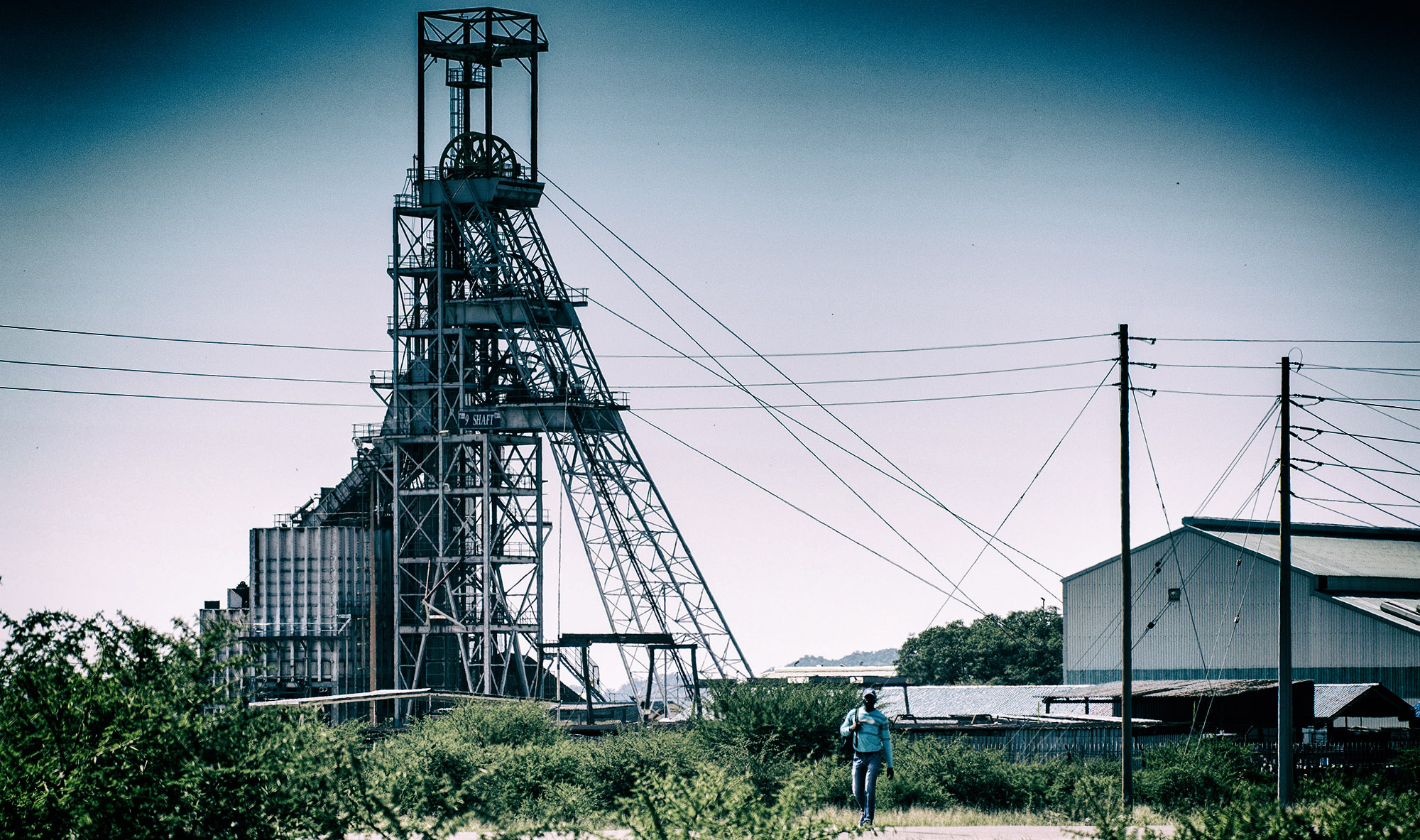
 The Impala Platinum Holdings, also known as Implats, shaft 9 mine tower in Rustenburg, South Africa. (Photo: Waldo Swiegers / Bloomberg via Getty Images)
South Africa’s mining sector and the wider economy were built on the backs of migrant labour, and the rise and fall of that system have sown seeds that are now reaping a bitter harvest of xenophobia.
Amid the March and March protests and the 30 June deadline – ostensibly for undocumented foreigners to leave SA – it is telling to recall how this exploitative labour arrangement laid the foundations for the City of Gold and the economy that rippled out from it, while its demise in turn has triggered a surge of illegal immigration.
SA’s mining sector under apartheid employed close to 500,000 foreigners. The latest available industry data showed that in 2023 the number had withered to 35,000, a plunge down a shaft of despair for rural communities and families in neighbouring countries, notably Lesotho and Mozambique.
The migrant labour system subjected an overwhelmingly rural population drawn from these countries – as well as the former Transkei and other Bantustans – to ruthless exploitation. The price of gold was long fixed, but costs could be contained by taking a hatchet to wages. And for decades, the wages of African mine workers stagnated and declined.
/file/attachments/orphans/SOWETOMARCH1_201457.jpg "Protesters march to Moroka Police Station in Soweto, Johannesburg, on Sunday, 28 June 2026. The march was one of several demonstrations mobilising communities before the 30 June deadline set by anti-immigrant groups for undocumented migrants to leave South Africa. (Photo: Leon Sadiki)")
“Here... was an industry successfully defying the laws of economic gravity. Despite real wages declining for more than half a century, the Rand gold mines – except for a few periods of usually short duration – not only grew, but also managed to maintain their complement of black workers,” notes the historian Charles van Onselen in his searing 2019 book, The Night Trains.
“It was an extraordinary achievement that reflected not only near-untrammelled industry and state power at the point of production itself, but also the increasing hardship and poverty in rural areas pushing out migrant labour.”
Migrants from other African countries also played a crucial role in the struggle against apartheid, which included union activism. A significant portion of the National Union of Mineworkers (NUM) membership in the 1980s was foreign, including its leadership.
The mining industry in the 21st century no longer requires the services of an unskilled, semi-literate rural base. It has dispensed with such workers, who also perished in their tens of thousands in mine and train accidents or from occupational diseases such as silicosis.
While the industry has undertaken projects in the former “labour-sending areas” to promote development in these islands of rural poverty, it lacks the capital or resources to meaningfully transform Lesotho or Mozambique in a way that would significantly raise living standards.
One consequence has been that migrants from such countries – where opportunities are sorely lacking – are still drawn to South Africa, following the spoor of their fathers, grandfathers and great-grandfathers who toiled underground.
Remittances from the wages of Lesotho nationals working in SA’s mines amounted in 1987 to an astonishing 236% of the mountain kingdom’s GDP, according to World Bank data. They now equal about 20%, a “remittance shock” without parallel in modern global economic history.
“An overlooked but major development in the last 30 years is the collapse of the migrant labour system organised for over a century by SA’s mining industry. Countries across southern Africa were made dependent on migrant labour by an industry that recruited and transported hundreds of thousands of people annually,” Duncan Money, a historian of mining and migration, told Daily Maverick.
“It is unsurprising that large numbers of people from these countries continue to migrate to SA after that system collapsed.”
Many of the zama zamas who illegally scavenge for gold among the industry’s skeletal remains hail from Lesotho and Mozambique, the headlamp passed from one generation to the next. Their forefathers were brutalised in the past by the licit mining sector, while it has been their fate to endure abuse from illicit criminal syndicates.
/file/dailymaverick/wp-content/uploads/2021/10/BM-Ed-Zamas-option-3.jpg "Illegal gold miners climb down an old rope as they enter a disused commercial gold mine. (Photo: EPA / Kim Ludbrook)")
They have also been reduced to scavenging on other fronts, collecting plastic and other rubbish for recycling on the streets of Johannesburg. The green/recycling economy has an underbelly, employing an underclass of undocumented workers who reside in squatter camps.
Others have turned to livestock raiding that has rendered commercial livestock farming along the Lesotho border unviable in many areas.
Malawi was also once a source of migrant labour to SA’s mines, and many of the workers in gardening and tree-cutting services are undocumented migrants who hail from that impoverished nation.
Boomerang
Like a boomerang, the migrant labour system has hurtled back at SA. And the latest rise of organised xenophobia has been an ugly, but predictable upshot. The mining industry holds other lessons, as South Africa stares into the abyss of this backlash against foreigners.
At its peak in 1987, the sector employed almost 830,000 workers. It now employs about 470,000 according to the latest data compiled by the Minerals Council.
The sharp decline in employment – notably for migrant workers – has also coincided with decades of above-inflation wage increases, which have reversed the impoverishing trend of the past.
One could look at this state of affairs and say: “You see! Throw the foreigners out and domestic wages rise!”
But this simplistic narrative fails to account for how the mining sector itself has recognised the need to raise the living standards of its labour force as it has come under increased and critical scrutiny while striving for increased productivity – which a well-paid workforce that does not down tools can deliver.
Mechanisation has also played a massive role, as it requires a more highly skilled and educated workforce than the industrial meatgrinder that defined South African mining in the past.
Wilted wages
As Stellenbosch University economic historian Johan Fourie noted in a commentary on Monday, 29 June 2026, when California sent 500,000 Mexican farm workers – known as braceros – back home at the end of a two-decade government programme, wages for domestic labour in the fields did not suddenly shoot up, but wilted on the stalks.
“Where did the adjustment go instead? Into machines and into crops,” he writes, citing a 2018 paper on the saga.
South Africa, he notes, has been experiencing a version of this since the 1970s, with mechanisation steadily replacing workers in mining, farming and manufacturing as former sources of labour grew scarcer and more expensive.
“Machines replaced unskilled workers, and the economy settled on to a path that created steadily fewer jobs for the least skilled. The structural unemployment we live with today is partly its inheritance,” he points out.
The pace of automation and mechanisation is accelerating. So a mass exodus of undocumented foreigners is unlikely to see domestic wages suddenly spike.
Former labour-sending areas of the old migrant labour system will continue to churn out an underclass with few economic options but the arduous trek to a South African shanty town. They remain reservoirs of labour that have now raised the political temperature in SA to a boiling point. DM
Comments
Scroll down to load comments...