




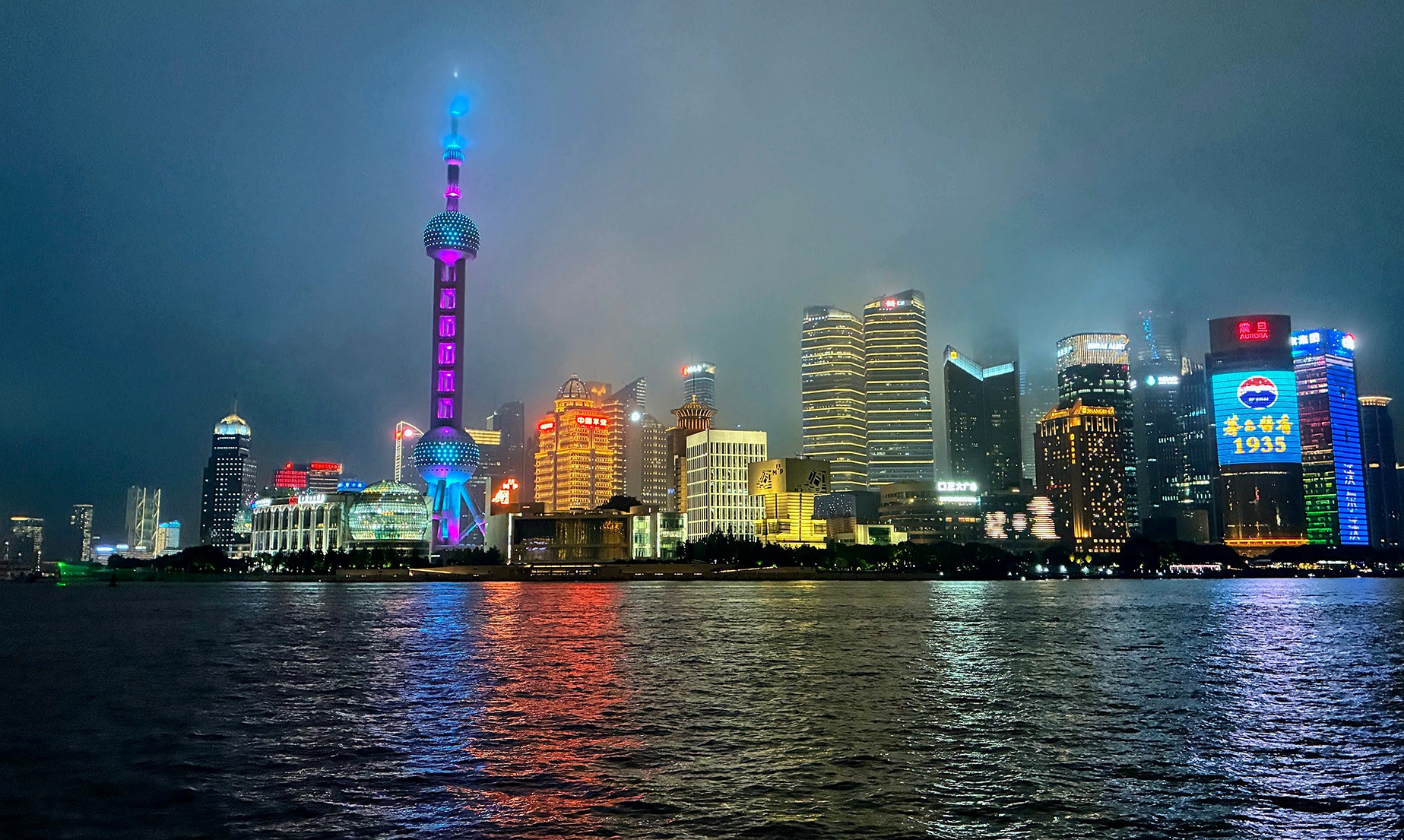
 The light show for the Shanghai cityscape ends at 10.30pm on most summer nights, but can stretch to 11pm on public holidays and weekends. Even the iconic Oriental Pearl Tower (Shanghai’s equivalent of Jozi’s Sentech tower) goes almost dark at curfew. (Photo: Lindsey Schutters)
“Switching the lightshow off at night really destroys the simulation of the future,” laments a whisky weary fellow traveller in our South African media delegation. Full disclosure: Daily Maverick was granted a business visa (of the M variety) and was prohibited from filing any reporting from the country – this is a travel log, if any officials are reading.
To be fair to my fellow countryman, I’m probably doing a very poor paraphrase of what he actually said because I too was teetering on the edge of having peaked too early on Asahi draughts for the Bafana Bafana triumph over South Korea – it was a 9am kickoff on the mainland.
While there are no discernible laws governing the time that alcohol can be sold in China, Shanghai’s legendary light show shuts off at 10.30pm on summertime weeknights. Yes, we were out on a school night – but the six-hour time difference meant it was technically a school day; and remember (assuming my editors are reading this) that I was under strict instruction to not work.
Lighting the way to economic prosperity
The wonderful kaleidoscope in the Pudong district seen above was developed from what was formerly farmland marsh and warehouse berths two months after Nelson Mandela walked free – starting with the 468m tall Oriental Pearl Tower that was completed in 1994.
The city itself was established as a cosmopolitan trade hub following Britain’s victory over China in the first Opium War in 1842 and the west bank of the Huangpu River (from whence the picture was taken), known as the Bund, became a foreign territory.
And in keeping with the proud tradition of British colonialism in the 1800s, commercial control of strategic foreign resources meant that the area under British control got electrified. Pudong got China’s first electric light in 1879, but municipal electrification happened in 1882; which was around the time electrification reached South Africa’s interior with diamond-rich Kimberley.
The port city by the Yangtze River flourished and led the mainland with coal power stations, culminating in the absolutely massive Waigaoqiao, which has a nameplate rating of 5,000MW, which could swell to 6,000MW if the set of four 300MW units (commissioned in 1994-1997) are replaced with a pair of hyper-efficient 1,000MW units.
At the moment coal powers 31% of the city’s demand, with the Caojing gas thermal power station adding an additional 658MW, and the rest being imported from other provinces across thousands of kilometres of ultra-high voltage transmission lines.
/file/attachments/orphans/2010111616169EZf5sBAQ8262y1KDoOIS_669421.jpg "Shanghai Waigaoqiao Power Plant. (Photo: Greenpeace Unearthed / Wikipedia)")
Streets ahead
I asked the concierge whether he had ever experienced load shedding and he didn’t understand my question, but could confirm that there had been power cuts for parts of the day in the “very hot” summer of 2021.
At the time China had ended its coal import contract with Australia as the lads from Down Under dared to probe the origins of the Covid-19 pandemic. Fun fact: you can get a small containership – loaded to the same capacity as a standard double stack train – all the way up the river from Shanghai to Wuhan (about 900km) in about 10 days.
Then there was flooding in Indonesia that jeopardised the bulk of coal imports, with a devastating drought also reducing the impact of the vast hydro power resources.
These issues were compounded by the fact that air conditioning makes up almost half of the city’s load during summer months, hitting a record 40,550MW in the summer of 2024 (up from 38,070MW in 2022) – which is 13 Joburgs worth of electricity in the depth of a Highveld winter.
Those post-pandemic brushes with energy poverty have sparked a massive investment in renewable energy and battery storage, as well as an expansion on that already impressive power grid – which all compliment the budgeted coal power station builds.
The nighttime light show gobbles about 2% of that electricity pie, which makes it an easy target for curfew because it only supports the tourist economy and steals from the city’s industrial powerhouse; which currently is electric cars and semiconductors (read: computer chips).
Transformation hits the road
It should come as no surprise that the Shanghai Automotive Industry Corporation (SAIC) is currently racing the city’s finance and services sector for municipal GDP contribution – about 12% for each sector. But, because of its crazy levels of industrialisation, SAIC is the biggest taxpayer on the city’s books.
With about half of all new licence plates in China belonging to hybrids or full electric vehicles, SAIC’s joint ventures with GM, Volkswagen and Audi, alongside its own brands (MG, Roewe, Feifan, Maxus, Intelligence in Motion and Shangjie) which you have probably never heard of, makes it comfortably the biggest carmaker in the city.
That growth in electric vehicle (EV) sales saves China about one million barrels of oil per day… you can do the math if you want, but it’s a lot of money that can be spent on local product.
SAIC dwarfs even Elon Musk’s Tesla Gigafactory Shanghai, despite the unprecedented full foreign ownership model the richest man on the planet was granted.
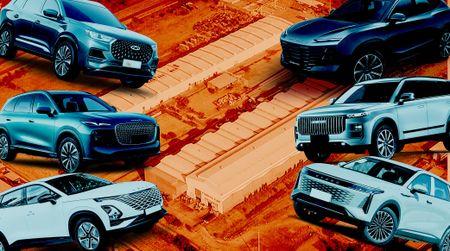
This mirrors similar automotive investments the country is making to propel Chery and BYD to the top of the global car sales charts and help wean the nation off of imported western oil.
Unfortunately, there was only one day of clear skies in Shanghai where you could see the tower stretch to the blue yonder. It was also the day after the Bafana win and the boozy night out on the Bund, so the crew was in full philosophical flow.
Yes, the vision of the future is slightly tainted with the nighttime curfew, but again it is a short-term sacrifice for long term economic gain. DM
Daily Maverick attended Mobile World Congress Shanghai as a guest of Huawei South Africa’s enterprise division.
Comments
Scroll down to load comments...