




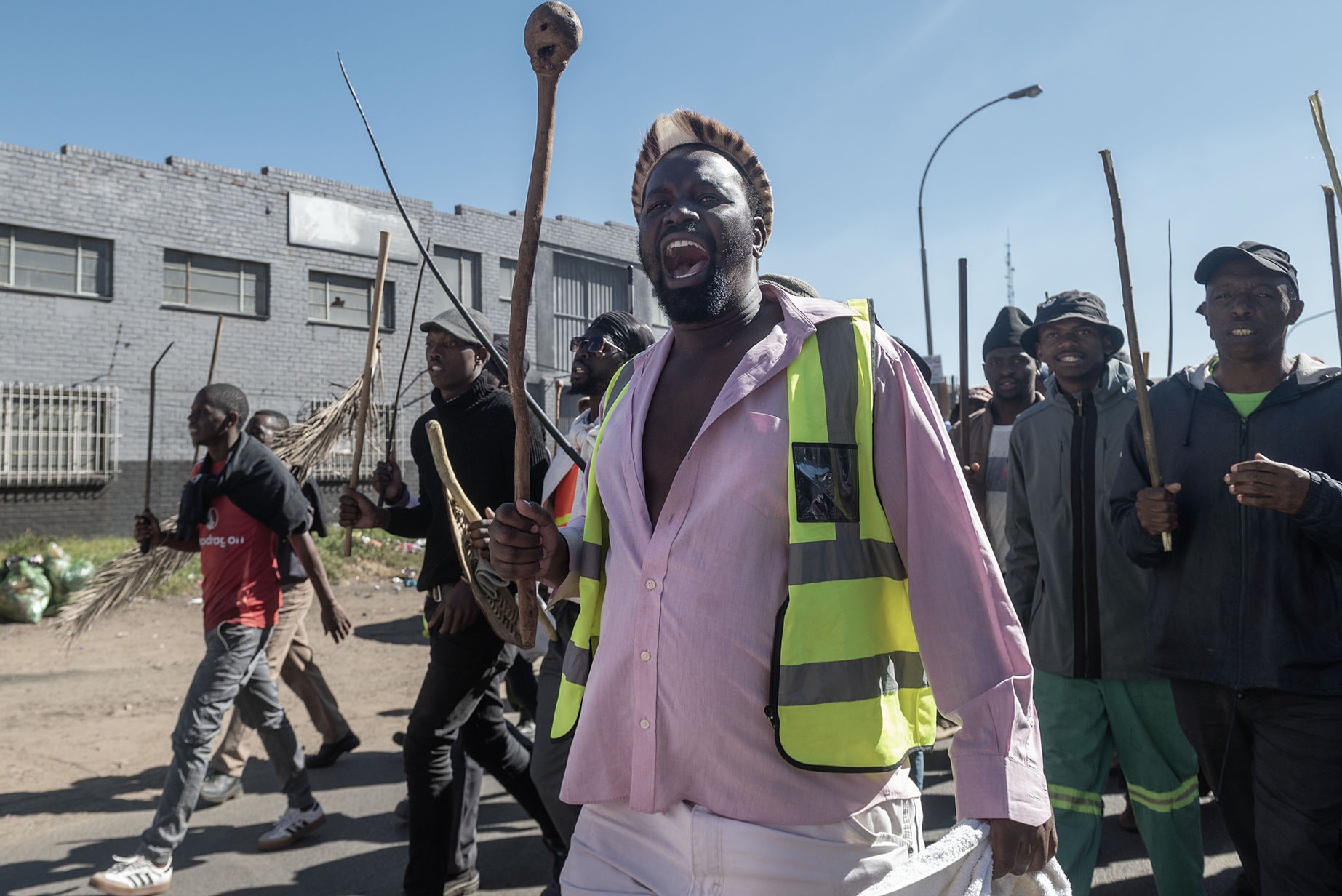
 Protesters, made up of community members and civic organisations, march to various companies alleged to be employing foreign nationals in the Boksburg and Benoni areas, east of Johannesburg, South Africa, on 8 June 2026. (Photo: Leon Sadiki)
 /file/dailymaverick/wp-content/uploads/2025/10/label-Op-Ed.jpg)
Anti-migrant groups, including Operation Dudula and March and March, have issued an ultimatum demanding that “undocumented” non-citizens leave South Africa by 30 June.
Reports from affected communities describe intimidation through harassment, verbal threats and demands that individuals produce identification documents or proof of their immigration status in the country. None of this is new. We have seen disturbing outbursts of xenophobic violence and attacks repeatedly and recall the specific episodes of xenophobic violence in SA in 2008 and 2015.
What follows is also familiar: civil society mobilisation, public condemnation, inflammatory rhetoric from political leaders, a brief period of attention from state actors followed by institutional drift until the next outbreak. The problem is not the lack of awareness of xenophobia – it is its repetition without accountability.
The absence of proactive action by police and justice actors is particularly concerning. Effective enforcement does not begin with arrests; it begins with timely and effective investigations. Yet allegations of xenophobic violence and incitement are too often met with inadequate investigative responses, undermining the possibility of subsequent arrests and prosecutions. The result is that perpetrators frequently face little meaningful accountability.
Xenophobic violence in SA is often mischaracterised. It is frequently treated as a social phenomenon driven by poverty, inequality and competition over scarce resources. While these factors do contribute to tensions, they do not explain the persistence of the problem. SA does not lack public awareness of or policy commitments and laws against xenophobia. What it lacks is consistent implementation and enforcement of national and international laws.
Governmental failure
At its core, this is a failure of the South African government to meet its legal obligations to protect non-citizens. These obligations are embedded in the Constitution of the Republic of South Africa, 1996 – particularly the rights to dignity (section 10), equality (section 9) and security of the person (section 12).
This is further reinforced by SA’s international legal obligations under the International Covenant on Civil and Political Rights and the 1951 United Nations Refugee Convention, which together require states to safeguard human rights, including the right to life and security of person, and to ensure access to effective remedies where violations occur. This duty is continuous – it does not depend on political urgency or public visibility.
The enforcement gap is where the pattern becomes visible. After multiple episodes of xenophobic violence, prosecutions have been slow and limited. Following the 2008 xenophobic attacks – in which at least 62 people were killed and thousands more displaced – the South African Human Rights Commission reported that of the 597 judicial cases linked to the violence, only 159 had been finalised with a verdict by October 2009, while 218 were withdrawn.
Accountability, however, is only one part of the problem. Policing in known hotspot areas has also often been uneven, shifting between periods of heightened attention and periods of relative neglect. The result is not random failure, but a pattern of weak and inconsistent enforcement – a pattern that facilitates the creation of the ideal conditions in which further outbreaks can recur.
This produces consequences that go beyond individual incidents. Where accountability is weak, impunity becomes embedded. Where enforcement is inconsistent, violence becomes cyclical and increasingly low risk for perpetrators. Where protection is unevenly applied, non-citizens are effectively positioned in practice as “second-tier human beings”, regardless of what the law says in principle. In this sense, inaction is not neutral – it actively creates risk.
National action plan
South Africa has already developed a National Action Plan to Combat Racism, Racial Discrimination, Xenophobia and Related Intolerance, which sets out clear commitments on prevention, enforcement and coordination across state institutions.
President Cyril Ramaphosa and other senior government officials have repeatedly condemned xenophobic rhetoric and violence in public statements. Yet these commitments have not consistently been matched by enforcement on the ground. The persistence of xenophobic violence therefore reflects a failure of implementation, not a lack of awareness or policy direction.
Without countering xenophobia through effective prevention, enforcement and accountability, the cycle persists. Each outbreak is treated as an isolated event rather than part of a predictable pattern of enforcement failure, and each response arrives too late to alter the underlying incentives that make repetition possible.
As SA approaches 30 June, the significance of this moment lies less in the threats being made than in the state’s ability to prevent them from translating into harm. The question is not whether such threats should exist. It is whether the state is consistently able to prevent them from translating into harm.
The measure of a state is not in its statements after violent episodes, but whether adequate measures are taken to proactively prevent violence and harm in the first place. These must further be reinforced by strong accountability measures – anything else is futile. DM
Kaajal Ramjathan-Keogh is the Africa Director at the International Commission of Jurists (ICJ) and Sanjna Jain is an International Law and Human Rights Fellow and a JD student at New York University.