





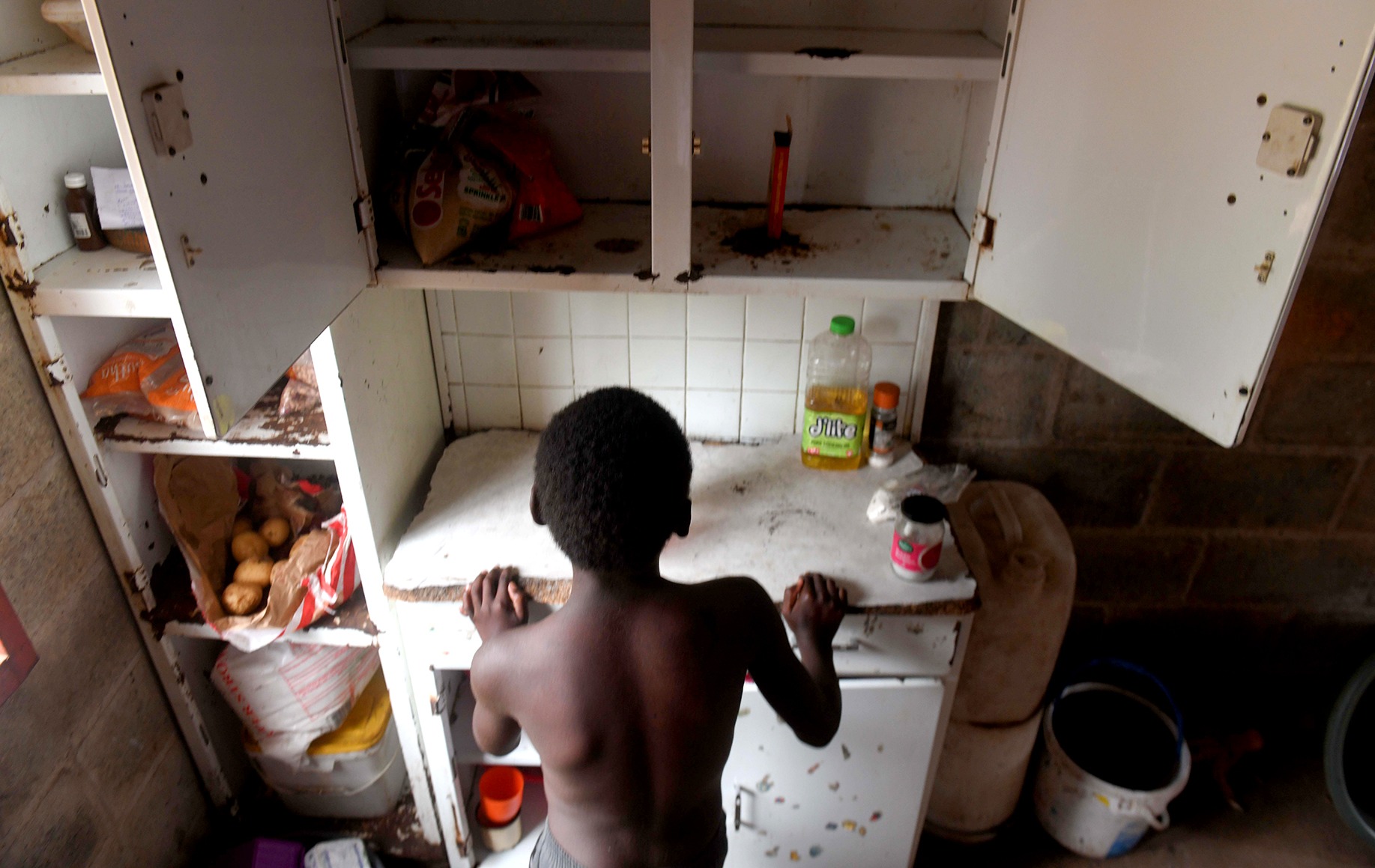
 South Africa is grappling with a severe food price and insecurity crisis, with more than 60% of households struggling to afford a healthy diet. (Photo: Black Star / Spotlight)
Rising fuel and fertiliser costs, as a result of the closure of Strait of Hormuz after the US and Israel attacked Iran, have threatened another global food price shock.
Even though the strait recently opened, fuel prices may remain high until the end of the year, with knock-on effects on food prices. South Africa’s persistent and rising rates of hunger and food insecurity mean that the public can ill afford yet another food price spike. This poses the question: Can the government do more to address high and volatile food prices in SA, and to end hunger and food insecurity?
Food price inflation slowed to 2.9% in April, after reaching 14% in March 2023. But when inflation slows, prices are generally still rising, albeit at a slower pace. When prices of the overall food basket climbed between 2020 and 2023, a continued food inflation rate above zero meant overall prices remained high. Households carry the cumulative burden of years of price increases. And, increased producer inflation portends further future upward pressure on food prices.
Food prices are a key determinant of food access in SA. As food prices rise, so does food insecurity, as well as coping strategies that reduce nutritional intake. Despite the Constitution guaranteeing the right to food, about 63.5% of households experience some form of food insecurity, and 17.5% are severely food insecure.
The 62% share of the population that cannot afford a healthy diet in SA is disproportionately high compared with other upper-middle-income countries like Brazil (24%) and China (12%). It is also higher than many lower-income countries, such as Ghana and Senegal. An estimated one in four children under five (28.8%) are stunted from chronic food insecurity. Almost 40% of audited under-five deaths of children in SA are associated with severe acute malnutrition.
As the country’s economy has sputtered over the past few years, the agricultural sector has been vaunted as a star performer in terms of consistent growth and job creation. State agricultural policy and industry organisations promote a guiding approach to the sector as one of economic growth, continued export expansion, and competitiveness. But does this emphasis address the problem of hunger, poverty and food affordability?
Daily survival dilemma
At the household level, food insecurity is an outcome of the relationship between food prices and incomes, and more widely of employment levels, social protection, transport and energy prices, as well as the structure of the food system. Low-income households have little choice but to allocate money to transport and electricity costs before food purchases. Surging utility rates, high transport costs, and stagnant wages force South African households into a daily survival dilemma.
Households must often make a choice between paying for transport, electricity, personal hygiene essentials, and nutritious food. Even when the prices of selected foods fall or remain static, the cost-of-living crisis continues. This is because for lower income households, wages and social grants have not caught up with the cumulative food price increases of previous years. These factors are rooted in structural dynamics of the South African economy that agricultural GDP growth does not solve.
This challenge is exacerbated by the structure of the food system. The South African Human Rights Commission’s inquiry behoves us to ask whether the current organisation of the food system is aligned with the constitutional right to food. Since the late 1980s, particularly after the passing of the Marketing of Agricultural Products Act in 1996 that deregulated and liberalised the agro-food system, the government handed over food pricing to the market.
Corporate concentration in agri-food markets has broadly increased since 1994. A few companies now occupy the inputs, storage, processing and retail components of the food system. This raises significant concerns about the power corporations have over pricing and profits to the detriment of the right to food. The Competition Commission has repeatedly noted concerns about “rocket and feather” dynamics – where prices rise when input costs increase, but fall far more slowly when those costs decline – following price spikes in sectors like maize meal, bread and edible oils. This raises concerns about profiteering associated with high degrees of market power.
Toolbox of interventions
The wisdom of a hands-off approach to food prices and affordability appears increasingly questionable in a context of mounting, overlapping emergencies and social inequalities. A more comprehensive food affordability policy framework encompassing a “toolbox” of interventions is indispensable to ending the hunger and food insecurity crisis.
This would need to cover at least four areas:
First, raising incomes through social and economic policy. This should include raising the child support grant to at least the food poverty line (currently R855 p/m). Further, the social relief of distress (SRD) grant should be transitioned to a universal basic income initially set at the food poverty line or higher, progressively expanding it to the upper bound poverty line. This should be combined with a set of economic policy interventions that raise incomes through the creation of decent jobs and livelihoods.
Second, given concerns about corporate power and food prices, the government needs to develop appropriate forms of regulation informed by the right to food. This should include enhanced competition and consumer regulation, as well as efforts to enhance transparency of corporate pricing behaviour through mandatory data disclosure mechanisms to regulators.
Third, beyond only competition policy, economic policy interventions are gaining traction in different parts of the world. Buffer stocks are held by a public agency to release food such as grains into the market when prices spike, and purchase when prices go too low, to help maintain price stability. They are an important mechanism to shield countries from global price shocks and domestic ones emanating from climate impacts.
Counter-cyclical tariffs or quotas for grain imports can be used to limit the translation of global price volatility into domestic markets and stabilise short-run domestic supply.
The Mexican government has led an initiative with retailers to cap a basket of 24 nutritious food items at a specified level (930 pesos), together with complementary policy interventions such as income support, minimum wage policies, coordination with producers and retailers, and selective price stabilisation. Further evidence also needs to be generated to inform other potential policy interventions, such as measures to alleviate the costs driving food price inflation, better understanding and acting on profit dynamics of incumbent firms in the food system, and monitoring how value is distributed across the food system for key foods from consumers, to retailers, to producers.
Fourth, strengthening the infrastructure for more localised, climate resilient food systems. The food system infrastructure (public and private) from large-scale commercial farms to supermarkets and export markets is well developed. However, greater infrastructural and government support to smallholder farmers (linked to agrarian reform), support for more agroecological and regenerative forms of farming and healthy eating, as well as public procurement, and strengthened non-corporate market linkages, are sorely needed.
Informal traders
Policies to support informal traders are a case in point. While informal traders play a critical role in making food more accessible particularly to low-income households at prices often lower than the commercial system, they are often actively marginalised by local governments. They are also targeted by xenophobic mobilisation and violence, given that a lot of immigrants work in the informal sector. Local governments should be required to enhance infrastructure for local food marketplaces, which benefits both traders and households.
These interventions for food affordability should be part of a coherent policy framework, at two levels. The first is food system and nutrition policy alignment and coordination across relevant government departments, including agriculture, land reform and rural development, environment, health, education and social development.
Second, fiscal and monetary policy should align with a more developmental framework. For example, food inflation in SA is driven by supply side factors, but as the SA Reserve Bank concedes, its interest rate tightening does not address these. Rising interest rates in fact worsen food insecurity of indebted households. Fiscal policy in coordination with monetary policy should support developmental interventions that address or buffer supply-side shocks, to advance the right to food.
Achieving the right to food requires the combined effort of all sectors of society, but global evidence shows that the government must show policy leadership. This is exemplified by the Brazilian experience: the Brazilian government under President Lula da Silva embarked on a Zero Hunger campaign which led to the country being removed from the Food and Agriculture Organisation’s hunger map in 2014.
Dismantling of social programmes
However, it returned to the map after the impacts of Covid-19 and dismantling of social programmes by right wing president Jair Bolsonaro. Then, with the return of the Workers’ Party and the revival of a food security architecture that encompassed income support, public procurement, family farmer support, and nutritional interventions, it was again removed from the hunger map in 2025. In only two years, 40 million people were lifted out of moderate to severe food insecurity.
Exciting options are available to rid our society of the scourge of hunger and food insecurity. The case of Brazil shows that SA just needs the requisite imagination, political commitment and leadership, and allocation of resources in order for this to be realised. DM
This article forms part of a debate series curated by the Institute for Economic Justice (IEJ), published by Daily Maverick, to deepen understanding of South Africa’s economic challenges.
It accompanies the IEJ’s podcast series Economic Justice Matters. The third episode of the 2026 season asks What is behind South Africa’s persistent and worsening food insecurity rates, and what can be done about it?
Koketso Moeti (Union Against Hunger and Amandla.Mobi) and Edzani Mphaphuli (GrowGreat Campaign) join Andrew Bennie (Institute for Economic Justice) in a thought-provoking discussion. Watch the full conversation here.
Dr Andrew Bennie is Senior Researcher in Climate Policy and Food Systems at the Institute for Economic Justice (IEJ) and research associate of the Department of Sociology at Wits University, and Yondela Mahlati is a Researcher in Climate Policy and Food Systems at the IEJ.
Comments
Scroll down to load comments...