



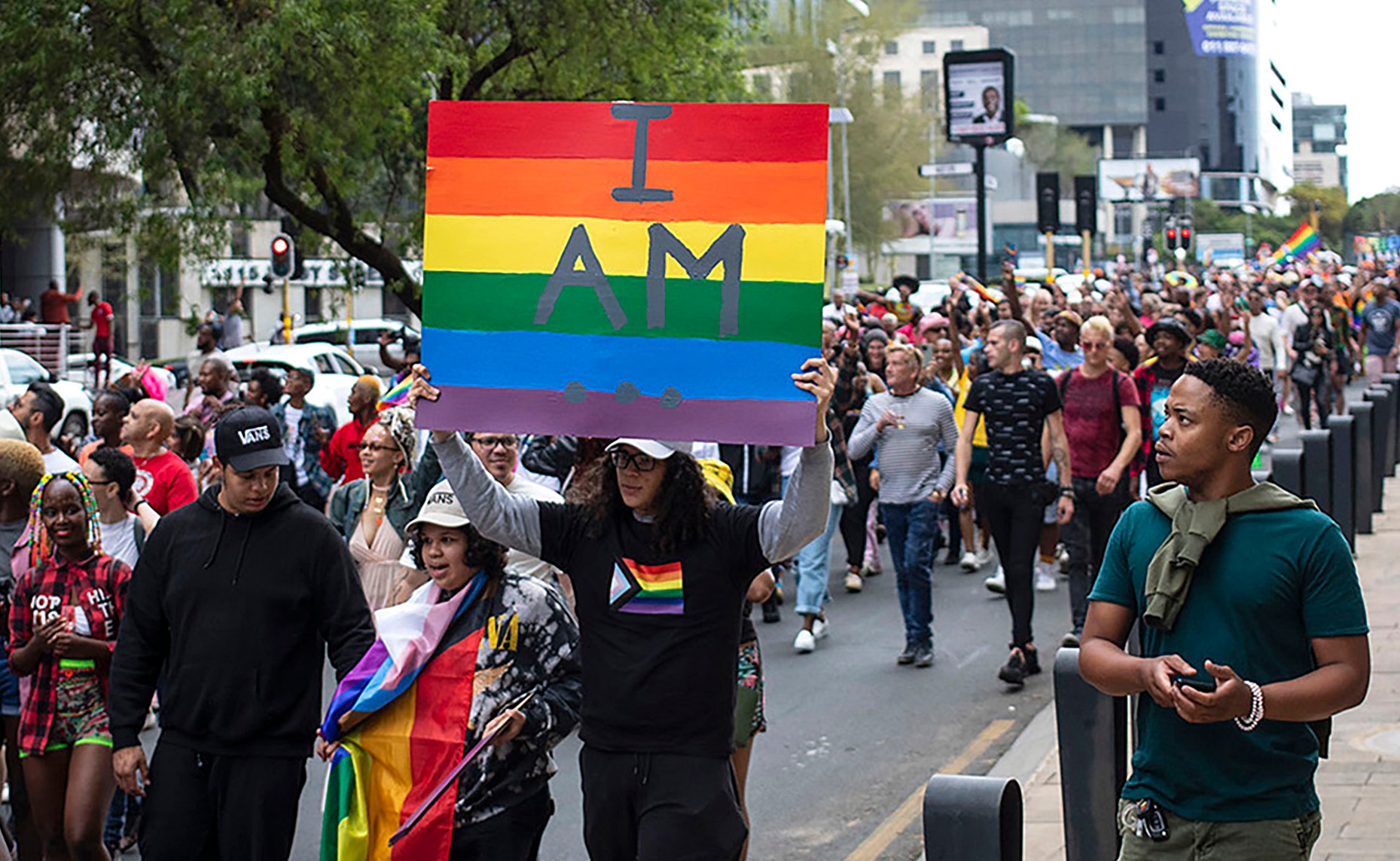
 Members of the LGBT community attend the annual Pride march in Johannesburg on 29 October 2022. (Photo: EPA-EFE / Kim Ludbrook)
 It has been 20 years since South Africa legalised marriage equality, and on paper, the country is a global haven. However, gaining real entry into everyday society is still an uphill struggle for the country’s estimated 2.39 million lesbian, gay, bisexual, transgender and intersex (LGBTI) population.
A landmark national report released on Friday, 26 June by The Other Foundation and the Human Sciences Research Council shows that South Africa has seen a shift towards acceptance, with fewer South Africans now believing that same-sex relations are wrong, support for marriage equality growing and LGBTI individuals increasingly recognised as an essential part of the country’s social fabric.
However, prejudice, invisibility and regressive values continue to shape whether LGBTI people are fully welcomed in everyday life.
“This report is titled Admission Reserved because it captures the evolving, but still contested, nature of LGBTI inclusion in South Africa. The door to equality and freedom has opened, but admission is still too often reserved,” the report reads.
A decade of change
The landmark report is the first nationally representative study to provide a highly detailed, disaggregated population estimate of South Africa’s LGBTI population, while tracking a decade of shifting public attitudes.
The data reveal that 5.3% of South Africans aged 16 and older identify as LGBTI, representing an estimated 2.39 million people. The foundation’s 2016 baseline study, Progressive Prudes, estimated the population at roughly 530,000. Experts suggest this surge does not indicate a sudden population spike, but rather an increasing willingness among citizens to openly embrace and report their identities as social stigma slowly recedes.
The findings paint a picture of a society in transition, caught between a growing commitment to equality and deep-rooted social resistance.
Based on fresh data collected from 3,285 respondents across all nine provinces between November 2025 and February 2026, the survey shows that South Africans are generally less hostile, more familiar with LGBTI individuals, and far more supportive of institutional equality than they were 10 years ago.
- Today, 46% of South Africans say their views on LGBTI people have become more accepting over the past five years, while only 11% report becoming less accepting;
- In 2015, 62% of the population believed same-sex relations between adults were “always wrong”. By 2025, this moral opposition dropped to 52%. This shift cut broadly across generations, provinces, education levels and population groups;
- Today, 42% of South Africans find same-sex romantic relationships acceptable, and 38% agree that same-sex couples should be permitted to raise children;
- Between 2022 and 2024, the belief that same-sex relations are always wrong spiked from 43% to 53%. Researchers note this 10% reactionary roll-back aligns with global patterns during the Covid-19 pandemic, which isolated individuals and halted visible civil society advocacy.
/file/attachments/orphans/attitudesareevolvingPART1_265582.jpg "Public opinion in South Africa is steadily shifting towards equality. Over the past decade, opposition to same-sex relationships has dropped as support for equal rights grows. (Source: The Other Foundation)")
/file/attachments/orphans/attitudesareevolvingpart2_904298.jpg "(Source The Other Foundation)")
While support for basic constitutional rights has entered the mainstream, specific administrative measures remain highly polarised:
- Support for general equality rose from roughly half the population in 2015 to 60% in 2025 for gay and lesbian individuals. General rights support stands at 57% for bisexual and transgender individuals, and peaks at 68% for intersex people;
- Support for same-sex marriage climbed from 37% to 45% over the decade, while active opposition dropped from 46% to 37%;
- 37% support an individual’s right to change the gender marker on their identity documents, while 42% oppose it.
/file/attachments/orphans/attitudesareevolvingpart3_785236.jpg "(Source: The Other Foundation)")
The data reveal that South Africans readily back equality in principle but remain hesitant to endorse it in close personal or public settings.
- About half of South Africans say they would accept a gay man (49%), a lesbian woman (51%) or a transgender person (50%) within their family. Acceptance for intersex family members stands at 64%;
- Roughly half of respondents agree that gay men (50%), lesbian women (51%), transgender individuals (49%) and bisexual people (47%) should be welcome in their traditions, compared with 63% for intersex individuals.
- Only 28% of South Africans view it as acceptable for a same-sex couple to kiss in public.
/file/attachments/orphans/attitudesareevolvingpart4_503801.jpg "(Source: The Other Foundation)")
Masked violence and the normalisation of xenophobia
While nearly half of South Africans believe LGBTI individuals face no violence or harassment in their neighbourhoods, self-reported metrics reveal a much harsher reality.
Roughly 6% of adults admit to mocking or insulting someone for being lesbian, gay or bisexual, while 4% confess to verbally abusing transgender individuals. Regarding physical abuse, 2.5% of respondents admit to physically harming or harassing lesbian, gay or bisexual people, while 1.9% target transgender individuals.
This means an estimated 2.85 million South Africans aged 16 or older have verbally abused someone for being lesbian, gay or bisexual. At the same time, 1.13 million have physically harmed or harassed someone for the same reason. Likewise, an estimated 1.72 million adults have verbally abused a transgender person, while 870,000 have physically harmed or harassed one.
The report also illustrated the intersection between homophobia and xenophobia, highlighting that prejudice rarely operates in isolation. The data show that anti-LGBTI behaviour is frequently part of a broader hostility towards anyone perceived as “the other”. Notably, South Africans who admitted to participating in violence against immigrants were statistically far more likely to report harassing or physically harming LGBTI individuals.
However, public accountability for these two types of prejudice is moving in opposite directions. Between 2015 and 2025, the percentage of people who admitted they might violently target a transgender person in the future dropped from 8% to 3%, signalling a growing social consensus that anti-trans violence is entirely unacceptable.
Conversely, the proportion of citizens willing to admit they might take violent action against immigrants in the future climbed from 13% to 17%. This reveals that while anti-LGBTI abuse is slowly becoming a social taboo, xenophobic hostility has become alarmingly normalised and socially permissible.
Defending the promise of lived equality
Speaking at the launch of the report, Constitutional Court Justice Jody Kollapen emphasised that legislation alone cannot guarantee true inclusion, noting that the deeper struggle lies in transforming hearts and minds.
“We prided ourselves on being a rules-based society, and a society where the law would be supreme, and yet the law can’t penetrate the recesses of our minds and the years of how those fault lines were constructed,” he said.
Kollapen called for a renewed commitment to the foundational values of equality and social justice that should underpin the nation.
/file/attachments/orphans/clusters_409811.jpg "The research breaks public attitudes down into five distinct categories. On the supportive end, 9% of the population are committed champions, 32% show broad support, and 29% hold mixed views. The remaining groups include principled conservatives (22% of the population), who show low acceptance but believe LGBTI people should not be harmed, and the uncompromising hardline (the final 7%), who are the least likely to change their minds. (Source: The Other Foundation)")
Neville Gabriel, CEO of The Other Foundation, echoed this warning against complacency, noting that a growing global and continental backlash means human rights progress can never be taken for granted. He emphasised that the study highlights both how far the country has come and exactly what risks rolling back these protections would bring.
“At a time when rights and protections are under attack in many parts of the world, civil society must remain vigilant. The gains reflected in this report were won through organising, advocacy and everyday acts of courage. We must continue to defend them with the same determination today,” he said. DM
Comments
Scroll down to load comments...