




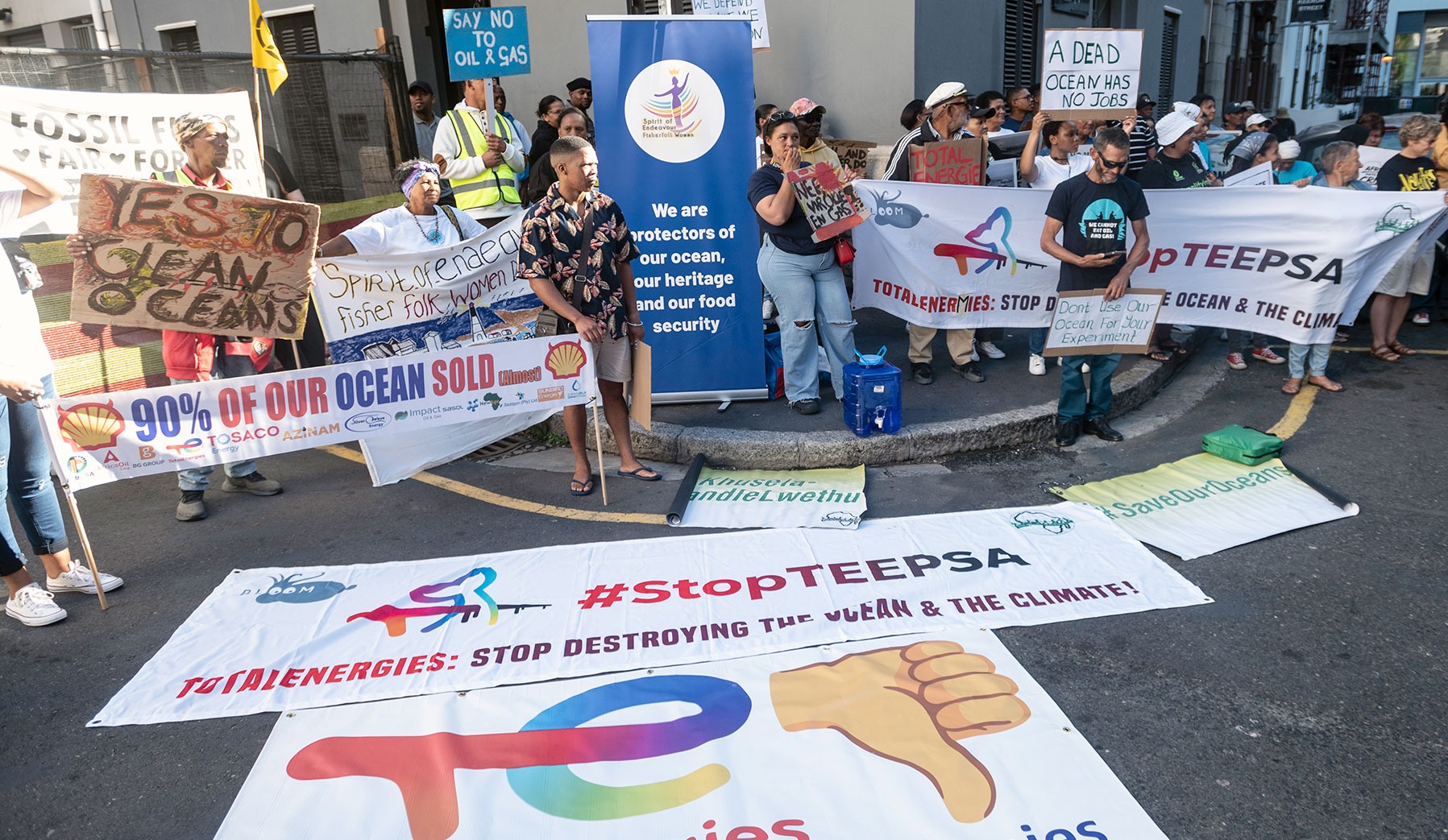
 Environmentalists and fishing communities protest outside the Western Cape High Court on 23 March against TotalEnergies’ oil and gas exploration project in the Deep Western Orange Basin. (Photo: Brenton Geach / Gallo Images)
From the cold, fish-rich Benguela system off the West Coast to the turbulent meeting of oceans along the South Coast, more than 90% of South Africa’s seabed has been carved up for oil and gas exploration.
Petroleum Agency South Africa’s latest map illustrating the grids of offshore open acreage, exploration rights, technical cooperation permits, production rights, seismic lines, wells and areas under application, stretching across the Atlantic and Indian Ocean hosts a crowded cast. This includes TotalEnergies, Shell, QatarEnergy, Africa Oil, Ricocure, Azinam, Impact Africa, PetroSA, Sasol and BG International, each attached to blocks, basins or data campaigns in what has become a new scramble for oil and gas off South Africa.
/file/attachments/orphans/image-1_194733.jpg "A map of the offshore oil and gas exploration in South Africa. (Source: Green Connection)")
But on beaches, in coastal fishing villages and in courtrooms, another map is being drawn. Since 2021, small-scale fishers, coastal communities, environmental justice lawyers and civil society groups have been trying to stop, delay or force deeper scrutiny of seismic surveys and exploratory drilling before the country commits more of its ocean to the extraction of fossil fuels.
/file/attachments/orphans/ED_361264_258219.jpg "A fishing community protests outside the Western Cape High Court on 7 February 2022 against seismic exploration off the West Coast. (Photo: Jaco Marais / Gallo Images / Die Burger)")
Multinational players and driving forces
The scale of corporate interest off South Africa’s shores is immense. A look at the country’s petroleum exploration mapping reveals that the ocean has been systematically carved up into specialised exploration blocks.
The corporate interest is clearest in the Orange Basin, where discoveries across the border in Namibia have intensified exploration plans on the South African side. In March 2024, TotalEnergies announced that, together with QatarEnergy, it had signed an agreement to acquire interests in Block 3B/4B, about 200km off South Africa’s western coast.
TotalEnergies said it would hold 33% and become the operator, while QatarEnergy would hold 24%; Africa Oil SA, Ricocure and Azinam would retain the balance. The company explicitly linked the move to its Namibian success: “Following the Venus success in Namibia,” TotalEnergies said, it was continuing exploration in the Orange Basin by entering a “promising” South African licence.
The map of oil and gas exploration shows the same corporate interests scattered across South Africa’s coastline. In addition to the TotalEnergies-QatarEnergy-Africa Oil-Ricocure-Azinam grouping over Block 3B/4B, it shows TotalEnergies with QatarEnergy and Sezigyn in the Deep-Water Orange Basin; and Shell with Qatar, Umbono and OK Energy, and TotalEnergies with Impact Africa and Qatar Petroleum in other offshore blocks.
A glaring hypocrisy sits at the heart of TotalEnergies’ operations in South Africa. The French energy company hails from a nation that enacted a world-first ban in 2017, prohibiting the issuance of new fossil fuel exploration and extraction permits across all French territories. Yet Total has majority stakes in multiple exploration projects in South Africa’s waters.
Neville van Rooy, a community activist and outreach coordinator at the Green Connection, said he experienced this contradiction firsthand during an advocacy trip to Europe.
“We also went to France, and we know the law ... it’s the Vigilance Act that says that there needs to be no vibrations of any type of drilling in the ocean,” said Van Rooy. “And then when we got there, the people really just told us, ‘But it’s not us, it’s your government that’s allowing them.’ We are very vocal to say that we would not allow Africa to be the gas station of the oil and gas industry that wants to come and loot Africa’s resources for their benefit.”
What is driving this sudden, concentrated push?
For the Department of Mineral Resources and Energy (DMRE), the exploration blocks in SA waters are not just speculative acreage; they are instruments of growth, energy security and economic empowerment.
In March 2025, Mineral and Petroleum Resources Minister Gwede Mantashe told the Southern Africa Oil and Gas Conference that exploration, extraction and monetisation of South Africa’s indigenous oil and gas resources “could be a game-changer” for the fiscus.
“We will aggressively pursue oil and gas, coal and renewables,” he said, adding that Namibian Orange Basin discoveries had drawn major petroleum companies southward and that accelerated exploration could, in the government’s view, lift economic growth.
/file/dailymaverick/wp-content/uploads/2025/04/ED_507764.jpg "Mineral and Petroleum Resources Minister Gwede Mantashe. (Photo: Sharon Seretlo / Gallo Images)")
Mantashe held the line at this year’s conference, stating that South Africa must harness the natural resources it has been endowed with to pressure-proof the nation against geopolitical shocks like the US-Israeli war on Iran, as Daily Maverick’s Lindsey Schutters reported in March this year.
But Melissa Groenink, an environment lawyer and programme manager for Defending Rights at Natural Justice, argued that the push is “more of a political issue than an issue with the regulatory regime”.
Groenink says each project is assessed as if it stands alone, yet the combined effect of multiple successful blocks could exceed domestic gas needs. “If we don’t need the gas, we know it’s not desirable from an environmental … or climate change perspective, then really what’s left is just political,” she said.
She added that the government and the global energy sector were leveraging international geopolitical tensions and fluctuating oil prices as a convenient justification to maximise profits and expand extraction boundaries in South Africa to the detriment of marine ecosystems and vulnerable coastal communities.
“What we’ve been raising since the Climate Change Act came into effect is that the continued exploration and exploitation of these resources does conflict with the Climate Change Act, and the proposed Upstream Petroleum Resources Development Act conflicts with it even more in the sense that it tries to push the envelope even further and is really intent on maximum exploitation,” said Groenink.
The Department of Forestry, Fisheries and the Environment (DFFE) has positioned itself differently. In March, the then minister, Willie Aucamp, announced that he would proceed with appeals lodged against environmental authorisations for offshore exploration drilling and seismic surveys along the west and south coasts, saying the move was intended to avoid “decision paralysis”. He said the government had a legal and constitutional obligation to take decisions that promote inclusive growth and jobs “without compromising” environmental protection.
/file/attachments/orphans/ED_595312_884461.jpg "The former minister of forestry, fisheries and the environment, Willie Aucamp. (Photo: Misha Jordaan / Gallo Images)")
In a written response to Daily Maverick, the DFFE confirmed that an independent panel of experts had been appointed to assist the appeal authority with four offshore oil and gas appeals: Searcher Geodata (UK), Shell Offshore Upstream Northern Cape Ultra Deep, Africa Oil/Ricocure/Azinam Block 3 and 4, and CGS SAS. The department said there could be no single timeline because of the different numbers of appellants and overlapping grounds of appeal, but that the matters were at an advanced stage.
The DFFE insists the panel is meant to add capacity and technical expertise, not weaken oversight. On climate, it says decisions are guided by section 24 of the Constitution and the National Environmental Management Act, and are made on a case-by-case basis, considering environmental and climate impacts, socioeconomic benefits and risks, alternatives, and mitigation. It also stressed that exploration does not authorise production, which would require further approvals.
Litigation and precedents
Yet it is precisely the case-by-case system that has produced years of litigation. The legal record has become a slow-moving counterweight to the state-corporate push.
In 2022, the Western Cape High Court interdicted Searcher Geodata UK, Searcher Seismic Australia and the vessel BGP Pioneer from continuing a seismic survey off the west and southwest coasts. The applicants included small-scale fishers, indigenous communities and environmental organisations, and the court criticised public participation failures that prejudiced poor, non-English and non-Afrikaans-speaking fishers without access to technology.
/file/attachments/orphans/ED_382553_145465.jpg "A protest outside the Eastern Cape High Court in Gqeberha on 30 May 2022 against a seismic survey off the Wild Coast. (Photo: Lulama Zenzile / Gallo Images / Die Burger)")
The landmark Wild Coast Shell case became a national symbol. Communities and environmental groups challenged Shell and Impact Africa’s exploration rights, arguing failures in consultation, cultural rights, livelihoods and climate considerations.
However, the judgment did not set a precedent to halt plans for future oil and gas exploration. Groenink explained why that victory did not automatically halt every subsequent application: each judicial review challenges a specific decision on specific facts. The case against Shell involved the exploration right itself; many West Coast cases challenge environmental authorisations. “Unfortunately, that is just the nature of challenging different authorisations and the way that judicial reviews work,” she says.
But the Block 5/6/7 case against TotalEnergies and Shell sharpened those precedents. In August 2025, the Western Cape High Court set aside the environmental authorisation for TotalEnergies EP South Africa to drill in Block 5/6/7, sending the matter back for a fresh decision, further studies and public participation. The court required a fuller assessment of the socioeconomic impacts of a blowout, full life-cycle climate impacts, Integrated Coastal Management Act factors, possible transboundary impacts on Namibia and oil spill response plans.
/file/attachments/orphans/ED_601448_913869.jpg "Environmentalists and fishing communities protest outside the Western Cape High Court on 23 March against TotalEnergies' oil and gas exploration project in the Deep Western Orange Basin. (Photo: Brenton Geach / Gallo Images )")
That judgment matters because it challenges the artificial separation between exploration and eventual production. The court noted that climate change is relevant to both stages: it makes little sense to rely on possible production-stage benefits while resisting assessment of production-stage harms.
However, the West Coast remains a live front for legal challenges. In June, the Western Cape High Court heard a challenge by Aukotowa Fisheries Primary Co-operative, the Green Connection and Natural Justice against the state and TGS Geophysical Company UK Ltd over a large-scale offshore 3D seismic survey. The authorisation was granted by the DMRE and confirmed on appeal by the DFFE minister. The applicants argue that seismic blasting risks to marine species, ecosystems and fishing livelihoods were not adequately assessed.
For Van Rooy, the fight is exhausting and expensive. Civil society groups, he said, are playing “whack-a-mole” against companies with deep pockets: Shell on the Wild Coast, Searcher and TGS on the West Coast, TotalEnergies in the Deep Water Orange Basin and Block 5/6/7.
At the heart of the conflict is a deceptively simple legal and moral claim: the ocean is not an empty space. It is a climate sink, a fishing ground, a spiritual landscape, a commons and, under South Africa’s coastal law, public property. “It belongs to every citizen in our country,” says Van Rooy, “whether you stay in Limpopo or in the Karoo.”
That is why this scramble is not only about hydrocarbons. It is about who gets to define development, who bears the risks of exploration, and whether the promise of gas can justify opening another fossil fuel frontier in a warming world. For now, the government and multinationals continue to map prospects beneath the seabed. Coastal communities and environmental organisations are mapping something else: the legal limits of extraction, one block at a time. DM


Comments
Scroll down to load comments...