



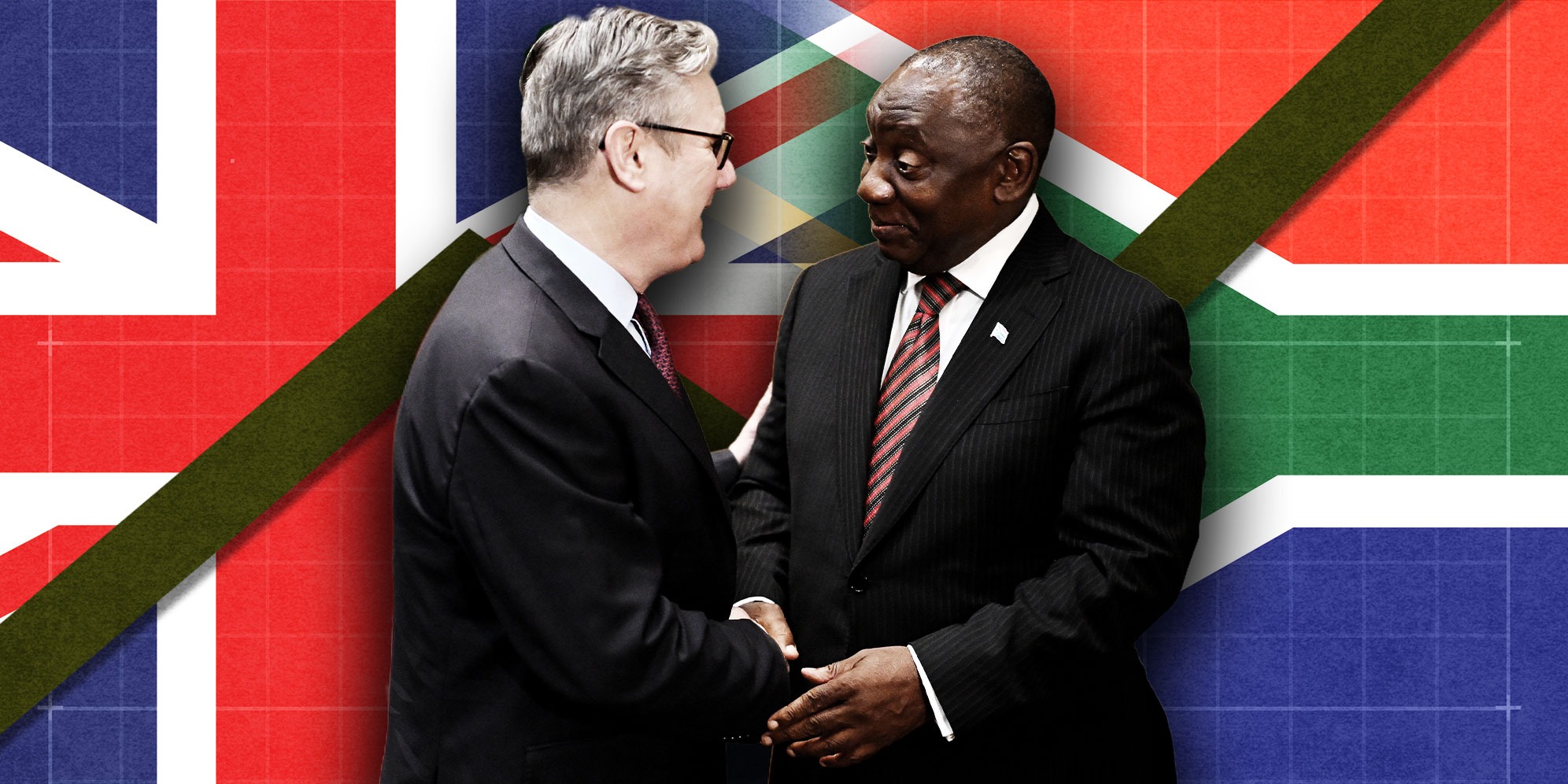
 Illustrative Image: British Prime Minister Keir Starmer and South African President Cyril Ramaphosa shake hands during a bilateral meeting at Sandton Convention Centre on November 21, 2025 in Johannesburg, South Africa. (Photo: Leon Neal / Getty Images) | UK flag | SA flag | Graph. (Image: Freepik)| (By Daniella Lee Ming Yesca)
Early last month, British Prime Minister Keir Starmer told a closed caucus of his Labour Party that he would defy clamours from within and outside its ranks to step down. In a defiant address, extracts of which were released by his office, the embattled leader said he would defy what he called his detractors.
“After having fought for the chance to change our country, I’m not prepared to walk away from my mandate and my responsibility to my country or to plunge us into chaos, as others have done,” he said.
A few days later, South Africa’s president took to the podium to proclaim the same thing. Cyril Ramaphosa addressed the nation and said that he wanted “to make it clear” that he would not resign because to do so would be “to abdicate the responsibility that I assumed when I became the president of the republic”. To resign now “would be to give in to those who seek to reverse the renewal of our society, the rebuilding of our institutions and the prosecution of corruption”.
The context in which these men took their defiant stances was very different, but the paths they had walked to the point where they had to make this declaration bore many similarities. The biggest of these can be encapsulated in one concept: wasted political capital. They could both have been much bigger players, but chose to be placeholders.
In the case of Starmer, he spoke days after delivering the worst possible outcome in countrywide municipal elections, losing hundreds of seats his party had held for decades, and in some instances for over a century. He had also made embarrassing policy flip-flops and grievous misjudgements.
His blandness had made him the most unpopular prime minister in modern British history, and he was a massive liability. It was becoming clear to all and sundry that, if Starmer remained the face of Labour over the next few years, it would be sleepwalking its way to electoral collapse in the 2029 general election. So, he had to go, and go now.
Ramaphosa was facing a different set of challenges. His apparent belief that Ellerines furniture yields better interest on your investments than a commercial bank had landed him in hot water and dogged him for years. Though his party had tried to shield him from parliamentary scrutiny over the $580,000 found in his four-seater set, the rule of law had prevailed when the Constitutional Court ruled that Parliament had a duty to hold the president to account.
The ruling, which was damning of Parliament’s behaviour when the ANC appallingly used its 57% majority to protect its leader, turned up the heat on Ramaphosa. Even though the ruling was not about him, calls for his resignation resounded among parties which are not part of the Government of National Unity. Various polls have shown a dramatic decline in his popularity since 2024.
The opposition’s call for him to go, though misguided in the context of the court’s ruling, was politically astute as they would have found fertile ground among a population that blames the ANC for high unemployment, service delivery failures, persistent crime and the crisis of illegal immigration. So, he was rightly concerned that this might gain momentum and had to be nipped in the bud.
Let’s get to the similar paths that these men trod. When Starmer belied his earlier defiance and resigned on Monday, 22 June, the move marked a remarkable reversal of fortune for a leader who had delivered the second-biggest Labour majority in British history. He rode to power on the back of a disastrous 14 years of Conservative Party government and unprecedented political upheaval. His 172-seat parliamentary majority gave him an incredible mandate to deliver on the party’s ambitious manifesto.
Anyone who knows government and politics in general knows that manifestos can never be carried out as they have been crafted. Once in power, you have to be realistic about the resources at your disposal as well as other exogenous factors that may constrain you or force you to alter direction. However, you have to try your utmost to move the needle.
But Starmer was like a country bumpkin who has recently arrived in the big city and is overwhelmed by all the bright lights, hooting cars and incessant sirens of police and emergency services vehicles. As a result, he will go down as a failed prime minister rather than a consequential leader.
Ramaphosa’s ascension was roughly the same. It followed the horrific years of State Capture. The mandate he received from his party’s delegates at the 2017 national conference was to turn the car around from the cliff to which Jacob Zuma had driven it.
Once he assumed the presidency of South Africa in February 2018, the euphoria with which he was greeted gave him a mandate much larger than his razor-thin victory at the ANC conference. And when he won the general election in 2019, he had even more legitimacy to vigorously move to clean the Zuma coterie’s mess. Alas, like Starmer, he did not recognise the weight of his mandate and the urgency of the task at hand.
Ramaphosa tiptoed around his rivals, prioritising the unity of his party over dealing politically with the bad guys. On economic policy reform, he was timid, seemingly afraid of confirming the slurs of those who were accusing him of being a project of so-called white monopoly capital. It took the shock of the Covid-induced economic crisis to jolt him out of his slumber and force him to take the hard decisions.
Perhaps the starkest sign of his timidity came in the form of his failure to give life to his flagship campaign promise: renewing the ANC and curing it of the corruption bug. Again, on the basis of protecting party unity, he has made peace with keeping really rotten apples in the Cabinet, parliamentary leadership and influential party positions.
The tone set at the top has continued to permeate down the ranks, with ANC cadres in municipalities and the public service normalising maleficence. Whereas Labour got punished in May largely for its chief’s distant and unfeeling leadership, the ANC will be punished in November for its failure to cleanse itself as Ramaphosa has repeatedly promised the nation.
Back to differences. Starmer never won full control of his party and was always vulnerable. As soon as he started stumbling, challengers started raising their hands. When he fell flat on his face with the Peter Mandelson saga and the municipal election disaster, it was easy for would-be kings Andy Burnham and Wes Streeting to pounce.
Ramaphosa is not in the same boat. He consolidated his control of the ANC at its 2022 conference and potential challengers are rather waiting for the national conference in December 2027 to take each other on. He is also more popular than his party, making it difficult for anyone to lead a mutiny.
So, barring a successful impeachment, he is safe in his seat. The question is: Does he continue to be a tentative leader? Does he continue to waste the precious political capital that he still has, or does he take the big risks and actually stand up and lead? DM
Mondli Makhanya is Daily Maverick’s editor-at-large.
This story first appeared in our weekly DM168 newspaper, available countrywide for R35.
/file/attachments/2994/DM-260626_643039.jpg)
Comments
Scroll down to load comments...