




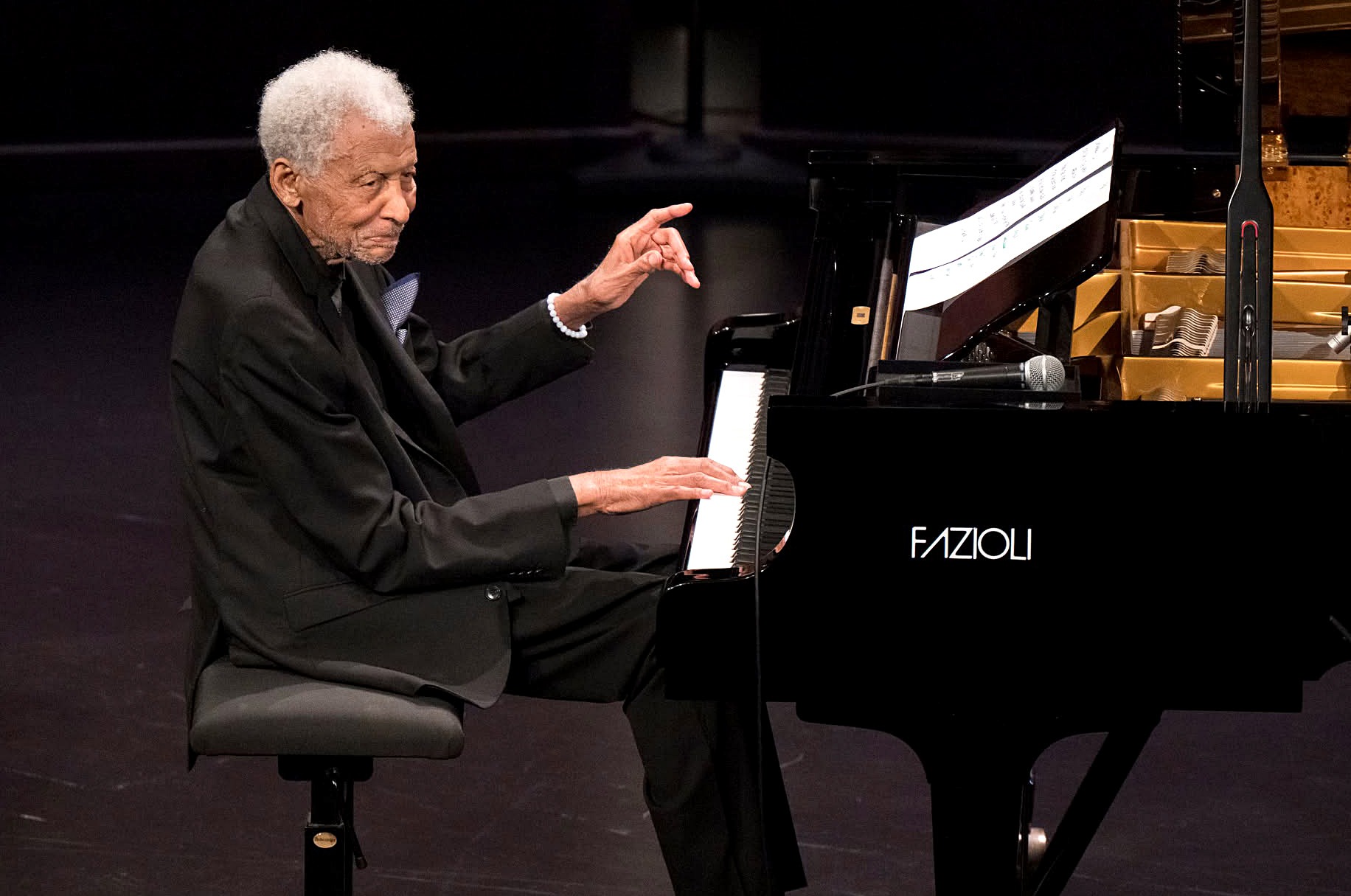
 Abdullah Ibrahim: Life of a Legend. Cape Town-born pianist, composer and NEA Jazz Master Abdullah Ibrahim performs solo, with his four-horn septet Ekaya, and with special guests Terence Blanchard (trumpet), Kenny Garrett (saxophone), and Cecil McBee (bass), at the Rose Theater on Friday, October 3, 2025. New York. Jazz at Lincoln Center. (Photo: Nathalie Schueller / Jazz at Lincoln Center / Facebook)
Adolph Johannes ‘Dollar’ Brand aka Abdullah Ibrahim 1934-2026
What do we say to this? What language exists to say it with? What words will ever be adequate? Let’s start with the basic, most commonplace: may he rest with the Sanusis, seers and angels. “Sensei” Abdullah ran a rare race, and lived to watch us trying to catch up.
I am no expert on him. In fact, I’m the least suitable testifier to riff his hosannas.
All I hold deep in my ribcage is teenage memories of how his work shaped a bunch of us, let’s call it our black consciousness sleeper cell, in Hammanskraal, “The Young & the Beautiful Poets’ Society”. That was it. Buried in the late 1980s. Until the call. That call.
Uncle Abdullah Ibrahim called me on 20 December 2013. It turned out to be the most improbable call I’d receive since I started using cellphones.
It was a hot and slightly humid late December, and I was holed up in a hotel overlooking Iziko museum and planetarium complex in Victoria Street in Cape Town’s City Bowl.
I was finalising a book that would become I’m Not Your Weekend Special, a collective, multi-threaded portrait of the ungovernable baroness of the streets and fairy godmother of the truly young at heart, Brenda Fassie.
It was actually an edgy moment for such a call. It was just before Christmas. In Johannesburg, my young family was cussing me out for abandoning them at such an intimate time of the year.
“Ha ha ha,” a salty sandpaper of a voice sounded, but, due to age, it sounded like, “Crah-crah, hay-low Bongani. Diz is Abdullah here. I’m calling from Aschau, Bavaria.”
He then started reciting lines from a tongue-in-cheek end-of-the-year piece I had written for the Mail & Guardian.
The piece was about a rather quixotic figure, Savita Mbuli, and the funeral of her children’s father, her husband: a beloved morning television mensch, Vuyo Mbuli. It had appeared the morning of the day I got cold-called.
I have no idea where he might have got my phone number. But I guessed a person of his stature would not break a sweat to find anyone’s phone number if they put their, or probably their management team’s, mind to it.
“It’s called, uhm, argrrr, uhm, My Way/My Story … would you please agree to write my biography?”
To say I was electro-zapped by shock is an understatement. I was vibrating like a battery-powered toy. Bzzzzzz. Bzzzzzz.
At this moment, I tell him, I’m in Cape Town. I’m wrapping up research and writing for the Brenda book.
He goes: “Oh, uh, a live wire, that one, no? Very talented. Such a pity it can sometimes feel like it all went to waste.
“But there you are. Holed up in our hometown. That, you know – crah-crah – tells me she will never die.”
Pop. Pop. Beats the heart.
Is this how wise, deep folks talk?
“Look, I’ve been looking at you for a while. May we talk further about it? I’m coming to Johannesburg. I’m coming to Gold Reef City, where I have a couple of shows. I will arrange access for you. Come over, and we’ll talk some more, right?”
Still shaking, I thank him and wait for him to end the call.
It’s only now that I’m able to recover my breath. Abdullaaaaah? What? Uncle Abdullah? The Sensei? Water From an Ancient Well? Tintinyana? Mannenberg?
Dead?
What do you mean he is dead?
/file/attachments/2994/Abdullah_Ibrahim_Oslo_Jazzfestival_191441_341673.jpg "Abdullah Ibrahim, who was born Adolph Johannes Brand on 9 October 1934, passed away on <br>15 June at the age of 91. (Photo: Wikipedia)")
15 June at the age of 91. (Photo: Wikipedia)
Searching for identity
Although I was already a black consciousness activist at 17, I was also ravaged by acne and still searching for my identity as a young man. Jazz and black liberation samizdat immediately filled the role one would expect a father or uncle to play.
I hung out with my fellow LP-collecting crew: Sithole Moatshe, Tumisho Manyathela. Tlokwe Sehume, who would later become an internationally touring roots-rock artist himself, was our political commissar.
We collected, listened to, debated, picked apart the music library we were accumulating. At first the music-collecting hobby was a facade. Just to throw off the scent for anyone too curious.
In practice, we were one of the fledgling community-engaging “cells” in the homeland of Bophuthatswana. Soon, though, we spent more time listening to music than implanting dialectical materialism within ourselves and rousing the masses to revolt.
Our staples included Abdullah, Hugh Masekela, Miriam Makeba, Wilson “King Force” Silgee, Morolong Kippie Moeketsi, and inevitably the vaunted “negro” contingent: Yusuf Lateef, John Coltrane, Pharaoh Sanders, even Mahalia Jackson.
One of us had this thing of playing Letta Mbulu repeatedly, until we threatened to disinvite him to the gatherings.
Rather slyly, the culprit quickly replaced Letta Mbulu with Abdullah Ibrahim: one person’s obsession gave way to collective devotion. Our listening sessions were always bookended by the real life-and-death urgency for which we were gathering in the first place: to listen to and surreptitiously share tapes of struggle leaders such as Allan Boesak, Bishop Tutu, even Steve Biko.
It was a shame, then, that later on, head filled with hubris and French existentialism, I looked down on the reverends Boesak, Tutu et al as revolutionary milquetoasts. “Men of the cloth” was the meanest jibe I could think of.
In a fit of ideological madness, I looked back and felt they were not nearly as radical as Frantz Fanon, Aimé Césaire and the Pan-Africanist pioneers George Padmore, Marcus Garvey, WEB Du Bois, or even one of our teen hood idols: Neville Alexander of the New Unity Movement.
Clearly one had got progressively more foolish as one grew up, which is a shock: why even pit struggle and intellectual pioneers against each other as though the local and international liberation struggle was some kind of Olympics?
But that’s what growing up did.
Or didn’t do.
We would be puffy-eyed after each tape ran to the end. We’d steal glances outside to check if we were still safe. Not that we were on the run or on any Wanted Dead or Alive poster, no.
And yet, the snap and crackle in the atmosphere of the time – 1986 to 1991 – made it feel as if we were hunted animals. It didn’t help that the “material”, as we referred to the resistance literature we were reading and listening to, weighed on us like contraband. Soon enough, everything quickened our pulses, made us excited and rendered us paranoid, all at once.
/file/attachments/2994/36HKc5YCGWUAAEXGb1_824056.jpg)
Visual and spiritual
Almost every time at the conclusion of our sessions, someone would put on Abdullah Ibrahim. The sound was deceptively familiar. As with his fellow members of the Jazz Epistles, Hugh Masekela and Jonas Gwangwa, as well as their predecessors, Abdullah’s “late-style” sound was eerily visual.
If Masekela’s voice modulated around the trains heaving with migrants, so that a listener would not only hear but see the locomotive, with the iron beast chugging along furiously, Abdullah’s music was less dramatic but no less photographic.
We were shocked at first, then immediately warmed by those rays of familiarity when we were introduced to the Mannenberg: It’s Where It’s Happening record.
Before that, I had never, with the exception of my beloved rock, psychedelia and punk, experienced the shock of sound and visuals so spiritually intertwined.
The music looked like the cover art. The cover art transported us to the township. And, if the face of the tannie on the cover is anything to go by, the place vibed with goema, strife and anxiety – an assemblage of Cape coloured tragic beauty.
Backed by, and often his street life expanded by, the likes of Basil Coetzee on tenor sax and Robbie Jansen on alto sax, among a revolving roster of township talent, the visuality of early Dollar Brand music encompassed its landscapes and postal codes. It was Cape Malay marabi, a different sonic beast from the 1920s-1940s original marabi sounds from old Doornfontein, George Goch and Marabastad slumyards.
If the late-style Abdullah Ibrahim waded deep into the classical piano concert hall arena, the earlier Dollar Brand sounded, as Zakes Nkosi put it, like our kind of jazz.
We could all appreciate his later directions, and indeed we had some of those records too. Just like the sound of old Steinways, or pianos in our churches, the sound was leavened with sparse bursts of classical or baroque.
And, depending on which Abdullah album you were lucky to find at Steve’s Record Bar in Marabastad, his music demanded a lot from young listeners. Sometimes it felt as if the music itself admonished the listener for lack of faith; lack of devotion too.
At its quietest, the sound vibrated with Islamic Sufi touches and with what the township ouens in floral shirts referred to as “straight-ahead” American jazz.
Although contemplative and slow, to us Dollar Brand/Abdullah Ibrahim sounded like a pot of township gold, liquified.
His music, particularly recordings such as Mannenberg, Water from an Ancient Well and Tsakwe Royal Blue, sounded like the soul of the townships, but with a thinking man’s strut.
Love vs respect
To listen to Abdullah Ibrahim’s music at that age (and, I have since realised, at any age) marked you out as different. However, to claim to love it helped to create an intellectual affectation that we had not really earned.
You loved some girl from St Camillus or the local boarding school. You loved your stash of comic books. You loved your Chuckies.
Oh dear, you loved Ranger, your dog. But you never loved your mom. You never loved your stern grandpa. Just like you never loved Abdullah Ibrahim. You respected him.
His music sounded like what we were struggling to articulate the many times we met clandestinely in the township. One of my comrades was so deeply affected by Sensei Abdullah Ibrahim’s music, and life, that it was not long before he, too, converted to Islam.
Unlike him, I’ve always been a voice or vocal-as-an-instrument devotee. In my cosmos, Miriam Makeba and Sophie Mgcina ruled.
Later on, and for an inordinate, inexplicable and irrational length of time, I spent my 20s and 30s down the rabbit hole of Lady Day, Bea Benjamin, Miriam, always Miriam, Nina Simone, Ella and Odette’s voices.
This morphed into my own version of scripture – its own liturgy, something I’m yet to expunge.
/file/attachments/2994/36IMG-20260617-WA00061_388710.jpg)
However, if the deep devotion to Abdullah Ibrahim’s music and, inevitably, faith, sent my comrade deeper in search of the teachings of the Sudanese intellectual theorist of the faith, Turabi, or the writings of Abolhassan Banisadr, the Paris-exiled “liberal” intellectual former comrade of the Ayatollah Khomeini, my naughty streak was just about to bloom. And perhaps that’s why I never became a radical revolutionary.
Being the philistine that I am, I continued referring to Abdullah as “The Dollar”, Dollar Brand, just to let some air through the valves of our smugness.
Back then, it was kind of vogueish to know by heart the names of revolutionaries. Toivo ya Toivo, Ben Bella, Abu Mazen, Josias Madzunya and other names that challenged our tongues were de rigueur.
If our idealised heroes sported long, unkempt beards and a curated state of dishevelment, the more political aura we ascribed to them.
When stars align
What my immersion in Abdullah Ibrahim did for me, though, was to introduce me, inevitably, to the music of The Blue Notes.
His faith, his ideological and creative covenant with Johnny Dyani, whom he had recruited to Islam and renamed “Fakir”, reinforced to me that when the stars align, politics or ideology can sometimes produce beautiful bonds of brotherhood.
The bond between Abdullah and Fakir (also known as “Mbizo”) was hatched in the stars. In 1978, Abdullah Ibrahim released a three-track album, The Journey, through Downtown Records. The project concluded with an epic 21.56-minute track, Hajj, featuring Fakir Dyani.
The latter’s contribution to Hajj, in particular, was shot through with nothing short of the gifts of the gods, transmitted via the upright bass.
Dyani’s licks wail, yowl and soar. Still tightly wound. Still ferocious. His playing works within the song with the intensity of a man who has been told he has only days to live.
Still, it was not on Dyani’s album. It was not his song. With The -Journey, Abdullah Ibrahim, ever the town(ship) crier, had issued a call to the ancients. Dyani responded in the only way he knew how.
This magic occurred a year after Biko had been slain, and two years after township students shattered the glass of one of the most vicious regimes in the world. Elsewhere, it was also the peak of disco madness, falsetto voices, bell bottoms and clogs.
These two, together or in parallel, simply took the “free” in free jazz, and sprinkled its juju on the surface of the moon. Which was sweet, considering that Abdullah Ibrahim was not even what was faddishly referred to as a free jazz cat.
With Dyani by his side he miaowed louder than most. Ultimately, he leapt to the moon and fell on two feet.
/file/attachments/orphans/724937612_10162710264446890_1739347990886738097_n_644456.jpg "South African jazz pianist Abdullah Ibrahim, formerly known as Dollar Brand, at the Jazz Cafe in London, 1996.
<br>(Photo: Marguerite Holtzhausen / Facebook)")
(Photo: Marguerite Holtzhausen / Facebook)
I am not here to bury Abdullah Ibrahim. I am here to conjure how his sound and vision soundtracked phases of my teenhood, and how a young man’s journey responded to the gift he gave us.
Abdullah Ibrahim passed on in his tenth decade. But he has been in conversation with God for at least seven full decades. We are all the better for it.
Or are we? Abdullah Ibrahim was not a perfect man. No one is. No one will ever be.
In Sean Jacobs’s insightful essay in The New York Review of Books, we are reminded that one of his daughters, Tsidi Ibrahim, known by her hip-hop moniker Jean Grae, loathed him.
I am old enough and young enough to be nosy, to have heard on the grapevine in Cape Town, New York and even Europe about his weird relationship with Bea Benjamin, his wife, who passed on a decade ago.
All of that demonstrates, instead of detracting from, his and our wholeness as human beings. It also mirrors our fullness and inherent inadequacies as a species.
Belated regrets
In the end, I never worked with Sensei Abdullah Ibrahim on his biography, for two reasons. First, I felt that the assignment was well above my pay grade. It would have been beyond my ability to conceptualise his significance to 20th-century South African, continental and global modernist culture.
The other reason I could not meet his challenge is because the piano master was 80 years old. I felt time was not on our side. Little did I know how wrong I was.
I’m not that rambunctious genius, Stanley Crouch, who famously worked on Charlie Parker’s biography from 1978 until its publication in 2013 – a masterpiece.
But none of the excuses put forth here devastated me more than this: none of the three publishers I approached in South Africa – a tactically wrong move, I should have known – was interested.
Two of them told me directly: “Music biographies don’t sell in this country.”
In one of my episodes of frustration, I caught myself correcting someone in the industry. You don’t get it. It is not music!
It’s Abdullaaah. DM
Bongani Madondo is an author, essayist and public arts director. He cowrote the welcoming introduction of Abdullah Ibrahim at Berlin’s Haus Kunst der Welt as part of his 90th Birthday Concert Series in Europe.
This story first appeared in our weekly DM168 newspaper, available countrywide for R35.
/file/attachments/2994/DM-260626_643039.jpg)
Comments
Scroll down to load comments...