



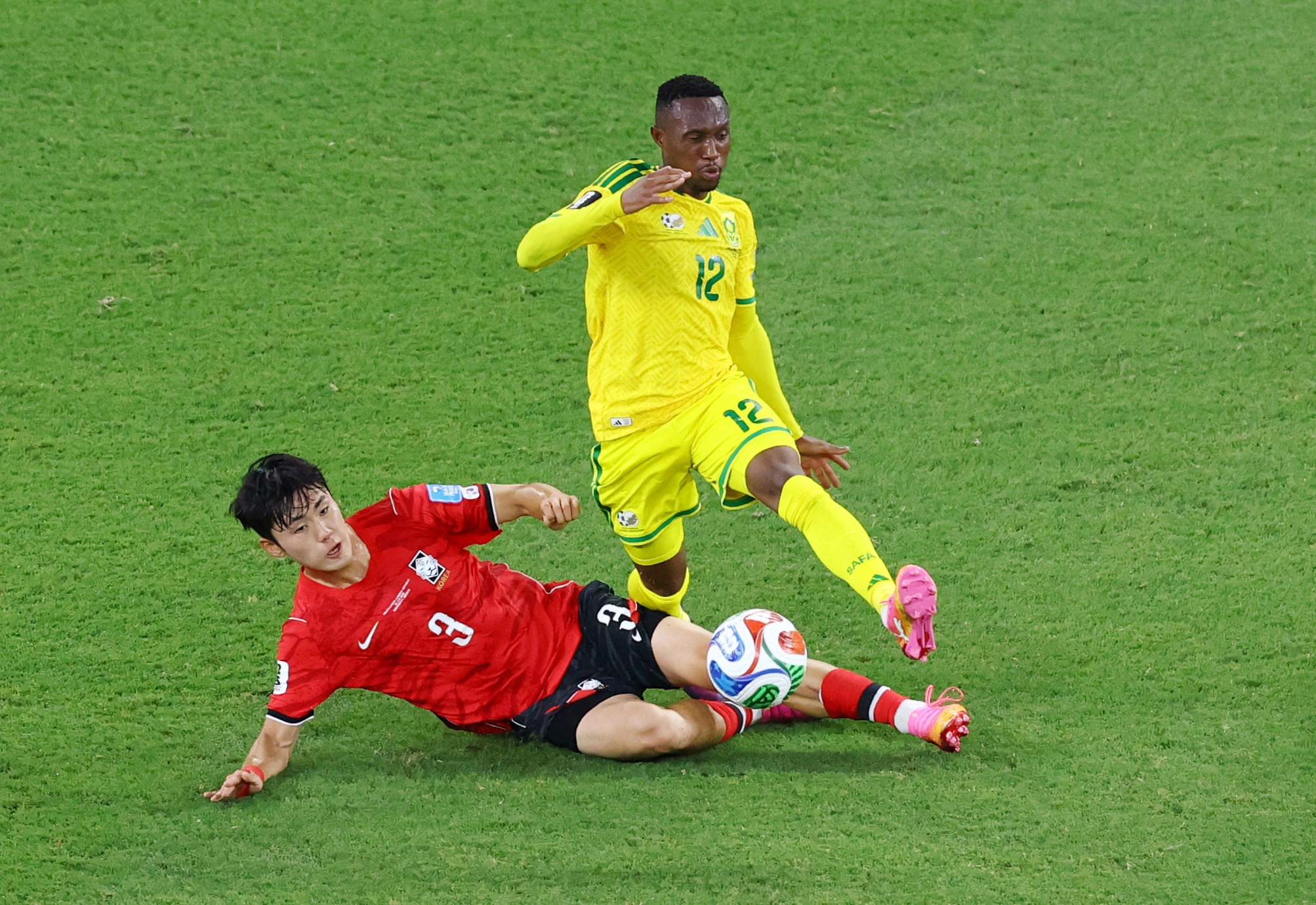
 Thapelo Maseko scored the winning goal for Bafana Bafana against South Korea at Monterrey Stadium on 24 June, booking the team’s first knockout stage qualification. (Photo: Reuters / Raquel Cunha)
 When Thapelo Maseko swept the ball into the net in Monterrey on 24 June to send Bafana Bafana into the Fifa World Cup knockout stages for the first time in their history, he marked his name in South African soccer folklore.
It has been a turbulent journey for the 22-year-old forward, who enjoyed success for his national team before an injury stalled his career. Earlier this year in February, Maseko had his first competitive start in nearly two years.
/file/attachments/orphans/UP1EM6P06WLIM_540592.jpg "South Africa's Thapelo Maseko celebrates scoring their first goal with Lyle Foster, Thalente Mbatha and Evidence Makgopa. (Photo: Reuters / Eloisa Sanchez)")
However, before Maseko was even a highly touted prospect, he was a 12-year-old student at Setlabotjha Primary School in Sebokeng and one of 146 children signed up for a pilot soccer programme built on the idea that kids learn the game best by playing it as much as possible.
Launched in 2015 by the Dreamfields Project, founded by 702 radio presenter John Perlman, the DreamLeague programme sought to give children regular game time, plenty of touches on the ball and an environment in which they could develop soccer skills and confidence.
Setlabotjha Primary School became the testing ground for the initiative, and among the first intake of youngsters was Maseko.
“We started the programme in 2015 at Setlabotjha Primary in Sebokeng and, interestingly, it was a pilot for the DreamLeague,” Dreamfields operations manager Silas Mashava told Daily Maverick.
“He [Maseko] was in the first group of boys who registered in that first year. He was in Grade 6 and would have spent two years in the programme.
“Who would have thought that a 12-year-old in Sebokeng would go out to score the winning goal at the World Cup? It’s what dreams are made of.”
/file/attachments/orphans/ThapeloMaseko_2_418632.jpg "A young Thapelo Maseko on the left. (Photo: Facebook / John Perlman)")
A sustainable programme built on inclusivity and security
The Dreamfields Project is a non-profit organisation formed in 2007 with the aim of investing in soccer and netball facilities and equipment for township and rural schools.
According to Mashava it started as a legacy project for the 2010 World Cup, because Perlman wanted to create something meaningful and tangible, beyond asking the tough questions.
“In the first phase of the project, we focused on rolling out basic interventions such as events, handing over equipment and building fields, which lasted probably until 2012,” said Mashava.
By engaging with the kids at these events, Mashava and other project staff noticed that the kids would be on the field and playing, but would not have an understanding of the game. Either it was because they were not engaging with the ball long enough, or the coaches, who are often teachers volunteering up their time, were not properly equipped with the knowledge and skills to meaningfully coach a team.
“Even with the best intentions, schools would only play once or twice in a year, and that’s it,” said Mashava. “We saw that as one of the weaknesses in school football, because many kids were not being exposed to playing the game frequently enough to be able to improve.
“We saw that as an opportunity to really create an environment where kids can enjoy the game and can play, but most importantly, can learn from the game.
“Because the more you play, the more you get to improve. You get to have more touches on the ball and your confidence grows.”
/file/attachments/orphans/ThapeloMaseko_438163.jpg "The DreamLeague programme under the umbrella of the Dreamfields Project was launched in 2015 with a pilot programme at Setlabotjha Primary School in Sebokeng. Thapelo Maseko was one of the 146 kids signed up to the programme. A decade later, he scored the winning goal against South Korea, progressing South Africa to the knockout stage in a World Cup for the first time. (Photo: Facebook / John Perlman)")
That is where the idea for the DreamLeague came about, shifting to five-a-side soccer with a structured, running league system rather than knockout competitions. Schools formed leagues of roughly 10 teams, depending on the size of the class or grade, with intra-school fixtures played every Wednesday.
“One of the main pillars is around ensuring that as many children as possible get an opportunity to take part in a structured football and netball programme,” said Mashava.
“Everyone speaks about the benefits of sports, but the architecture of it always focuses on those who can make the team. We’ve been trying to build a base around affording each and every young boy and girl the opportunity to experience those intrinsic benefits that comes with playing team sports and expose them as much as possible to that environment during their school life.”
More than the sum of its parts
A DreamLeague rollout began with equipment, in the form of a bag called the DreamSeed Kit which contained bibs, cones, soccer balls, a whistle and a set of foldable portable posts, said Mashava.
So far, Dreamfields has equipped 3,950 schools with DreamBags, and has invested more than R160-million in disadvantaged schools and communities and currently has 80,000 children playing soccer and netball in DreamLeagues.
It runs projects in nine provinces, involving 415 schools and 63 community soccer and netball clubs, with its work in Sedibeng, which includes Setlabotjha Primary, being funded for more than 10 years by the Italtile and Ceramic Foundation.
/file/attachments/orphans/IMG_0931_896980.jpg "The DreamSeed Kit includes all the necessary equipment to start a team in the DreamLeague. (Photo: Facebook / Dreamfields Project)")
As the project has grown, Dreamfields has expanded its programme to include community coaches, which affords unemployed youth the opportunity to come in and assist with the running of the league.
It has also introduced Excellence Clinics, where schools send their top five players at the end of the term or season to receive additional training from coaches affiliated with soccer academies, aimed at skills development and potential talent identification.
“For us, we know that not every young child is going to go out to be a professional sports person,” said Mashava. “But the value and the life skills that they learn will help them to become better citizens who take care of their communities.
“And when you get successes like this [Maseko], the young boys and girls in Sebokeng now have a stronger sense of belief that they can also make it. In the system there’s a whole lot of other partners who come in, the coaches in the local clubs, the community coaches, the teachers in the school. So it’s an ecosystem.
“We are fortunate and honoured to be able to be part of that ecosystem that made it possible for the young boys and girls to dream even bigger, like Thapelo Maseko.” DM