




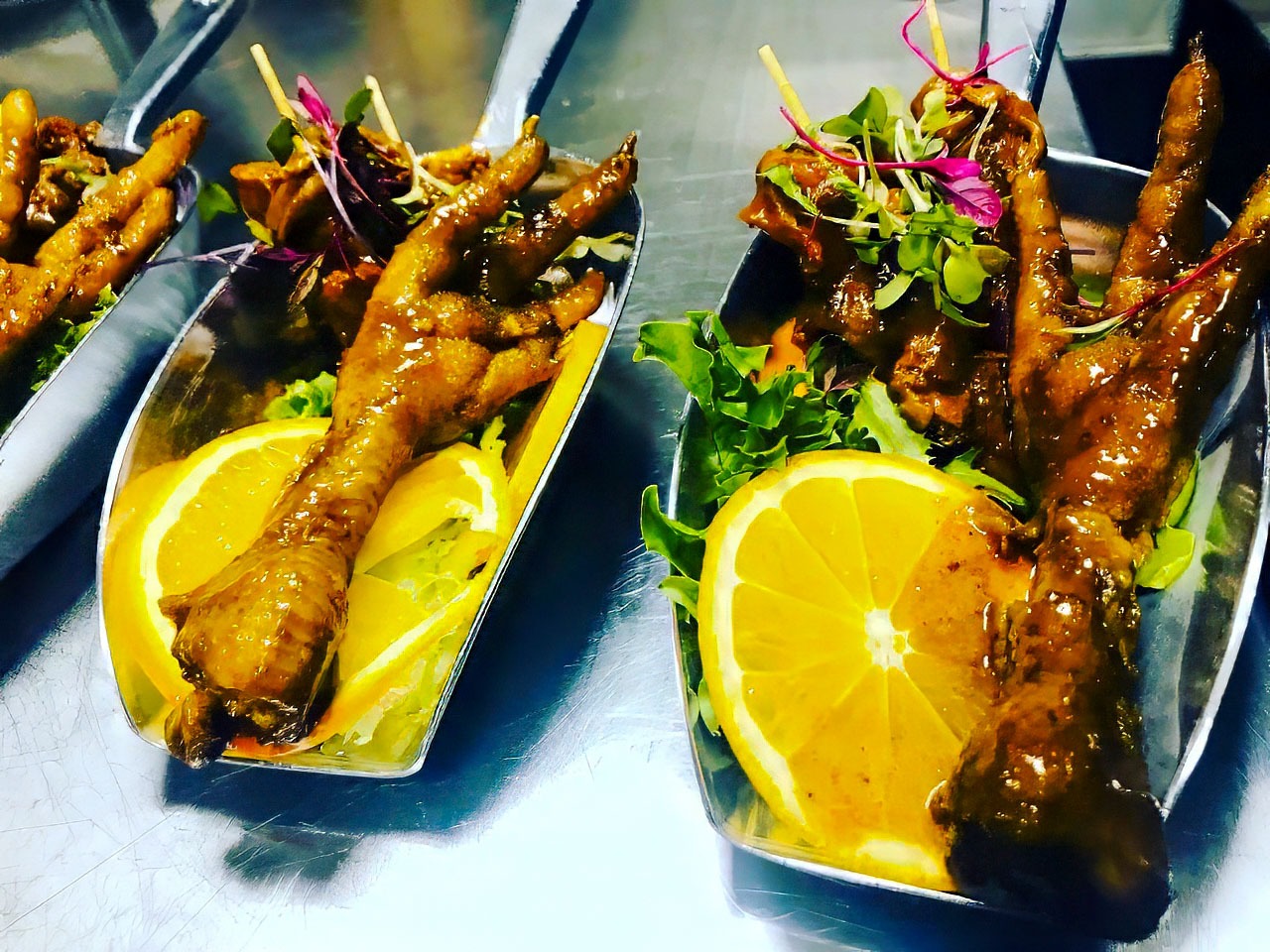
 Chef Absa’s orange and chutney chicken feet. (Photo: Absa Kotsokoane)
Long before collagen was repackaged as a luxury wellness supplement, this humble structural protein was already doing extraordinary work in the most ordinary way: bringing strength and shape to skin, joints, bones, cartilage, tendons, ligaments and blood vessels. An anatomical scaffold, made within us all, without which we would literally fall apart.
As we age, our bodies produce less collagen, while the collagen already in place is gradually damaged by factors such as poor diet, sunlight, stress and smoking. This depletion makes itself felt in a variety of dispiriting ways, including – but not limited to – thin, dry, wrinkled skin; creaking, stiff joints, fragile bones and painfully slow tissue repair when injury occurs.
Which is why being able to buy extra collagen is such an enticing idea – so enticing that Fortune Business Insights put the global collagen supplements market at US$2.6-billion in 2025. Much of the marketing rests on a beguilingly simple suggestion: If collagen is what keeps skin springy, joints cushioned and connective tissue strong, then surely swallowing more of it should help repair what time has undone?
Ja, well, no, fine. Sadly, the reality is much more nuanced. PR puff frequently implies that there is a direct route from scoop to eternal youth, radiance and vigour, but Ivaskiene et al recently published a paper in the journal Frontiers in Nutrition temptingly entitled “Collagen supplementation and regenerative health: advances in biomarker detection and smart material integration”, which suggests that hydrolysed collagen peptides may modestly improve skin hydration and elasticity, and perhaps help with some forms of joint discomfort, especially when taken consistently over time; but that the effects are not guaranteed, not dramatic, and not targetable.
Basically, the scientists say that consuming collagen is not like dealing with Checkers Sixty60. The body has its own priorities and cannot be ordered to march molecules towards specific sites. No matter how much you want to smooth out wrinkles there is no way to influence whether the collagen is used for skin, joints, tendons, wound repair, general protein needs or energy. That limitation does not make supplements pointless – it just means that some of the miracle mongering marketing exaggerates impact.
Then there is the elephant in the room – or rather the chicken, pig, cow or fish on the farm. When nutritional supplements come gussied up in pretty packaging, origins are often obfuscated. While there are recombinant and vegan synthetic collagen products, most of the supplements do not descend from the heavens in a vanilla-flavoured haze.
Why not cut out the industrial processing plant?
They are almost always derived from bones, skin, cartilage or connective tissue that has been treated, heated, filtered, concentrated, hydrolysed into smaller peptides, dried and finally milled fine. So why not cut out the industrial processing plant and just ingest collagen as part of our daily diets? Especially in the context of the climate crisis, where we cannot ignore the water- and energy-intense negative environmental impact of industrial extraction.
Anyone who has ever sipped on a bone broth, bitten into brawn or munched on maotwana (chicken feet) and amanqina enkomo (cow hooves) has consumed collagen. Regardless of how it is ingested, collagen is digested by the body into amino acids and peptides.
USDA FoodData Central gives chicken feet, boiled, as 19.4g protein per 100g edible portion. Santana et al. (2020) report that approximately 70.9% of chicken-foot protein is collagen. The sums are complicated but basically boil down to 100g of cooked chicken feet contain roughly 13.8g collagen-equivalent protein, which means that a 35-50g cooked chicken foot could plausibly provide about 5-7g collagen protein. This is similar to a small tablespoon/scoop of collagen powder.
Clearly this is an estimate rather than a neat conversion because, while powder can be standardised, foot measurements vary. The foot is dinner, not dosage. There are some indications that the process may be more efficient with hydrolysed powder – because it has been pre-digested into smaller peptide fragments – but the difference is minimal and greater efficiency is not the same thing as targeted delivery.
In a South African setting, chicken feet and cow’s hooves are among the most readily accessible and affordable sources of collagen, but since amanqina enkomo are often culturally reserved for men, chicken feet are my preferred pathway. Not only because they taste great but also because roughly 70% of the protein in a chicken foot is collagen, and they also deliver the holy trinity of bone-boosting minerals; calcium, magnesium and phosphorus.
As always, I have a few clawed caveats. Clearly the health consequences of sipping on an umhluzi broth that comes from slow-simmered chicken feet are very different to those that result from binging a bowl of battered, deep-fried fowl feet drenched in sugary, super-salty sauce. There are also practical safety issues. Chicken feet contain many small bones, which can present a choking hazard for overenthusiastic eaters.
For those who can be trusted to chew and swallow in a mindful manner, I think that the pleasures of savouring the real deal beat a sterile scoop every time. There is nothing nicer than nibbling, sheering and sucking through umami-laden skin and tendons until surface gives way to gelatinous, wiggly, shimmery, melty magnificence.
Johannesburg diners wishing to swap out a posh powder for a fabulous foot should head to Chef Petunia Thebe’s teeny tiny bistro Cosmo Dumpling in Northriding. Mop up meat juice from lightly curried hardbody chicken feet with airy amadombolo steamed breads. Chef Absalom Kotsokoane of Happy Spoon catering serves them embraced by an orange marinade and paired with pap croquettes (@chefabsa).
‘Phoenix claw’
Those seeking sizzling smoky spice will adore the exotically named “phoenix claw” skewers sold streetside by BBQ vendors in the Cyrildene Chinatown. There is also the chicken foot consommé served inside an eggshell as an amuse bouche at Chef Wandile Mabaso’s Les Créatifs in Bryanston (lescreatifs.co.za).
To date, even the aforementioned super-stylish efforts have not been able to overcome the “poverty food” stigma that so often clings to poultry paws. Award-winning ceramicist Rebaone Finger first examined this prejudice in her August 2025 Cheese Girl: Conspicuous Grandeur exhibition at Circa/Everard Read Cape Town. The interest in the meaning of chicken feet has continued at the same gallery’s winter 2026 show Only Prayers, Prayers. No Sorrows.
She says: “What drew me to them was my interest in the use of food naming cultures to critique social disparities in the black South African community. From cheese girl as an indicator of black middle class-ness, to fish bones as an indicator of being underweight according to societal standards. When I was doing my research on township food, I stumbled on chicken feet as a food that was at the bottom of the food hierarchy, yet a food that was able to fill the dietary gap. And one that I personally find so elegant.
“I wondered what would become of it when I translated it into ceramics, a considerably expensive material... would its social position change?”
Her vessels and forms are covered with repeated clay-cast chicken feet which transform maotwana from humble offal into charged art that speaks to class, race, hierarchy and consumerism in 21st-century South Africa. Depictions of luxury, lack, aspiration and social mobility merge as part of a wider meditation on opulence, empowerment, hunger, conspicuous consumption and the disparities within South African society.
/file/attachments/2994/rebaone_313141.jpg "Chicken feet as muse for artist Rebaone Finger. (Photo: Mike Hall)")
In some pieces, the bird feet wear long acrylic nails, bringing together street food and the gendered glamour economy. In one work, a chicken foot rises out of caviar: an egg, but not the egg; appetite, fertility and flesh unsettled – extraordinary in the ordinary. A humble food positioned at the bottom of the food hierarchy, elevated into a new opulent social register. Which came first, chicken or egg, sustenance or social status? Or are they both at the heart of the human condition?
/file/attachments/2994/anna-pair_165798.jpg "Left, Fundamental Beluga Caviar. Right, Prayers Prayers No Sorrows, by Rebaone Finger. (Photos: Mike Hall)")
There is, as yet, no collagen powder in Rebaone Finger’s work, but it might as well be there. The same logic applies: an essential, readily available and affordable ingredient is repackaged as luxury, raising issues of sustainability and substance. Exposing the strange hierarchies through which food, class and the body are imagined. Neither the high-status supplement nor the grounded everyday eating chicken foot can be fully controlled by those who consume them.
The body makes its own decisions, as it always has. DM
Comments
Scroll down to load comments...