




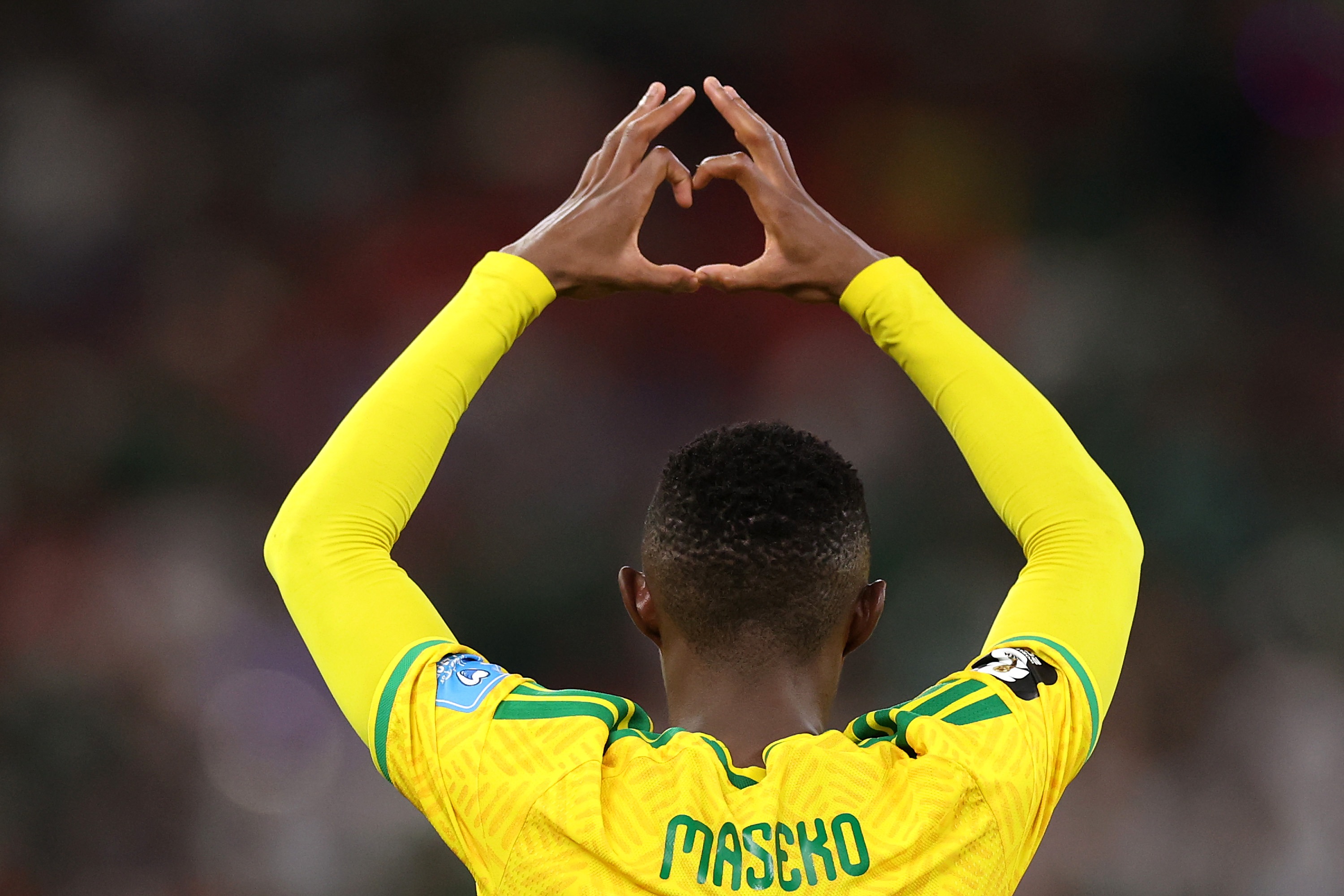
 Bafana’s Thapelo Maseko made history in their match against South Korea on 24 June 2026. (Photo: Carl Recine / Getty Images)
With his soccer career at a crossroads, Thapelo Maseko, not a familiar name to many South Africans, moved to a foreign country to rediscover himself and his love for the beautiful game.
His journey to Cyprus, where he was warmly welcomed by his adopted country and his new club, Limassol, gave him a sporting lifeline.
After two years without a start at his South African club, Mamelodi Sundowns, it was on foreign shores, backed by people who had no business caring for him other than that he was now considered one of theirs, where Maseko found his groove.
He had considered quitting soccer. Now he is a national hero and one of six foreign-based players in the Bafana Bafana squad.
Perhaps there is a lesson in this for South Africans who are thinking xenophobic thoughts. Kindness and respect are far more powerful in the long run.
The love and support Maseko found at Limassol culminated in a crucial moment against South Korea in the muggy heat of Monterrey, in northeastern Mexico, on Wednesday night, 24 June (Thursday morning South African time).
As a rejuvenated player, thanks to his stint in Cyprus, Bafana coach Hugo Broos made the bold decision to include Maseko in the 2026 Fifa World Cup squad based on his performances for Limassol.
Broos’s faith paid off in spades. Maseko had been a nuisance to the South Korean defence all night and he probably should have scored earlier.
In the 63rd minute, however, he pounced. The ball was swept in from the left across the Korean penalty area by substitute wing Tshepang Moremi, nicknamed “Rea Vaya”, colloquial Sesotho for “we are going”. And going into the next round they are.
Maseko, dangerously positioned on the right edge of the area, moved to his left to meet the pass, and after one touch to control the ball, he struck a shot with pace and accuracy into South Korea’s net.
It broke the deadlock and gave Bafana a crucial lead. It gave them confidence and, most importantly, belief, while it had the opposite effect on the Koreans.
“It’s an incredible feeling. I feel like I’m dreaming,” Maseko said after the match.
“A couple of months ago I went through a rough patch, and now I’m here. I’m a Fifa World Cup Player of the Match, which is surreal. I’m just thankful and grateful to the ones who believed in me.”
The final 33 minutes of the game seemed like hours for South Africans, but only seconds for South Koreans.
/file/attachments/2994/2283204428_583621.jpg "Thapelo Maseko scores Bafana's crucial goal against South Korea at Monterrey Stadium on 24 June. (Photo by Carl Recine / Getty Images)")
Eventually, and fittingly, it was captain and goalkeeper Ronwen Williams who had the final touch before the referee blew his whistle to end the game and send South Africa through.
Maseko deservedly took the plaudits for his unerring finish, but it was a goal scored from a good counterattack and teamwork. It was a microcosm of Broos’ Bafana – no superstars, only hard-working players who put the team first.
The reward is a round-of-32 clash against cohosts Canada in Los Angeles on Sunday, 28 June. There is a real chance Bafana could go even further in the tournament.
Canada will not have home ground advantage and Bafana have a chance to write their own Hollywood script in California.
“Today you saw a team that believed in itself... On Sunday again you will see a team that will believe in itself and that will fight for the 90 minutes, and more if we have to,” Broos said after the victory against South Korea. “And then we will see. But let’s hope we come out with a good result.”
Hitting back at the critics
For Bafana, this campaign has been a slow burner. They have gradually improved with each outing to the point where they dominated the more fancied South Korea in terms of shots at goal and on target.
Bafana had 13 shots at goal to South Korea’s eight, despite South Africa only having 32% possession. Four were on target.
It underlined Bafana’s urgency and directness in possession and was a vast improvement from two weeks ago in their opening match against co-hosts Mexico.
After their opening game 2-0 loss at the intimidating Azteca Stadium, situated 2,200m above sea level in Mexico City, Bafana were being written off. Although they deserved some valid criticism for defensive lapses that led to both Mexico goals and little ambition on attack, some of the commentary was over the top.
/file/attachments/orphans/22822203971_351918.jpg "Hugo Broos, Head Coach of South Africa, during the Fifa World Cup 2026 Group A match between Czechia and South Africa at Atlanta Stadium on 18 June 2026 in Atlanta, Georgia. (Photo: Lars Baron / Getty Images)")
There were personal attacks on players and Broos, while so-called fans quickly forgot the quality Bafana displayed in qualifying for the World Cup.
Broos was naturally testy when asked about the backlash after that Mexico defeat.
“After nearly 40 years as a coach, I know there is a side to your job where you are criticised. For the moment I am criticised, but for those who still don’t know it, I do it my way,” a defiant Broos said before the 1-1 draw with Czechia in game two.
“I never listen to the trash of social media. I never listen to people who sometimes think they are important and must criticise the team,” he added.
“I know what went wrong. I know we had a debriefing two days after the Mexico game. The players know it and that’s the important thing. For the rest, I will do it my way.”
Broos, who became Bafana coach in 2021, couldn’t resist a swipe at the critics after the team’s success against Korea.
“I’m very proud of the performance of my team and I think we gave an answer to all those big mouths of the last weeks that thought that we had to change something,” he said.
“We just did what we did. We just did what I wanted to do, and this is the result.
“I said it already in the past that probably it will be one of the last games of my career. When you can end a career like I had in this way, I think everybody or every coach dreams of it.”
Of course, it is not the end of the road for him or Bafana just yet.
Praise from those in the know
Bafana’s progression has also been hailed by former players. “What a wonderful moment last night,” former Bafana skipper Neil Tovey told Daily Maverick.
/file/dailymaverick/wp-content/uploads/2024/02/1578892.jpg "Flashback to 3 February 1996 and winning Afcon final captain Neil Tovey of South Africa holds the cup aloft after then president Nelson Mandela presented it. South Africa beat Tunisia 2-0. (Photo: Mark Thompson / ALLSPORT)")
“It earned them a nice draw against Canada for the next round, which they’re quite capable of taking care of. They got Canada in America, which will make a big difference.
“Bafana were very good; they were much better. They played like they can play, but when they get those chances in the World Cup, they’ve got to do better in front of goals and can’t miss the chances that they missed and the situations that they had.
“They’ve got to do better because the better teams will take advantage of that. But they did wonderfully well last night.
“We’ve all spoken about how wonderfully he [Broos] has done just getting South Africa to the World Cup, and now he’s taking it a step further.
“Let’s hope they can play with the freedom that they did last night and not get inhibited like they did in the opening game.
“They’ve done exceptionally well, so they’ve got nothing to lose now. They must go out and enjoy and play like they can.”
/file/attachments/2994/04BlackClosedSignLandscapePoster4261x202mm1_337481.jpg "Bafana Bafana's record at all World Cups. (Graphic: DM)")
Former Bafana and Sundowns midfielder Hlompho Kekana was also effusive in his praise. “These boys deserve the credit for what they’ve done to sell the product of South African football to the world because nobody gave us a chance,” Kekana said.
“There’s two different criticisms that I experienced in my football career. The first one is positive criticism, which I think is a plus, on how I should fix my performance or how I should apply myself better. Maybe the person understands or knows me better to know that I can do more.
“Then there’s the crazy criticism where people just say things out of proportion without thinking of the impact it might have on players’ performances or players’ lives.
“The players are human, after all, and they want to do better for themselves before they please the people that write things about them. There’s no player that I have met in my life who wants to go into the field of play and waste time and wants to lose a football match.”
/file/dailymaverick/wp-content/uploads/2022/09/Soccer-Kekana-feature5.jpg "Hlompho Kekana of Mamelodi Sundowns during the Absa Premiership match between Baroka FC and Mamelodi Sundowns at Peter Mokaba Stadium on 6 November 2019 in Polokwane, South Africa. (Photo: Philip Maeta / Gallo Images)")
Pointed timing
The timing of this success is almost unbearably pointed.
Bafana’s group phase success landed in the midst of weeks of xenophobic attacks targeting African and Asian foreign nationals.
There have been at least two confirmed deaths and thousands of migrants from Malawi, Mozambique, Nigeria, Ghana and Zimbabwe are fleeing or are being repatriated as anti-migrant groups enforce a self-declared 30 June deadline for their departure.
It’s an ugly, frightening backdrop, which has led to many negative social media comments from other Africans about Bafana’s progression. Outside soccer, the world does not love what it sees in South Africa.
Bafana have a chance to change that perception, and perhaps their continued presence at the World Cup will have a positive impact here at home. Soccer is truly global, and the world is no longer a parochial place. People move freely and offer the transfer of their skills and culture wherever they reside.
According to a report in Britain’s The Times, of the 1,248 players at this World Cup, 292 were born outside the country they represent, and 99 players at the tournament were born in France.
The next highest supplier of players is the Netherlands with 65, whereas 50 players born in Germany and 48 born in England are at the World Cup. Hopefully there is a small kernel of understanding in those numbers in a South African context.
Sport cannot fix society’s problems, but it can distract from them and offer hope and positivity. DM
Additional reporting by Annemieke Thomaidis and Yanga Sibembe.
This story first appeared in our weekly DM168 newspaper, available countrywide for R35.
/file/attachments/2994/DM-260626_643039.jpg)
Comments
Scroll down to load comments...