




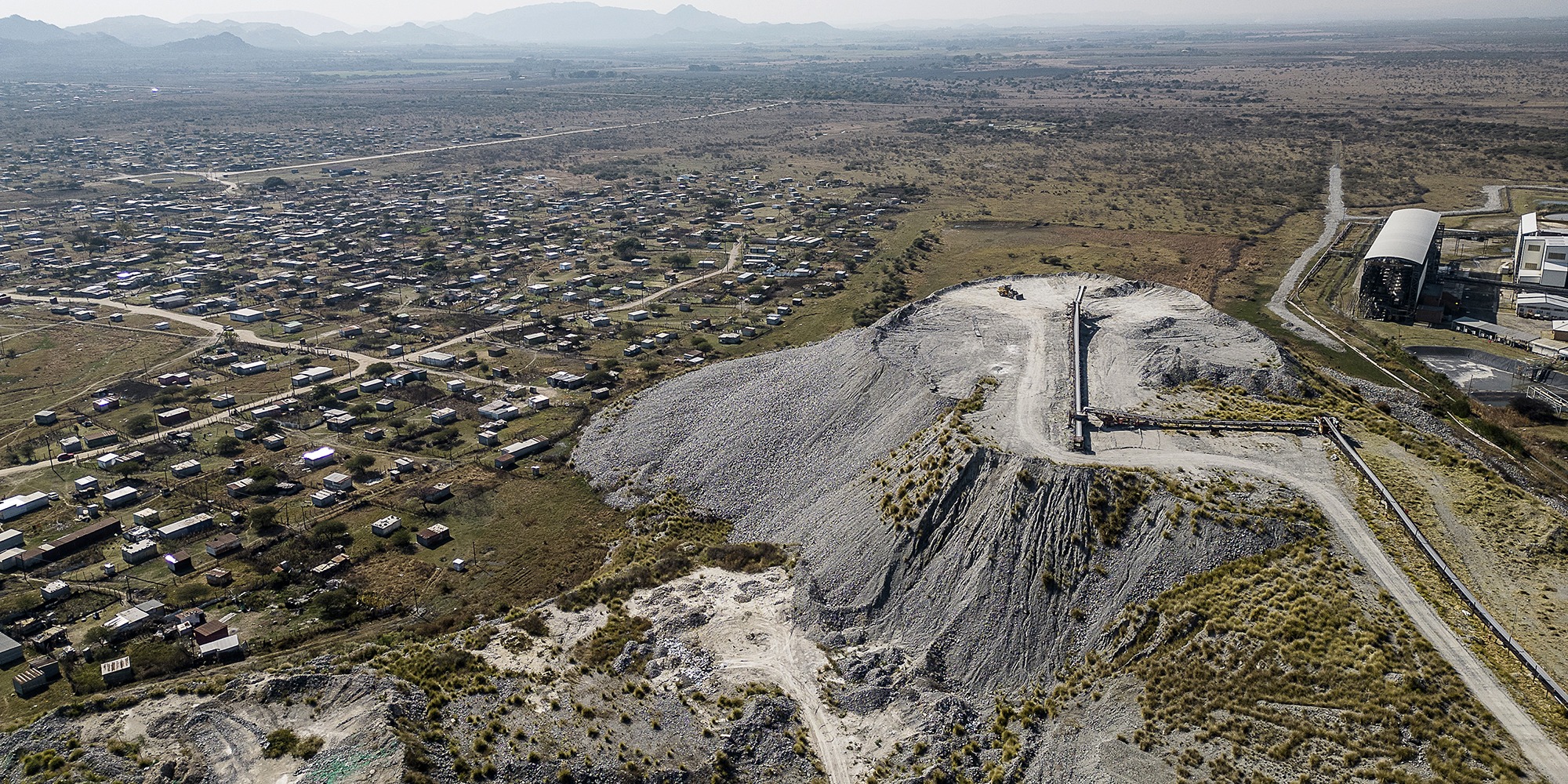
 The Saffy Shaft mine, operated by Sibanye-Stillwater in Bojanala Platinum District Municipality, South Africa, on 6 June 2023. (Photo: Guillem Sartorio / Bloomberg via Getty Images)
In July 2012, I visited the Saffy section of the Marikana mine that was owned at the time by Lonmin. I returned to the shaft – now part of Sibanye-Stillwater – on another junket this week, and the tale of these two visits was both telling and poignant.
My first visit was accidental. We were supposed to visit another shaft that day, but the Association of Mineworkers and Construction Union (Amcu) had spoiled the proceedings by staging a wildcat strike, forcing a hasty change of plans.
Amcu at the time was dislodging the National Union of Mineworkers (NUM) from the shafts in a vicious turf war that would lead to the Marikana Massacre the following month when the police shot dead 34 miners taking part in a violent wildcat strike.
One thing I vividly recall from my first Saffy visit – amid a liquid fog – was sitting at the bar at Lonmin’s conference centre and game farm the night before with a senior executive who told me over red wine that the company had “stuffed the Amcu genie back into the bottle”.
Subsequent history would throw the folly of that assessment into sharp relief.
In the ensuing years, South Africa’s platinum group metals (PGM) industry would be rocked by frequent outbursts of labour and social unrest while prices for the precious metals would tank. In 2014, Amcu lead a five-month strike that brought the industry to its knees.
Lonmin barely weathered that storm and it never recovered in the aftermath of the massacre, which had rendered the Marikana operations toxic in the view of most investors. By 2019, as it burnt cash and the markets would no longer support endless rights issues, the die was cast and the company was acquired by Sibanye.
A very different backdrop
My latest visit came against a very different labour, economic and social backdrop.
The Marikana operations have not experienced a serious flare-up of labour unrest since Sibanye acquired it from Lonmin – a company that was not only noxious in the eyes of investors, but also workers and the surrounding communities.
Lonmin had infamously only built three of a promised 5,500 houses for its migrant employees, and its relationships with communities and unions was marked by suspicion as it ran out of the money needed for such initiatives.
When I was at the game farm/conference centre in 2012, it was only Lonmin executives who were present the night before for the dinner and drinks.
This time round, Sibanye invited three local black entrepreneurs whom it has supported.
/file/attachments/orphans/Sibanye_124426.jpg "Sibanye’s Beatrix gold mining and processing operations near Welkom in the Free State. (Photo: Sibanyestillwater.com)")
“Lonmin was not listening to us and so we were causing trouble. If that door was still locked we would still be causing trouble,” said Raserola Mashamaite, who now operates a bakery and told me that he employed 30 people.
Rolls from his bakery were served that night and they were pretty good.
It is easy to be glib about this stuff and see it as an example of corporate white-washing. And the area remains scarred by searing rates of unemployment and poverty.
But Marikana has also become a microcosm of broader trends in SA’s mining industry that have doused the flames of labour and social unrest.
Battle cry
The battle cry at Marikana in August 2012 was a monthly wage of R12,500 – a pittance for hard and dangerous work that was a legacy of the sector’s historical exploitation of migrant labour.
In 2019 when Sibanye acquired Lonmin, the basic pay of entry-level miners at Marikana was R12,713 a month. From 1 July this year it will be R20,813 – an increase of 64% over the past seven years that is well above the cumulative inflation rate of about 46% over that timeframe.
Total income for that category of workers over the same period – which includes pension and medical aid contributions and housing allowances – rose to R31,092 from R18,861, an increase of about 65%.
This is a reflection of wider trends across the industry, which has seen annual wage hikes significantly outpacing inflation – testimony among other things to the success of unions in securing decent pay for their members.
The mining industry has also learned that a fairly paid workforce is more productive and less apt to go on strike.
This in turn explains why so many multi-year wage agreements across the industry in recent years have been signed without workers downing tools, with Amcu and NUM often uniting in such negotiations.
/file/attachments/orphans/image001copy_687985.jpg "Cumulative pay increases for entry-level miners at Marikana since 2019. (Source: Sibanye-Stillwater)")
Shaft down memory lane
There were other differences I detected at Saffy from my 2012 visit.
After our 500m descent, the trip in a tram to the stoping or production area where the rock-drill operators ply their craft took more than 30 minutes – much longer than I recalled. The reason for this was simple: the mine, which would have probably closed years ago had it remained a Lonmin asset, had expanded significantly since then.
When we got to the stope, I noticed additional lighting and protective overhead netting right up to the face where the blasting takes place. These are safety measures that have been extensively rolled out over the past couple of decades that have contributed in no small way to the steep fall in accidental deaths and injuries in SA’s mines.
And like my visit 14 years ago, I and some of the other visitors got to grip the rock drill for a few seconds and do a bit of drilling. Powered by compressed air, the drill seemed lighter and less jarring than I recalled from my previous experience when I must admit I had a bit of a babalas. (That is another difference – the bar time the night before mine visits is much more moderate than it was in the past.)
The rock drills now feature an innovation called an “air leg” which supports its weight, making the task semi-automated and far less arduous than it was in the past.
The stoping area itself is not an easy place to work in. You need to almost crawl into it – the height is only about 1.2 metres – and the gradient is steep, which mirrors the ore body. This arduous geology was one of the factors that thwarted Lonmin’s costly and futile attempts to mechanise the operation.
Lonmin in the wake of the massacre also often gave the impression that it was trying to bury it in the past. Sibanye, by contrast, has always acknowledged it and commemorated it as part of a process of healing and redress.
“One of the reasons no one wanted to touch these assets was the Marikana legacy,” Sibanye CEO Richard Stewart told me during the visit.
“It’s one of the things we openly took on – let’s acknowledge what happened and let’s deal with it. We can’t sweep these things under the table. And I think there’s a lot of that that is needed in South African mining generally. Mining has a fantastic legacy in this country, but it also has a dark history. And quite honestly we should be able to acknowledge both and fix what we can and build a better future.” DM
Comments
Scroll down to load comments...