




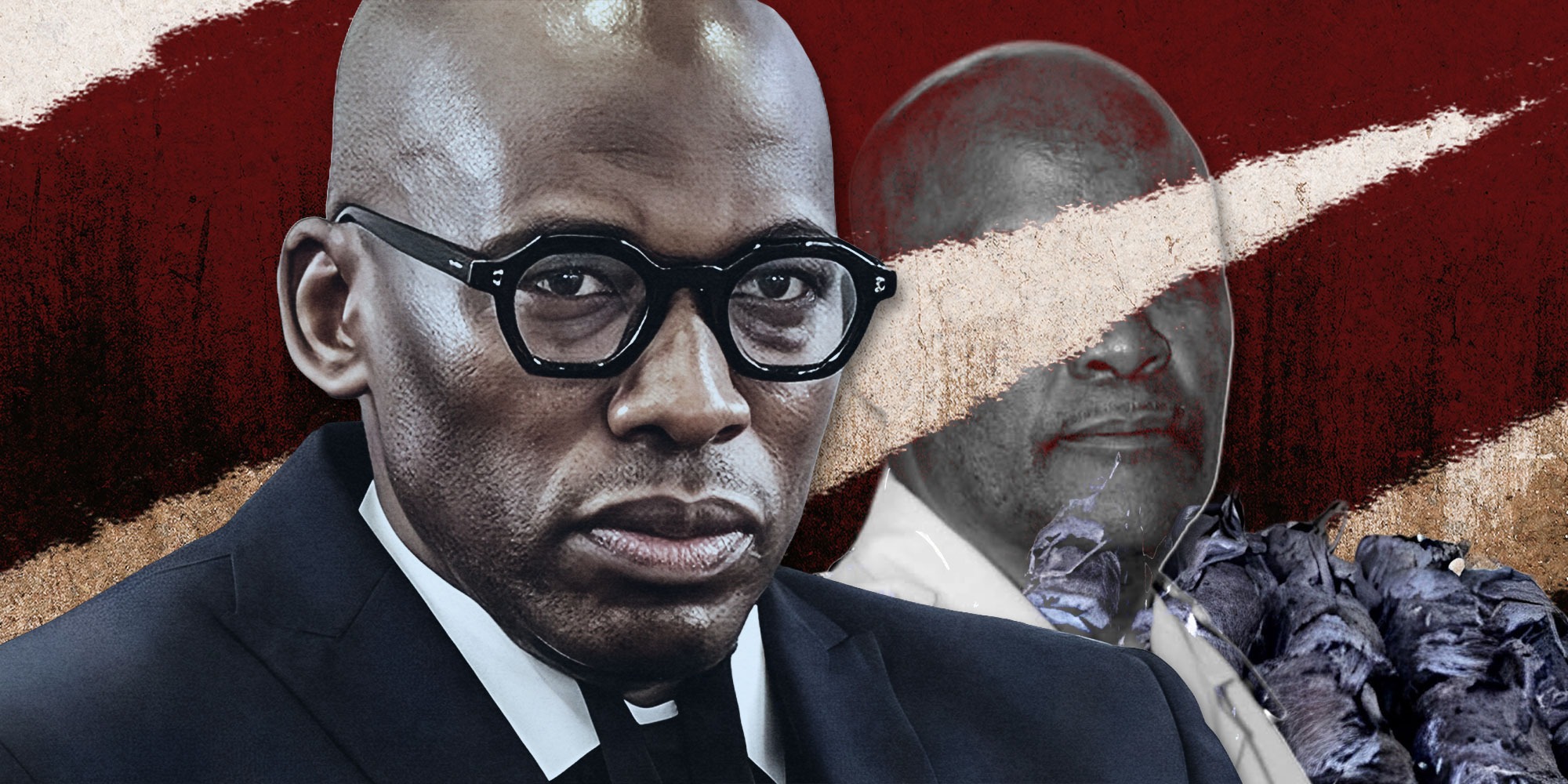
 Illustrative Image: Businessman Tumelo Nku. (Photo: Facebook) | The late Lieutenant General Sindile Mfazi, former deputy national commissioner of crime detection. (Photo: SAPS) | In July 2021, a cocaine consignment worth R286m was intercepted in Aeroton, Johannesburg, leading to suspicions that police officers may have colluded to move the drug. (Photo: Madlanga Commission of Inquiry) | (By Daniella Lee Ming Yesca)
Sindile Mfazi, the deputy national commissioner for crime detection, died in 2021 under mysterious circumstances. On Thursday, 25 June 2026, his name appeared at the Madlanga Commission of Inquiry, linked to a controversial quarter-of-a-billion-rands drug bust.
Businessman Tumelo Nku told the commission that he had informed Mfazi about the huge cocaine consignment that landed up in South Africa.
Mfazi died on 8 July 2021, the day before the cocaine, worth about R286-million, was intercepted in Aeroton, Johannesburg.
Mfazi and Maphatsoe
Around the time of his death, the government issued a statement saying the death had been a result of Covid-19.
Daily Maverick has reported that accusations subsequently surfaced that Mfazi was covertly assassinated – poisoned – after uncovering corruption involving fellow police officers. (This was not raised at the Madlanga Commission.)
During Thursday’s proceedings, Nku said he knew Mfazi through “former deputy minister of Defence Commissaire Kebby Maphatsoe, as he expressed that Lieutenant General Mfazi was once his compatriot in exile”.
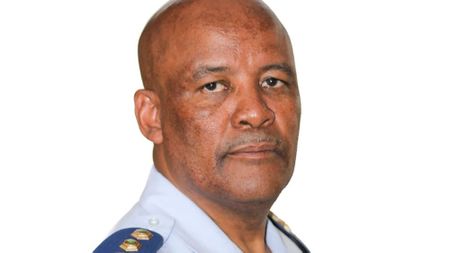
He described Maphatsoe, who died the month after Mfazi in 2021, as a distant relative.
Nku told the commission on Thursday that he became caught up in an intricate plot that ultimately led to his facing criminal charges, linked to cocaine, that should not have been levelled against him in the first place.
However, during the commission proceedings, Nku was grilled intensely over aspects of his testimony.
Evidence leader advocate Teboho Mosikili even accused Nku of “tailoring evidence as you go.”
Nku began his testimony slowly and methodically, but as the hours went by and he faced question after question, he appeared to become hesitant and even stumbled over his words.
Backdrop to testimony
Nku was among four people arrested in 2021 in connection with the R286-million cocaine interception.
That cocaine had been shipped from Brazil to Durban, while concealed in Scania truck parts.
From Durban, it was transported to Aeroton, a Johannesburg industrial area, where it was controversially intercepted on 9 July 2021.
The two main theories
Based on what the Madlanga Commission of Inquiry has so far heard, there are two main theories about what happened in the 9 July, 2021 Aeroton saga. One is that businessman Tumelo Nku and the three others he was initially arrested with were part of a legitimate cocaine interception; the other is that they were part of a plot to get the cocaine away from the Aeroton scene and move it to an undisclosed location before other police officers arrived.
Three others were arrested over the interception: Gauteng traffic official Samuel Mashaba; Warrant Officer Marumo Magane of the Zonkizizwe police station in Gauteng; and Warrant Officer Steve Phakula, a National Intervention Unit member.
The case against them was later withdrawn, but the investigation is now continuing.
Nku is the last of the four people arrested to testify before the Madlanga Commission, which is investigating accusations that a drug cartel has infiltrated South Africa’s criminal justice sector, politics and private security.
‘Foreign intelligence’ and ‘cyber exploitation’
During Thursday’s proceedings, Nku explained that he was “an entrepreneur” and a “business consultant who had clients who are tenderpreneurs”.
He said he was proficient in “data analysis, ‘ethical hacking’, consignment and inventory management [and] conducting cyber-penetration research for various organisations.”
Nku said there had been instances where, “I’ve consulted with, I’d say, foreign intelligence entities on the basis of my skill set.”
/file/attachments/orphans/pic18_421112.jpg "Businessman Tumelo Nku. (Photo: Facebook)")
At one stage during the proceedings, he said he did not want to incriminate himself and testified about accessing another individual’s “device” because he “still had access to military-grade offensive cyber exploitation tools”.
He said this had led to him uncovering information about possible arms trafficking and drug distribution.
‘Confidential sources’ and cocaine
Nku testified that through “confidential sources,” he first became aware of a potential shipment of contraband towards the end of April 2021.
He shared this information with Mfazi.
“Further details were received and shared in late June 2021,” Nku said.
“By approximately 7 July 2021, certain containers were identified as being prioritised for transportation. One of them was conclusively positive.”
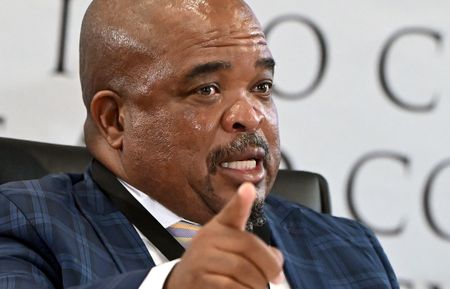
Nku was previously mentioned at the commission as an informant in relation to the cocaine that was subsequently discovered.
During Thursday’s proceedings, Nku clarified he was not a paid informant, but rather considered himself a “confidential source”.
He said that on 8 July 2021, he had told [Warrant Officer] Mashaba that he felt the information he picked up about the contraband was “sufficiently specific to warrant operation follow-up.” (This was the day that Mfazi died.)
/file/attachments/orphans/WhatsAppImage2026-05-12at122459_380488.jpg "Cocaine worth around R286-million was discovered concealed in a consignment of truck parts in Aeroton, Johannesburg, in 2021. (Photo: Madlanga Commission of Inquiry)")
The following day, a shipping container was intercepted in Aeroton, in which the R286-million cocaine consignment was discovered.
This was where Nku and the three others – Mashaba, Magane and Phakula – were arrested.
The latter three were directly involved in the interception, and Madlanga Commission evidence leaders have been highly critical of their actions.
This was because they did not appear to follow proper police protocol. For example, Magane had neither worn gloves when handling the cocaine nor placed it in evidence bags.
Magane had conceded he may have contaminated the crime scene.
‘Discreet travel’ and ‘high stakes information’
During Thursday’s proceedings, Commissioner Sesi Baloyi SC pushed Nku on why he had been present at the Aeroton scene, saying that he could have avoided going there, inferring that his presence had been unnecessary.
Nku explained that he had been keen to see if the information he provided had led to a successful operation.
Baloyi also asked Nku what he stood to gain from being a member of the public passing on exceptionally sensitive information to authorities.
She reiterated that he was not a paid informant.
Nku explained he had been in the process of being “uptaken as a source” into a law enforcement agency and that this would have seen him being paid.
Baloyi pointed out that he was a businessman and could have provided information without becoming an official informant.
Nku said some of the information he dealt with was “high stakes” and that if someone was an official informant, they were protected in relation to how information was acquired.
MADLANGA COMMISSION | Tumelo Nku says he was carrying between R64,000 and R65,000 in cash because the trip was unplanned and he was unsure what accommodation would be available. He says it was a spur-of-the-moment decision and he had cash on hand. pic.twitter.com/Ki0eomj7bC
— SABC News (@SABCNews) June 25, 2026
Later, explaining to the commission why he once travelled with tens of thousands of rands in cash (around R60,000 was confiscated from Nku at the Aeroton interception scene), Nku said he did so because it was an “advantage” when he “travelled discreetly.”
At this, commission chair Justice Mbuyiseli Madlanga, who had been grilling Nku on the cash, hit back bluntly: “What on earth do you mean?”
Nku said that when he travelled discreetly, he would not use his bank cards.
Madlanga then questioned “who would have cared” about him using his bank cards, and said Nku’s worries were clearly based on certain other issues.
Later, when revisiting these issues, Madlanga’s tone became stern when addressing Nku.
The Hawks and Feroz Khan
The proceedings also focused on what happened at the Aeroton scene.
One of the many police officers who arrived in Aeroton was senior Crime Intelligence officer Feroz Khan, whose presence also became a point of controversy.
Nku said Khan had instructed that he be arrested.
Nku insisted that he was at the scene because of his role as “a source of information” relating to the cocaine interception – this is what Baloyi questioned him on.
The Khan controversies
Other officials who faced scrutiny over the 2021 Aeroton cocaine interception included embattled Crime Intelligence officer Feroz Khan. He previously faced disciplinary action over his conduct at the scene, but was cleared. Khan was arrested over another matter, an illicit precious stones case, in May 2026. He has been called to testify at the Madlanga Commission of Inquiry and is expected to do so in July 2026.
After Nku’s arrest, his cellphone was confiscated and later returned to him.
Nku said the Hawks had indicated “they were done with downloads”.
He said after that he “started getting very odd calls” from Hawks officers who wanted to meet and who told him “that whenever I have information, I must consider them first.”
During Thursday’s proceedings, Nku said that in July 2023 – two years after the Aeroton cocaine interception – people who identified themselves as Crime Intelligence officers stopped him in the Vereeniging area, where he was busy with “church-related engagements”.
/file/attachments/orphans/ED_608571_266719.jpg "Senior Crime Intelligence officer Feroz Khan appears at the Kempton Park Magistrates’ Court on 11 May 2026. He faces charges in an illicit precious metals case. (Photo: Gallo Images / OJ Koloti)")
“I was transported to an unknown residential property and questioned,” Nku said.
“I was instructed to hand over my mobile devices without being provided with any documentation or warrant.”
His testimony suggested that the officers who allegedly questioned him were retaliating because the Independent Police Investigative Directorate (Ipid) had initiated action against certain police officers, presumably in relation to the Aeroton cocaine interception.
Ipid had previously recommended disciplinary action against Khan over the Aeroton saga. Khan was subsequently cleared and now faces other controversies. DM
What’s next?
The Madlanga Commission of Inquiry will continue hearing witness testimony. It aims to complete a final report on the evidence that has emerged through its proceedings to President Cyril Ramaphosa by 31 August 2026.
Comments
Scroll down to load comments...