




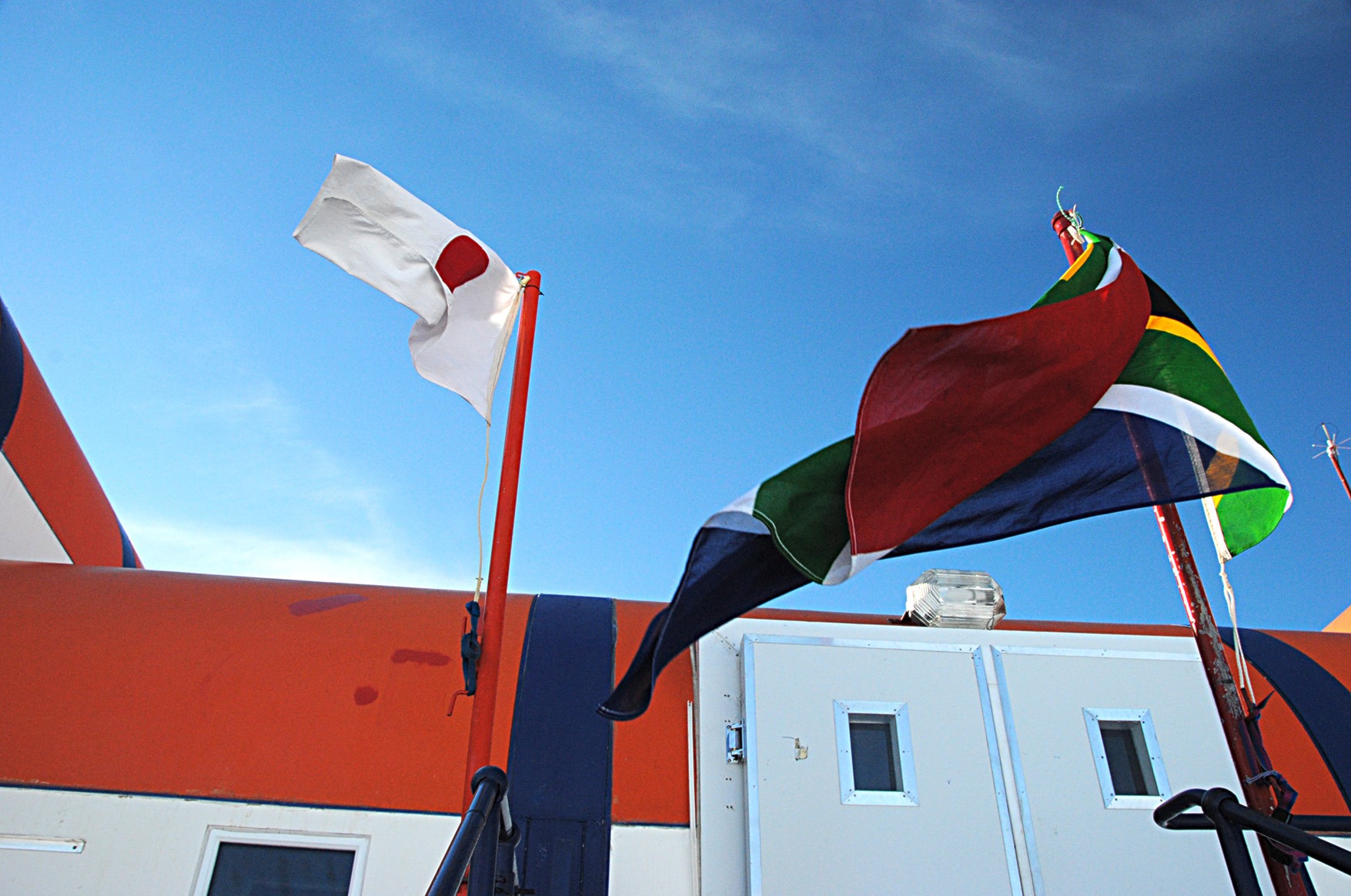
 In the interests of transparency, South Africa’s East Antarctic research station opened its doors to an inspection team from Japan on 7 February 2010. These states represent two of 12 founding consultative parties to the 1959 Antarctic Treaty. (Photo: Tiara Walters)
Less than one month after 58 states concluded the world’s highest Antarctic diplomatic forum in Hiroshima, Japan, the Antarctic Treaty has released its meeting minutes in what could to be the swiftest publication yet.
The early release marks a significant shift for a diplomatic system long criticised for operating behind an “Ice Curtain”, where negotiations are closed to the public and media, and records of discussion have traditionally taken months to emerge.
Debate? What was the debate? No. Public can't know that. Won't know even the sanitised version until the report is made public in around THREE MONTHS time. #IceCurtain. https://t.co/UUSlKPrUFH
— Andrew Darby (@looksouth) June 2, 2023
The 48th Antarctic Treaty Consultative Meeting (ATCM), held over 10 days in May, gathered the 29 consultative and 29 non-consultative parties that govern nearly 10% of the Earth’s surface. Among them are Australia, China, the Netherlands, Russia, South Africa and the US, which make decisions on environmental protection, science, tourism and governance across Antarctica.
The preliminary final report, released on 19 June after the meeting concluded its business on 21 May, arrives dramatically earlier than the Treaty’s own rules require. Those rules allow up to three months for publication in all four official languages – English, French, Russian and Spanish.
Preliminary final reports have typically appeared several months after meetings.
The accelerated release follows an Australian initiative tabled at this year’s meeting that called for shorter publication timeframes as part of a broader campaign to improve transparency across the Antarctic Treaty System (ATS).
The ATS marked its 65th anniversary on 23 June.
“Australia firmly believes that transparency is vital to the health of the ATS,” Canberra argued in its working paper.
“As a group of states making important decisions for the protection and management of the Antarctic, it is important we undertake efforts to inform our citizens, and the wider world, about the discussions and outcomes arising from Antarctic Treaty meetings.”
/file/attachments/orphans/WhatsAppImage2026-04-09at152112_217787.jpeg "Beneath the flags of apartheid South Africa, the Soviet Union and other founding states, Australian Prime Minister Robert Menzies leads the first opening ceremony in Canberra, 1961. (Photo: Antarctic Treaty Secretariat image bank / Creative Commons)")
Australia’s proposal built on a transparency campaign launched at the 2025 ATCM in Milan, Italy. Led by the Netherlands, with Canberra and Seoul as co-backers, the initiative seeks to improve communication with the public, broaden engagement and make one of the world’s least accessible diplomatic forums more open.
The working paper argued that the meeting reports were “an important mechanism to inform stakeholders and the general public”. They also “demonstrate the breadth and depth of work across environmental protection, science, operations, tourism management and governance fields in support of a peaceful and protected Antarctic continent”.
The Australian Department of Foreign Affairs and Trade welcomed the outcome.
“Australia has long been a champion of transparency in the multilateral system as a key accountability and confidence-building measure,” said a spokesperson, who noted that Hiroshima also adopted an agreement to boost transparency and information exchange.
The department said Australia would continue working with the Netherlands and South Korea to advance transparency across future Treaty meetings.
The Netherlands, which spearheaded the broader transparency campaign last year, also commended the faster publication.
“The Netherlands welcomes the timely release of the final report and appreciates the efforts of the Secretariat to follow up on the request by the ATCM,” Mirjam Hoogendam, the country’s head of delegation, told Daily Maverick.
/file/dailymaverick/wp-content/uploads/2025/09/Dutch-delegate.jpg "Dutch delegate Dr Arthur Eijs addresses the Committee for Environmental Protection in Milan. (Photo: Antarctic Treaty Secretariat image bank / Creative Commons)")
“The Netherlands will continue its efforts, in consultation with other ATCM parties, to enhance communication, transparency and inclusiveness of the ATCM in a pragmatic manner.”
Citing its own recent ATCM positions, South Africa said it wanted parties to release the preliminary version immediately after the meeting.
“South Africa, at both ATCM47 and ATCM48, supported enhanced transparency and reporting of important decisions and discussions to the public as efficiently, accurately and effectively as possible while remaining respectful of the equal treatment of all languages,” said the Department of Forestry, Fisheries and the Environment.
Africa’s only Treaty consultative state “thus supported the expedited publication of an ‘as adopted’ version of the final report in all four languages”.
For South Africa, the “as adopted” version “would then be followed with a final report after the editing process, which would take approximately three months”.
/file/attachments/orphans/JapanSouthAfricaninspectionwelcome_931361.jpg "Professor Ian Meiklejohn of Rhodes University welcomes an inspection team from Japan at SANAE IV, South Africa's Antarctic research station, in Queen Maud Land, East Antarctica, 7 February 2010. (Photo: Tiara Walters)")
Former US Antarctic policy chief William Muntean, who led the US delegation to Treaty meetings between 2018 and 2023, described the faster release as a notable achievement.
“Excellent work by the Antarctic Treaty parties and Secretariat to speed up the release of the preliminary final report,” said Muntean.
“It is noteworthy that the Secretariat continues to have a budget of less than US$1.5-million to support the Antarctic Treaty members, including preparing and sharing this final report, which demonstrates the Secretariat’s good value for money.”
Japanese Antarctic law expert Professor Akiho Shibata also highlighted the unprecedented timing.
“Hiroshima ATCM final reports (preliminary version) already made public,” he wrote. “In all four official languages; within one month after the closure.”
But the report is a heavily edited diplomatic record. Some individual governments are often not identified by name in debates. Sensitive or contentious interventions are attributed only to “some parties” or “many parties”.
Nevertheless, the report provides the only official account of discussions inside negotiating rooms that are otherwise inaccessible to journalists and the public.
Daily Maverick has investigated the Antarctic Treaty’s culture of secrecy since 2022, including consistent delays in publishing final reports, opaque gatherings and the 1959 disarmament pact’s revision of its own transparency rules.
A 2025 investigation found that although the Treaty’s rules require the opening plenary session to be held in public, governments have for decades restricted access to little more than ceremonial opening proceedings while substantive discussions remain behind closed doors.
A 2024 investigation found that the meeting discussed deadly bird flu in May the previous year, but the Secretariat only announced the minutes in the Christmas season half a year later.
/file/dailymaverick/wp-content/uploads/2025/03/Scientists-in-protective-gear.jpg "Chile’s BASE Millennium Institute researchers during the March 2024 expedition that first confirmed H5N1 in penguins and cormorants. (Photo: Fabiola León)")
So, the early release of the Hiroshima final report represents one of the first tangible transparency reforms to emerge from the Treaty’s governance system.
The change is modest. The negotiations themselves remain closed. Journalists are still excluded from almost all proceedings. And the reports are published with persistent redactions.
But for a system often criticised as slow-moving and resistant to reform, the earlier publication demonstrates that change is possible.
The next challenge may be even more significant.
Meeting documents – the paperwork submitted by states ahead of each year’s talks – are already made public immediately after each ATCM ends. As South Africa’s position suggests, an “as adopted” version of the report exists before the three-month editing process is signed and sealed.
The Netherlands is second in the world for press freedom on Reporters Without Borders’ 2026 index. South Africa ranks at 21st position, followed by Australia at 33rd with South Korea at a slightly more glacial 47th spot.
/file/dailymaverick/wp-content/uploads/2025/06/SA-delegation-treaty.jpg "Romi Brammer (left) of South Africa’s Department of International Relations and Cooperation was elected as chair of the Milan ATCM’s working group on policy, legal and institutional matters. Ashley Johnson, South Africa's delegation head. (Photo: Supplied)")
But it is The Hague that is scheduled to follow as host of the landmark 50th ATCM in 2028, a year after South Korea.
This suggests the chill in the sealed chambers may indeed reach a more hospitable room temperature within just two years. This would lay critical groundwork for upcoming hosts New Zealand and Norway.
The latter state came out swinging for Antarctic influencers in Hiroshima, refusing to back a German campaign proposing to consider undesirable comportment on social media.
The Germans simply wanted to know if guidance might – eventually – be useful.
Norway, reportedly smelling a thawing rat, would have none of it.
“Freedom of speech and freedom of the press are core principles, and therefore could not support the working paper’s recommendations, as they were seen to limit some people’s right of expression,” the delegation noted.
“Norway was of the view that instead of regulating a specific group of people, a better way forward would be to address relevant activities, and for instance set distance requirements and/or speed limits for periods when different species are vulnerable to disturbance.” DM


Comments
Scroll down to load comments...