




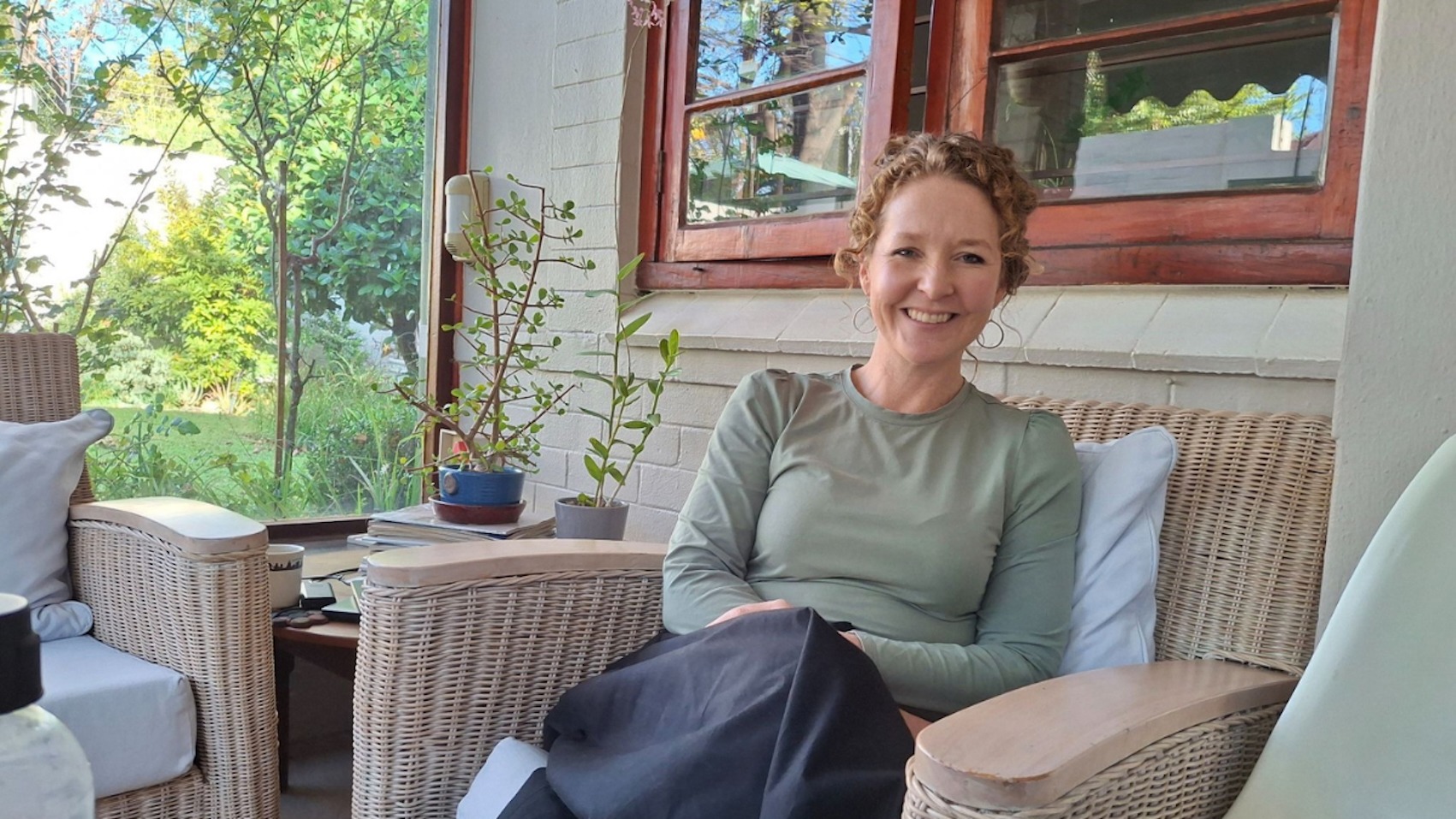
 ‘I love Joburg, it‘s both wonderful and impossible, a source of joy and deep frustration,’ Sasha Stevenson says, speaking from her home in Johannesburg‘s northern suburbs. (Photo: Sean Christie)
SECTION27’s offices are on De Korte Street in Braamfontein, a stone’s throw from the University of the Witwatersrand’s main campus and more or less along a line between Constitutional Hill and the Johannesburg Magistrates’ Court. During the Fees Must Fall protests in 2016 the Puma store below the office was looted, and a Rea Vaya bus was torched at the intersection with Bertha Street. An apt location, some might say, for an organisation that has, since its establishment in 1993 as the Aids Law Project, vigorously applied itself to the upholding, testing and shaping of citizens’ (and non-citizens’) rights in South Africa.
I do not meet SECTION27’s executive director Sasha Stevenson here, however. She is working from home, nursing a cold. Home is in the near northern suburbs, off a street lined with large trees. Like many of the streets in Johannesburg’s old suburbs, the road deck and pavement have been torn up in places by City water and electricity utility teams, looking for faults to patch in a world of collapsing subterranean systems. Johannesburg’s infrastructure problems can seem insuperable, and it is hard to resist seeing a metaphor here for the societal unfairness SECTION27 works on, predominantly in the areas of education and healthcare.
Stevenson – tall and athletic, her pre-Raphaelite tresses tied back – invites me to take a seat in a comfortable garden chair, next to a fluffy cat. We haven’t met before but I was impressed by an intervention she made a few years ago at a gathering of NGOs working at the intersection of migrant rights and healthcare in South Africa. One of the organisations present was mulling the closure of its activities, amid lots of bickering. Asked for her view, Stevenson made a quiet but impassioned plea to its leaders to not abandon migrants, arguing that access to healthcare for vulnerable communities was, in her view, the next big human rights challenge in South Africa. Her words calmed the room, and refocused the discussion.
Authority of this sort comes from experience, and Stevenson had been working on “migration and health” for years already by this time, since joining SECTION27 in 2012, in fact. She tells me her involvement began with a Zimbabwean man, who had been living in the Johannesburg Methodist Church since the 2008 violence targeting migrants.
/file/attachments/orphans/CopyofFromRowingforRhodes_907620.jpg "From Rowing for Rhodes to running endurance events, sports plays a major role in Stevenson’s life. (Photo: Supplied / Bhekisisa)")
/file/attachments/orphans/CopyofCivilsocietyorganizationsarefacingsteepchallenges_128399.jpg "Civil society organisations are facing steep challenges, from funding shortages to a lack of expertise. For now, SECTION27 continues to punch above its weight. (Photo: Supplied / Bhekisisa)")
“He needed his colostomy bag changing after an operation, but Charlotte Maxeke Hospital had denied him access, telling him ‘we can’t do it, because you’re foreign’,” recalls Stevenson, who read the relevant law, and found out that in fact South African law provides extensive protection to migrants who need access to healthcare services, especially for emergency treatment. She wrote to the hospital’s admissions department, and the barrier was removed in that instance, and in many subsequent cases, but getting any systemic change eluded SECTION27 because, as Stevenson explains, “the law was good – the problem was implementation, and whenever we intervened on behalf of a patient access was always granted”.
During the Covid-19 outbreak in South Africa in 2020 the Gauteng department of health passed a policy that would have severely limited migrant access to healthcare services, giving SECTION27 something to oppose.
“We went to court, and received an order that all pregnant women, lactating women and children under the age of six years have the right to access free healthcare services at all public health establishments, irrespective of their documentation status,” says Stevenson.
/file/attachments/orphans/CopyofAnti_xenophobiamarch_375781.jpg "Anti-xenophobia march, March 2026. (Photo: Supplied / Bhekisisa)")
/file/attachments/orphans/CopyofStevensonalongsideAdilaHassim_913585.jpg "Stevenson alongside Adila Hassim, who with Mark Heywood founded SECTION27 in 2010, incorporating the Aids Law Project. (Photo: Joyrene Kramer)")
For a time SECTION27’s advice office was notably quieter – the situation seemed to have improved – but from 2022 health vigilantes under the banner of Operation Dudula began picketing health facilities in the province, effectively preventing migrants from gaining access. SECTION27 litigated against the state again, arguing that it had a duty to ensure access to healthcare services, and that this meant getting the vigilantes out of the way. The court again found in their favour, but Stevenson says getting the government to fully comply is an ongoing battle.
“We find ourselves in a really horrible situation, where we’re just getting no leadership [from the government] on this issue, and it means that all of the narrative space is being taken up by people who are intent on denying migrants access to healthcare. The frustrations behind it are understandable – our systems are underresourced and severely strained – but they are being taken out on people whose fault it isn’t,” says Stevenson, adding that vigilantes have targeted individual staff members within organisations that work on migrants’ rights, “singling out Black women particularly, doxing them”.
With anti-migrant protests surging unchecked in parts of the country, many of them marked by violence and other abuses, the old system of human rights protection, I venture, appears muted and weak. It used to be (I complain) that a feisty media would highlight an abuse, after which fearless civil society would take up the issue and hold politicians and institutions accountable through a court case, or through parliamentary advocacy, and from that justice and better policy would flow. Today, the media doesn’t have any money, civil society (with some notable exceptions) appears to be inert, and the legal system can seem at times to be either too broad or too blunt an instrument to effect much meaningful change. Even when good judgments are handed down, they are routinely ignored by politicians.
Stevenson rejects my analysis, or at least the part about the law being a blunt instrument.
“When a judgment is handed down against a government department, we don’t expect it to be self-executing. We expect to have to follow up, repeatedly, and spend a lot more time and money monitoring implementation. But when we do these things we find that government will ultimately implement,” she says, making an example of the judgment handed down by Judge Gerrit Muller in the trial of the tragic death of Michael Komape, the five-year-old boy from Chebeng village in Limpopo who fell into a school pit latrine in 2015, and drowned in others’ waste.
/file/attachments/orphans/CopyofNewspapersreportingtheLifeEsidimeniarbitrationaward_158050.jpg "Newspapers reporting the Life Esidimeni arbitration award, 2018. (Photo: Supplied / Bhekisisa)")
/file/attachments/orphans/CopyofHealthandfoodrightslawyers_413102.jpg "Health and food rights lawyers from across the Global South on a tour of South Africa’s Constitutional Court, in 2023. (Photo: Supplied / Bhekisisa)")
“In that judgment we got compensation for the family but we also got a plan, or rather the requirement for a plan, for [the provincial government of] Limpopo to get rid of all unsafe sanitation in schools. And after years of monitoring and a huge amount of follow-up work they’ve actually done it. If you are prepared for all of that work, then the judgments still mean something,” says Stevenson.
Back in time
It seems a good moment to go back in time, into her own story, to try to understand where the fortitude to do this work (and to keep doing it) comes from.
Her parents’ decision to give up their home in South Africa for a “Volksie bus” and a pickers’ life on vegetable and grape farms in France, provides an early clue.
“They met while working for Eskom, but couldn’t abide apartheid and so they decided to leave in the 1980s, ultimately settling in Enfield, north of London, where they had me and my brother,” Stevenson says, adding that South Africa was always seen as “home” for the family.
She recalls better than most people her age South Africa’s 1992 referendum (where white voters were asked whether or not they supported the negotiated reforms begun by State President FW de Klerk) because her family’s fate – whether to stay in England or return to South Africa – depended on the outcome. When an overwhelming majority of voters returned a “yes” vote, they packed their bags.
Back in Johannesburg, Stevenson attended Rivonia Primary, and later St Stithians Girls’ College, not long after its formation and under the leadership of powerhouse educator Anne van Zyl, who would later be appointed headmistress of the Oprah Winfrey Leadership Academy for Girls.
“She had a very feminist approach, which was unusual at the time, so there was no home economics, and she was quite particular on there being no prefects, because in her view everyone is a leader. It worked brilliantly for me,” says Stevenson, who excelled at rowing and debating, the last of which steered her in the direction of law.
“During my school years the Constitutional Court was deciding all of these fundamental rights cases, around the death penalty, abortion, prisoners’ rights and other basic questions. Our debating topics were in line with many of those, so I was learning a lot about constitutionalism and human rights, and it just made me think: ‘here I am in this place at this time where things are changing for the better, and there’s this tool, in the law, that can be used to make things better’, and it just seemed brilliant to me,” she says.
After completing a law degree at Rhodes University Stevenson started articles at Bowans, which allowed her to take time off to do a Constitutional Court clerkship.
“The timing was serendipitous because I was able to work for former chief justice Pius Langa in his last year on the bench. Not only that, but a lot of socioeconomic rights cases were heard that year. If you speak to clerks now, with the changes to the courts’ jurisdiction they see a lot more competition and tax law matters – not what many constitutional lawyers get excited about!”
A stint as an intern at the International Criminal Court (ICC) in The Hague in 2011, working for the head of the trial chamber, Adrian Fulford, convinced her that international law was not for her.
“Too much politics,” Stevenson says.
“The ICC was hearing a case about Thomas Lubanga at the time, who was accused of using child soldiers in the DRC. I was doing some deeper reading and kept encountering certain names, and I didn’t understand why Lubanga and a few others were before the court and not these other guys, and it turned out it was because they had gotten into bed with the incoming government, and so they didn’t get sent to the court, and I just found that extremely frustrating in comparison with South Africa, where you’ve got a constitution, and courts that are set up to do the right thing, to realise rights and improve peoples’ lives,” she says.
A scholarship enabled Stevenson to attend Cambridge University, where she did an LLM in human rights and international human rights law. In her last months she read about an opening at SECTION27, an organisation she had long admired for its approach of combining research, mobilisation and rights literacy with litigation in order to catalyse social change.
“I found it so compelling,” says Stevenson, who was hired on the spot, while finishing her degree.
Working for SECTION27 was an induction into a different country from the one she knew. Her childhood had been sheltered, the schools she attended “not yet very multiracial at all”. Rhodes University was the first time she met South Africans from different provinces, but even then the institution was in a moment of political quietude, and Cambridge had been all “Friday night dinners in robes, and then port afterwards”.
Now she found herself in Johannesburg, the country’s chaotic economic heart, working under the guidance of Mark Heywood and Adila Hassim, both among the most astute social justice activists at work in the world today.
“Civil society spaces are overtly political, and you’re dealing with heavy issues all the time, where your clients are almost always in great need of your help. This isn’t for everyone but I found it exhilarating and exciting and freeing,” says Stevenson, who feels if she has any special ability to cope it comes from “always being able to switch off, and sleep well!”
Going for the jugular
After some digressive talk about the challenges of training for trail marathons in urban, not very hilly Johannesburg (“There’s Klipriviersberg Nature Reserve, but you have to run every path in the place, twice!” jokes Stevenson, who has completed several endurance events), we get back to her professional story.
“It might surprise some, but we only litigate as a last resort,” says Stevenson.
In December 2012, two months after she joined SECTION27, the Mthatha medical depot collapsed, leaving hundreds of medical facilities in the Eastern Cape without critical medicines. Stevenson and her colleagues considered litigating but the problem was more urgent than that. The TAC and Doctors Without Borders/MSF ultimately took over the management of the depot for three months, and established a stockouts monitoring alliance (Stop Stockouts Project) in an attempt to mitigate future disasters. Similarly, when SECTION27 learnt in 2013 that the Eastern Cape’s emergency services were in a tailspin because there were not enough ambulances, they decided, instead of litigating, to ask the Human Rights Commission to investigate, which they did, producing a detailed report in 2015.
“There’s a real benefit to the investigative capacity that Chapter 9 institutions like the Human Rights Commission have, because it means a process doesn’t have to be adversarial in order to come to conclusions that can be implemented. Adversarial processes are always limited; the issues have to be narrowed down so much in order to be adjudicated upon, and you don’t always get an answer that is as complex and multifaceted as the problem,” says Stevenson.
Sometimes, however, there is simply no choice other than to go for the jugular, something Stevenson has done repeatedly in the long-running Life Esidimeni matter.
/file/dailymaverick/wp-content/uploads/2025/07/0000263444.jpg "Current SECTION27 head Sasha Stevenson and former head Mark Heywood embrace after after retired chief justice Dikgang Moseneke released the Life Esidimeni arbitration findings on 19 March 2018 in Johannesburg. Moseneke ordered the government to pay R1.2-million to each of the bereaved families. (Photo: Gallo Images / Netwerk24 / Felix Dlangamandla)")
/file/attachments/orphans/CopyofBereavedfamilymemberNthombifuthiDhladhlaconsultingwithStevenson_269483.jpg "Bereaved family member Ntombifuthi Dhladhla consulting with Stevenson in the course of the Life Esidimeni arbitration. (Photo: Joyrene Kramer)")
The story will be familiar to many. In 2015, after learning of the Gauteng department of health’s plans to decant more than 2,000 people from Life Esidimeni’s psychiatric facilities around Gauteng to unlicensed and wholly undercapacitated NGOs, SECTION27 pressed the department to account to the families of the mental healthcare users, but the moves went ahead in 2016 regardless, shrouded in secrecy.
From around June of that year, news of the horrific consequences of the operation started to come out.
“We learnt that the body of Virginia Machpelah had been transferred from an NGO called Precious Angels to a funeral parlour in another province called Put U 2 Rest (I kid you not), and when we approached them they said, ‘we have eight other bodies from there in this place’. It felt like uncovering an atrocity, and when the MEC for health [Qedani Mahlangu] was asked a question about this in Parliament it turned out there had been 36 deaths by that point,” says Stevenson, who remembers feeling “like my insides were being sucked out: just this horrible feeling of guilt, you know, that we had failed to prevent this”.
Stevenson petitioned “everyone we could think of”, and ultimately struck it lucky when the Health Ombud, Malegapuru Makgoba, decided to look into the deaths. She was in constant contact with Makgoba as he exposed the fuller extent of the human rights abuses that had taken place, ultimately releasing a report that put the number of dead at 94.
In April 2026, following an inquest that commenced in 2023 (which followed a successful arbitration led by former acting chief justice Dikgang Moseneke), the National Prosecuting Authority announced that it would institute legal action against individuals implicated in the Life Esidimeni tragedy. The individuals were not named, but it is safe to say that Stevenson is Mahlangu and Manamela’s bête noir.
Over the span of Stevenson’s involvement in Life Esidimeni, SECTION27 has doubled in size and adopted a new structure. She became the head of the health programme in 2018, and in 2023, following the departure of Umunyana Rugege (who succeeded founder Mark Heywood in 2019 but resigned when she was offered a senior role at UNAids), Stevenson was made executive director.
“It wasn’t part of any plans but I really love this organisation and its people, and rather than have an outsider come in and change the way we work, I thought let me apply,” says Stevenson, who took the reins knowing that steep challenges awaited.
“I was counting the other day and there are only a handful of lawyers in our sector with more than 10 years’ experience, which is problematic because to remain effective you need depth of experience,” she says.
Her capacity concerns look particularly worrying against the backdrop of the fight over the government’s National Health Insurance (NHI) plans.
“We’re in the midst of God knows what in relation to NHI,” Stevenson laughs (something she does freely), abandoning the highly professional persona familiar to many through countless broadcast media appearances. She has been personally working on NHI issues since 2013, after SECTION27 was asked to provide legal memorandums on different elements of the NHI green paper. The NHI project has since become mired in lawfare, and civil society’s attempts to ensure that it delivers much-needed health sector reform are essentially stuck waiting for the outcome of the two Constitutional Court challenges that were heard between 5 and 7 May this year.
Sitting in the ConCourt as an observer, Stevenson marvelled at the size of the legal teams representing all parties – “the amount of money that is being spent!” – and couldn’t shake a feeling of immense frustration.
“There’s still some preparatory NHI work going on, but the kind of deep health system reform that’s required – the regulation of the private sector to bring prices down, the improvements to the way provinces run health – is all on pause, as it has been for years. The longer this drags out…”
She doesn’t complete her thought, but Stevenson does seem worried about civil society’s ability to stay the course “in the face of government and private medical aids, both of which have seemingly infinite funds to continue fighting each other”.
It is a heavy note to part on, but standing out on the sidewalk awaiting my Uber, Stevenson makes an offhand comment that serves as a caution against despair. It is in reference to the plane trees towering above us. Eight years before, Stevenson explains, much of the neighbourhood was convinced these arboreal giants would be taken down by the polyphagous shot hole borer, which arrived in South Africa in 2018, possibly as a stowaway in palette wood from Vietnam. The tree-killing beetles made it to Johannesburg in a climate of low-level hysteria, with some residents felling branches at the slightest hint of infestation, and others preparing to chain themselves to their favourite oak, or box elder, to deter the chainsaw. Committees were convened and mitigation strategies drafted, but ultimately very little was done. Thankfully, Johannesburg’s forest seems to be thriving.
“There’s a lesson in there somewhere,” says Stevenson. DM
This story was produced by the Bhekisisa Centre for Health Journalism. Sign up for the newsletter.
/file/dailymaverick/wp-content/uploads/2025/02/Bhekisisa_logo_hi_res.jpg)
Comments
Scroll down to load comments...